


Wire Fraud · Federal Charges
What Is Property After Ciminelli and Kousisis?
The Supreme Court rejected right-to-control fraud and later clarified that fraudulent inducement to obtain money or property does not require net economic loss.
Eligible to Practice in Texas
Attorney at Law
Bar Card Number: 00796807
TX License Date: 11/01/1996
214 Connally St Ste A
Sulphur Spgs, TX 75482-2612
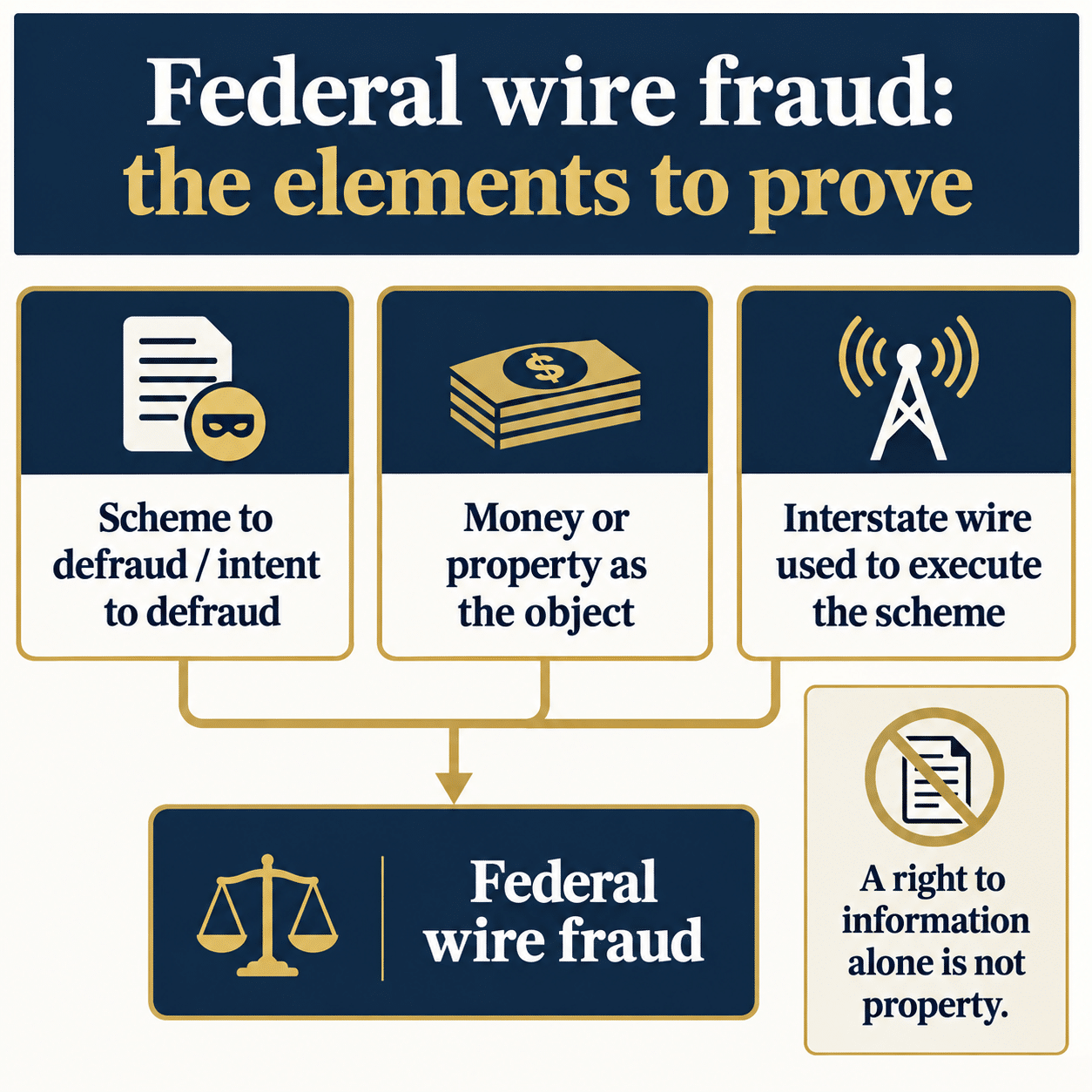
Federal wire fraud has three parts. There has to be a scheme to get money or property through materially deceptive means, a specific intent to defraud, and use of interstate wires to carry out the scheme. Ciminelli threw out a theory that treated a victim’s abstract right to economically useful information as property. Then Kousisis held that a scheme that fraudulently induces a victim to part with money or property can meet the property requirement, even if the victim got the contract performance it expected and lost nothing on net.
Start with the property the scheme targeted
In Ciminelli v. United States, the Supreme Court rejected the “right-to-control” theory the government used in that case. The argument was that withholding information could deprive a victim of potentially valuable economic information it needed for a discretionary decision. The Court said that theory doesn’t identify traditional money or property as the object of the scheme.
So in a federal fraud case, the charging theory should name the property the scheme supposedly went after, such as funds, contract payments or another recognized property interest. It should also explain how the deception was aimed at getting it.
This matters in disputes over a procurement process, an application or a business decision. A misleading statement isn’t automatically federal property fraud. Neither is an unfair process. If all the scheme targeted was a better-informed decision, Ciminelli says calling that interest “property” isn’t enough. Read the indictment, the proof and the proposed jury instructions to see whether the government’s theory really centers on money or property.
What Kousisis changed about loss
In Kousisis v. United States (2025), a contractor allegedly got government payments through materially false statements about disadvantaged-business participation, though it did the work. The Court said net economic loss isn’t required when material deception induces the victim to part with money or property.
What matters is whether money or property was the scheme’s object, not whether the victim got its money’s worth.
So property and loss are now separate issues. Full performance, contract value, restitution and sentencing still matter elsewhere, but receiving what you bargained for doesn’t automatically defeat a fraudulent-inducement theory.
Kousisis also doesn’t turn every broken promise or technical contract violation into wire fraud. The government still has to prove material deception, intent to defraud and a scheme to obtain property.
Test the representation and the alleged exchange
Go statement by statement: what was said or left out, who said or adopted it, when, whether it was material, and what money or property it aimed at.
Put the written agreement and certifications next to the performance records, payment conditions, invoices, communications and explanations from the time. A later dispute, or poor performance, doesn’t by itself show that anyone intended to defraud when the statement was made.
Performance still counts for something. It can bear on what was exchanged and on whether the government can prove its theory, though Kousisis drops net loss as a requirement in fraudulent-inducement cases. Treat property, materiality, intent at the time and the actual deal as separate questions, not one blurry question about “loss.”
Keep the legal theories distinct
The two theories ask different things. Right-to-control is about lost information or discretion, and after Ciminelli that alone won’t do. A traditional property theory is about using deception to get money or property; Kousisis says it doesn’t fail just because nobody lost money on net.
Compare the charging document, the trial evidence and the instructions to see which theory the jury was actually asked to decide. That’s the comparison a wire fraud defense lawyer makes, and our federal wire fraud guide covers the statute as a whole.
Sources
This article provides general information, not legal advice. A specific case requires review of its charging instrument, offense dates, and underlying records. Representation begins only after the firm agrees to take the matter.