


Wire Fraud · Federal Charges
What Must Prosecutors Prove for Federal Wire Fraud?
How the alleged scheme, property, intent, and specific communication fit together in a federal wire fraud charge.
Eligible to Practice in Texas
Attorney at Law
Bar Card Number: 00796807
TX License Date: 11/01/1996
214 Connally St Ste A
Sulphur Spgs, TX 75482-2612
For a charge under 18 U.S.C. § 1343, start by finding the communication named in the indictment. It may be an email, a payment instruction or a submission through a website. Prosecutors must connect it to an intentional scheme to obtain money or property through material deception. They must also establish the required interstate or foreign transmission. The burden at trial is proof beyond a reasonable doubt. Read the Official statute.
The person on trial may not be the sender. Suppose a business owner supplies a false invoice to an employee and tells the employee to send it to a customer. Counsel would need to consider whether the owner caused the use of the wire under the governing law, including the rules on foreseeable use. The message could help carry out the alleged fraud even if the lie had been made in an earlier conversation.
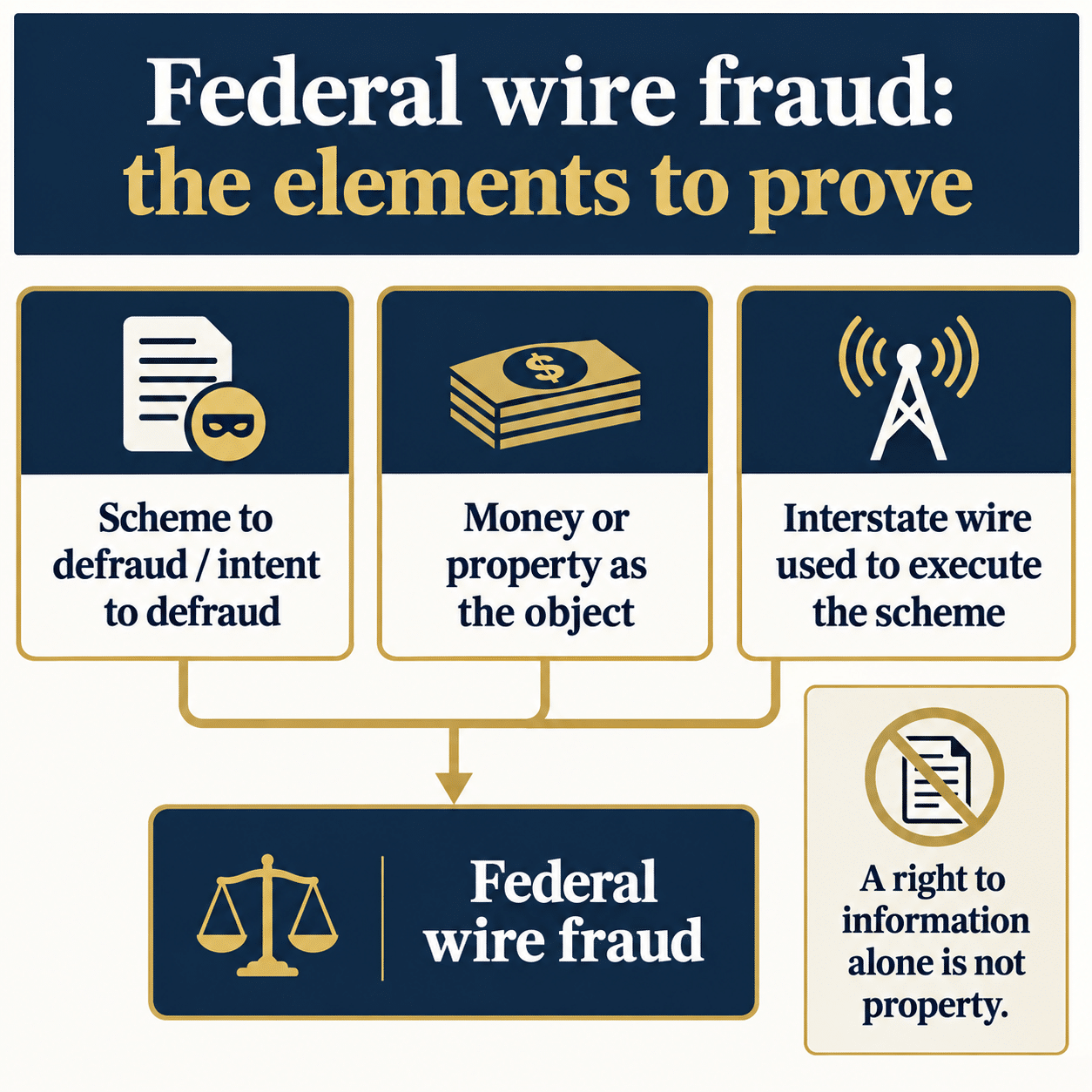
Organize proof for each charged wire
Write down the names of people who can explain the records you bring. The customer awaiting an order may not know what happened inside the business. A warehouse employee might know the goods arrived late, or that none had ever been ordered. Counsel needs to investigate that distinction before drawing conclusions about intent.
Test the communication against the alleged scheme
Timing can change the significance of a message. A request for another installment may help keep a scheme going. An ordinary receipt after everything has ended raises a different question. Have counsel work through why the particular wire charged was in furtherance of the alleged fraud; a folder full of unrelated emails won’t resolve that issue.
A defense based on the customer receiving value needs to account for Kousisis. A theory based only on withholding information needed for an economic decision runs into Ciminelli. Ask counsel how those decisions apply to the property and deception alleged in your count.
Counsel can then compare the count with the governing Fifth Circuit instructions. Keep calculations of loss and possible punishment on a separate sheet. The number of emails and the size of the eventual loss cannot substitute for proof of intent.
Related resources
To discuss representation, contact Heath Hyde or call 903-439-0000. Representation begins only after the firm agrees to take the matter.