


WIRE FRAUD · LOSS AND RESTITUTION
How Is Wire Fraud Loss Calculated?
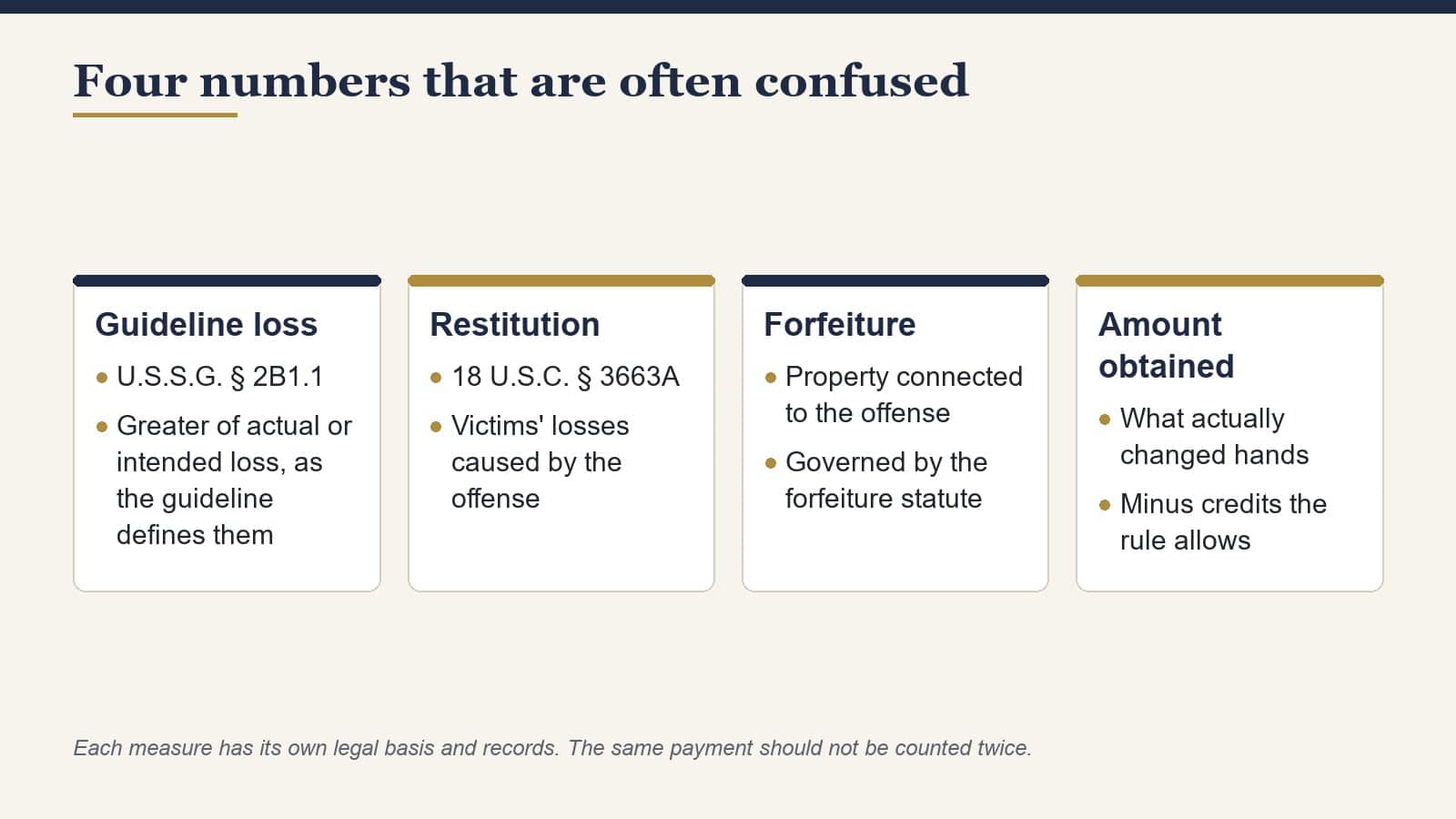
Sentencing loss, restitution and forfeiture come from different rules and often produce different numbers. Ask which one a figure is before you accept it.
Eligible to Practice in Texas
Attorney at Law
Bar Card Number: 00796807
TX License Date: 11/01/1996
214 Connally St Ste A
Sulphur Spgs, TX 75482-2612
For sentencing, wire fraud loss under USSG §2B1.1 is the greater of actual loss or intended loss. Restitution and forfeiture are separate figures, each calculated under its own statute, and nothing requires the three numbers to match.
Hypothetical: one week in a roofer’s case.
- November 16, 2026: the presentence report puts loss at $200,000 (page 9, USSG §2B1.1).
- His signed plea agreement: restitution of $75,000 under 18 U.S.C. § 3663A.
- November 23: a motion to forfeit his $60,000 pickup, bought with customer deposits, citing 18 U.S.C. § 981(a)(1)(C) and 28 U.S.C. § 2461(c).
Where each number comes from
Each figure answers to its own rule, and nothing requires them to match.
| Measure | Legal source | What it counts | What it leaves out |
|---|---|---|---|
| Guideline loss | USSG §2B1.1(b)(1) | Greater of actual or intended loss | Repayments made after detection |
| Restitution | 18 U.S.C. §§ 3663A, 3664 | Each victim’s actual loss | Intended loss that never happened |
| Forfeiture | 18 U.S.C. § 981(a)(1)(C); 28 U.S.C. § 2461(c) | Property traceable to the offense | What any one victim lost |
The $200,000 on page 9 belongs in the first row. Keep it out of the second.
Peugh and the manual on the sentencing date
Marvin Peugh was convicted of five counts of bank fraud for conduct in 1999 and 2000. The district court used the 2009 manual, which set his range at 70 to 87 months, and sentenced him to 70. The 1998 manual gave 30 to 37 months, and its loss table added 5 fewer levels. In Peugh v. United States (2013), the Supreme Court held 5–4 that using the newer, harsher manual violated the Ex Post Facto Clause.
The manual rules now read this way:
- Section 1B1.11(a) says “the court shall use the Guidelines Manual in effect on the date that the defendant is sentenced.”
- If that manual gives a higher range than the one in effect when the offense was committed, the court uses the earlier manual as a whole.
- The November 1, 2026 amendments raised the first step of the §2B1.1 loss table from more than $6,500 to more than $9,000. An $8,000 loss used to add 2 levels. Under the new table it adds none.
What the loss-table notes say
A 2024 amendment moved the definitions into the notes to §2B1.1(b)(1):
- Loss is “the greater of actual loss or intended loss.”
- Actual loss is “the reasonably foreseeable pecuniary harm that resulted from the offense.”
- Intended loss is “the pecuniary harm that the defendant purposely sought to inflict.” It “includes intended pecuniary harm that would have been impossible or unlikely to occur.”
- Gain is a fallback, used “only if there is a loss but it reasonably cannot be determined.”
I’d check whether page 9 labels the $200,000 as actual or intended loss.
Finished roofs and late refunds
The §2B1.1 commentary credits money returned to a victim “before the offense was detected.” The fair market value of property returned and services rendered gets the same credit on the same timing. Detection is when the offense “was discovered by a victim or government agency,” or earlier if the defendant knew or reasonably should have known it was coming.
The roofer’s file:
| When | What happened | Amount |
|---|---|---|
| January to June 2025 | 40 homeowners pay deposits. | $200,000 |
| By August | Crews finish 25 roofs (permit cards and shingle invoices). | $125,000 |
| September 12 | A homeowner complains to a state agency. | None |
| October | The company mails six refunds. | $30,000 |
The 25 roofs support a credit for services rendered. The October checks went out after the September complaint, so they likely won’t lower guideline loss. They do cut restitution for those six homeowners.
If the agent sampled the 40 contracts rather than counting each one, I’d ask whether duplicates were stripped out. I’d also ask whether different contract types were mixed in the sample.
Hughey and the charged scheme
Hughey was indicted in 1986 on three counts of postal theft and three counts of using unauthorized credit cards. He pleaded guilty to one count, for one MBank Mastercard. The district court still ordered $90,431, MBank’s losses on 21 cards. In Hughey v. United States (1990), the Supreme Court reversed. Restitution under the older statute covered only the loss caused by the conduct underlying the offense of conviction.
Congress answered with the scheme language now in § 3663A(a)(2). The restitution rules today:
- Section 3663A(a)(2) defines a victim as a person “directly and proximately harmed,” including by conduct in the course of the scheme.
- Section 3663A(c)(1) makes restitution mandatory for property offenses, “including any offense committed by fraud or deceit,” when an identifiable victim suffered a pecuniary loss.
- Section 3664(e) puts the amount on the government by a preponderance of the evidence.
- Section 3664(f)(1)(A) requires the full amount of each victim’s losses “without consideration of the economic circumstances of the defendant.”
- Under § 3664(f)(1)(B), a victim’s insurance doesn’t reduce the amount, though the insurer can be repaid.
- Section 3664(d)(5) lets the court set a final date up to 90 days after sentencing.
For the roofer, I’d ask what scheme the indictment charged and whether each of the 40 homeowners was harmed by it.
Honeycutt and the pickup
The facts of Honeycutt v. United States (2017):
- Tony Honeycutt owned a Tennessee hardware store. His brother Terry managed sales and inventory on salary.
- The store made $269,751.98 selling Polar Pure, an iodine water purifier.
- Tony pleaded guilty and agreed to forfeit $200,000.
- The government sought the other $69,751.98 from Terry, who didn’t personally benefit.
The Court held without dissent that 21 U.S.C. § 853(a)(1) reaches only property the defendant himself obtained.
For wire fraud, forfeiture comes from § 981(a)(1)(C), property “derived from proceeds traceable to” the offense, applied in the criminal case by 28 U.S.C. § 2461(c). Circuits split on whether Honeycutt reaches those statutes. If the roofer’s partner kept $40,000, the local circuit’s cases decide who answers for it.
The pickup turns on tracing. The motion has to connect the $60,000 purchase to deposit money.
One $5,000 deposit can show up on a bank statement and again in the ledger. It still counts once.
Records for the roofer’s file
- The agent’s spreadsheet behind the $200,000 on page 9.
- Job folders and final inspection sheets for the 25 finished roofs.
- Each refund’s check number and the date it cleared.
- The pickup’s title and the bank record of its purchase.
Common questions
Which sentencing manual applies to my case?
The one in effect on the sentencing date. If it gives a higher range than the manual in effect when the offense was committed, §1B1.11 points to the earlier one.
Will the judge lower restitution if I can’t afford it?
Not the amount. Your finances come in later, when the court sets how and when you pay.
If I pay the victims back now, does my loss number go down?
Probably not. Repayments count against guideline loss only if they reached the victim “before the offense was detected.” Money paid back later still lowers restitution.
Sources
- U.S. Sentencing Commission, Guidelines Manual §1B1.11 and §2B1.1
- U.S. Sentencing Commission, 2026 Amendments to the Sentencing Guidelines
- 18 U.S.C. § 3663A
- 18 U.S.C. § 3664
- 18 U.S.C. § 981
- 28 U.S.C. § 2461
- Hughey v. United States, 495 U.S. 411 (1990)
- Peugh v. United States, 569 U.S. 530 (2013)
- Honeycutt v. United States, 581 U.S. 443 (2017)
This article provides general information, not legal advice. The law and its application depend on the facts and the law in effect on the relevant date. Consult a lawyer about a specific matter.