

What Happens Before a Murder Case Is Presented to a Grand Jury?
A grand jury vote can show probable cause. It can’t show guilt. Here’s what happens in the weeks before that vote and where the defense can act.
Mr. Heath Enix ‘Heath’ Hyde
Eligible to Practice in Texas
Attorney at Law
Bar Card Number: 00796807
TX License Date: 11/01/1996
Primary Practice Location: Dallas, Texas
Return to the Texas Murder Trial Defense Knowledge Hub
Short answer
A grand jury vote can show the State has probable cause. It can’t show guilt beyond a reasonable doubt, and the accused has no automatic right to be heard there. So your lawyer uses the weeks before presentment to investigate, and may ask the prosecutor for permission to submit information.
| What families may hear | What it may actually mean |
|---|---|
| “The grand jury will hear his side.” | Only if the prosecutor approves it |
| “He was indicted, so the case is strong.” | Probable cause, and no inference of guilt |
| “His lawyer can go in with him.” | The lawyer waits outside the chamber |
| “Nothing happens until the vote.” | Police and prosecutors are still building the file |
What to do now: Put the bond papers, court notices and any subpoena in one folder. Write the date your loved one was booked on the front, and give a copy to the lawyer.
What happens to the case while it waits?
Your brother has sat in the county jail for 60 days. Nobody has told the family when the grand jury meets.
The case is still moving. Police gather statements, scene evidence and lab work, then write reports. Prosecutors review those reports and may ask police for more. A prosecutor then presents the case. At least nine grand jurors must agree for an indictment to issue.
The grand jury doesn’t wait only on the prosecutor. Under art. 20A.051, it inquires into indictable offenses grand jurors know about or that the prosecutor or another credible person reports. Under art. 20A.251, the foreperson or prosecutor can summon any witness in the county without naming the matter under investigation.
Your lawyer uses the gap to chase open items. Is the autopsy report final? A cause-of-death opinion can shape the charge. Is a phone extraction still at the lab? The State may wait for it or present without it. Is the State weighing capital murder? That changes the stakes and the procedure. Does page 9 of a report mention a jacket nobody has found? It may need preserving now.
Say your brother was booked on March 2. Day 90 is May 31. Under art. 17.151, a person held on a felony must be released on personal bond or lower bail if the State isn’t ready for trial within 90 days of detention. The article has exceptions, so the lawyer checks them first.
Can the defense show the grand jury anything?
Say your lawyer has hospital records pointing to a separate cause of death. Can the grand jurors see them?
Only with the prosecutor’s approval. Under art. 20A.104, the accused and his lawyer may address the grand jury only if the prosecutor approves. Under art. 20A.257, only a grand juror or the prosecutor may examine a witness.
A submission puts verified facts in the room. It also shows the State part of the defense.
| Possible submission | What your lawyer weighs |
|---|---|
| Letter with self-defense records | Help now against a preview of the defense |
| Medical records on cause of death | A check against the originals first |
| Phone records for an alibi | Gaps the State can use |
| The accused testifying | A recorded answer usable later |
Each choice turns on the facts. A two-page letter with a clean medical chart is one thing. A stack of phone records with a missing hour is another.
What if your loved one gets a grand jury subpoena?
A deputy hands your brother a subpoena for 9 a.m. Tuesday. Take it to a lawyer that day. The law gives an accused or suspected person specific protections before any questions start.
| Rule | What it requires |
|---|---|
| Art. 20A.258(a) | Oral and written warnings, and a chance to get and consult a lawyer first |
| Art. 20A.258(b) | Right to refuse incriminating answers; testimony usable later |
| Art. 20A.258(b) | His lawyer waits outside the chamber, not beside him |
| Art. 20A.201 | A stenographer or recording device records his examination |
Say a detective calls Monday afternoon. Tuesday, he says, is “his chance to clear his name,” and the lawyer can sit in. Neither line settles anything. Counsel decides whether he appears and answers, and art. 20A.258 keeps the lawyer outside.
How is a grand jury different from a trial?
The room is closed: grand jurors, a prosecutor, one witness. If your brother is that witness, his lawyer waits in the hallway. Only grand jurors and the prosecutor ask the questions.
The proceedings are secret under art. 20A.202. The rules of evidence don’t apply there, except privilege rules, under TRE 101(e)(2). Later, a defendant can petition the trial court for grand jury records. Art. 20A.205 requires a particularized need.
An indictment also carries no weight on guilt at trial. Under Penal Code §2.01, it gives rise to no inference of guilt. The State must still prove each element beyond a reasonable doubt.
What happens after the vote?
The foreperson records the vote. That changes the next steps, but it doesn’t settle the case.
| Result | What follows |
|---|---|
| True bill | The prosecutor prepares the indictment (art. 20A.301). |
| Indicted while in custody or on bond | The presentment goes into the court’s record (art. 20A.304(a)). |
| Indicted while not in custody or on bond | It stays sealed until the capias is served (art. 20A.304(b)). |
| No-bill | Ask your lawyer about custody, bond and further investigation. |
What can a family do before the grand jury meets?
Maybe a cousin hears the case goes up “next Thursday.” Maybe a neighbor who saw the fight asks your mother what to tell the grand jury.
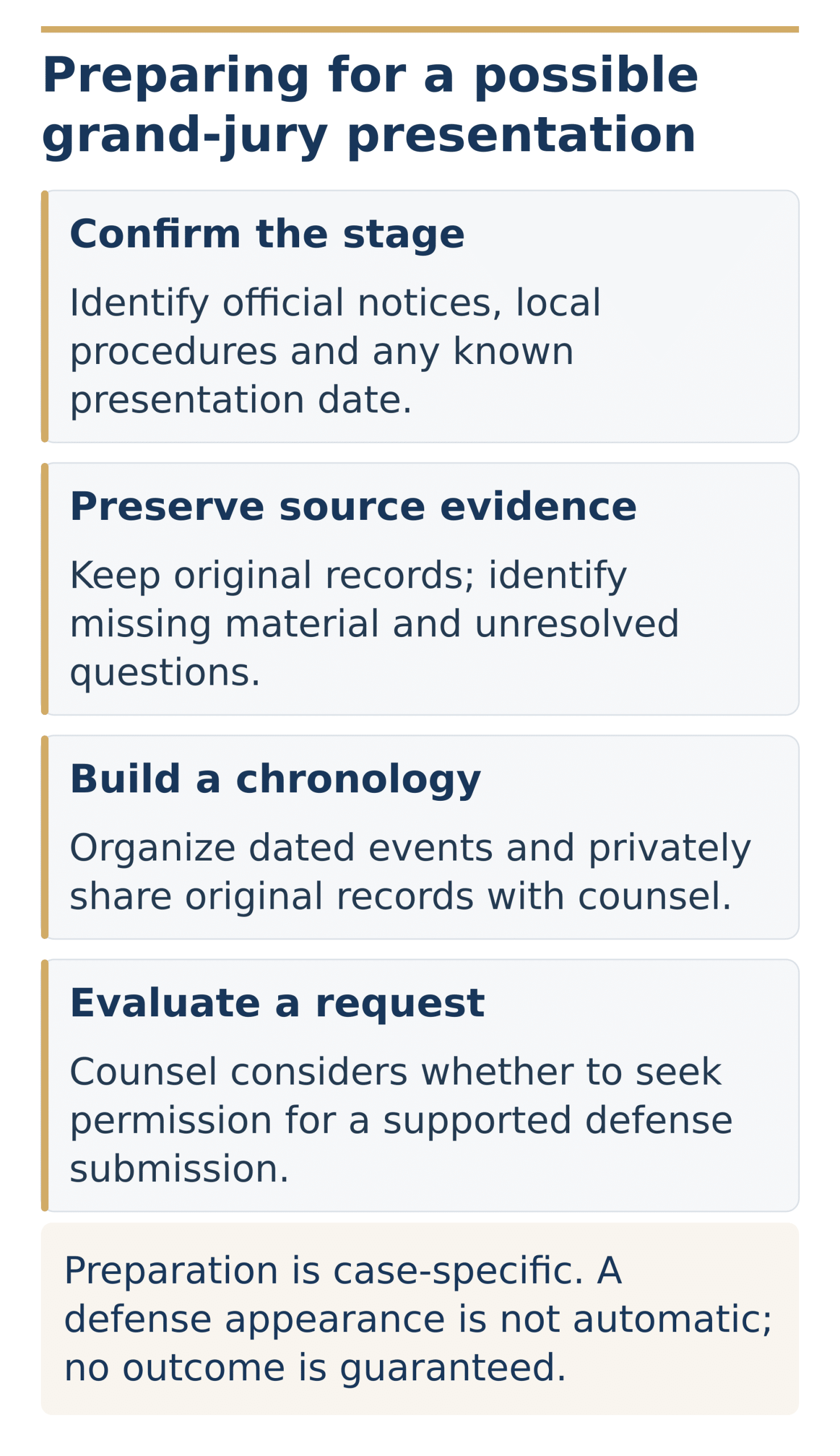
- A folder of bond papers, notices and any subpoena
- A dated timeline, shared only with counsel
- Witness names and phone numbers, for the lawyer
- No guesses about the presentment date
Don’t tell any witness what to say. The family arrest guide and the first 48 hours guide cover the early steps.
Frequently asked questions
Can we find out when the case will be presented?
Sometimes. Your lawyer can ask the prosecutor, and the answer depends on the county and the office.
Will the grand jury hear the defense side?
Not by itself. Art. 20A.104 requires the prosecutor’s approval before the accused or his lawyer can address the grand jury.
Can someone be indicted without testifying?
The accused doesn’t have to appear. The grand jury votes after hearing whatever testimony is available to it.
What if he’s been jailed 90 days without an indictment?
Ask the lawyer about art. 17.151 right away. It requires release on personal bond or lower bail when the State isn’t ready for trial on a felony within 90 days, subject to exceptions.
Talk with Heath Hyde
If a murder case is heading to a grand jury, the weeks before presentment are worth using. Call Heath Hyde, P.C. at 903.439.0000 or request a free consultation.
Legal sources
- Tex. Code Crim. Proc. ch. 20A
- Tex. Code Crim. Proc. art. 17.151
- Tex. Penal Code §2.01
- Tex. R. Evid. 101(e)
- Kaufman County District Attorney, Intake Division
This article provides general educational information, not legal advice. Every case depends on its facts, evidence, court, deadlines and governing law. Past results do not guarantee a similar outcome.