


MONEY LAUNDERING · FEDERAL CHARGES
Does a Money Laundering Conspiracy Require an Overt Act?
No. The Supreme Court settled that in Whitfield. But the government still has to prove a knowing agreement to launder, and that’s where most of these cases are fought.
Eligible to Practice in Texas
Attorney at Law
Bar Card Number: 00796807
TX License Date: 11/01/1996
214 Connally St Ste A
Sulphur Spgs, TX 75482-2612
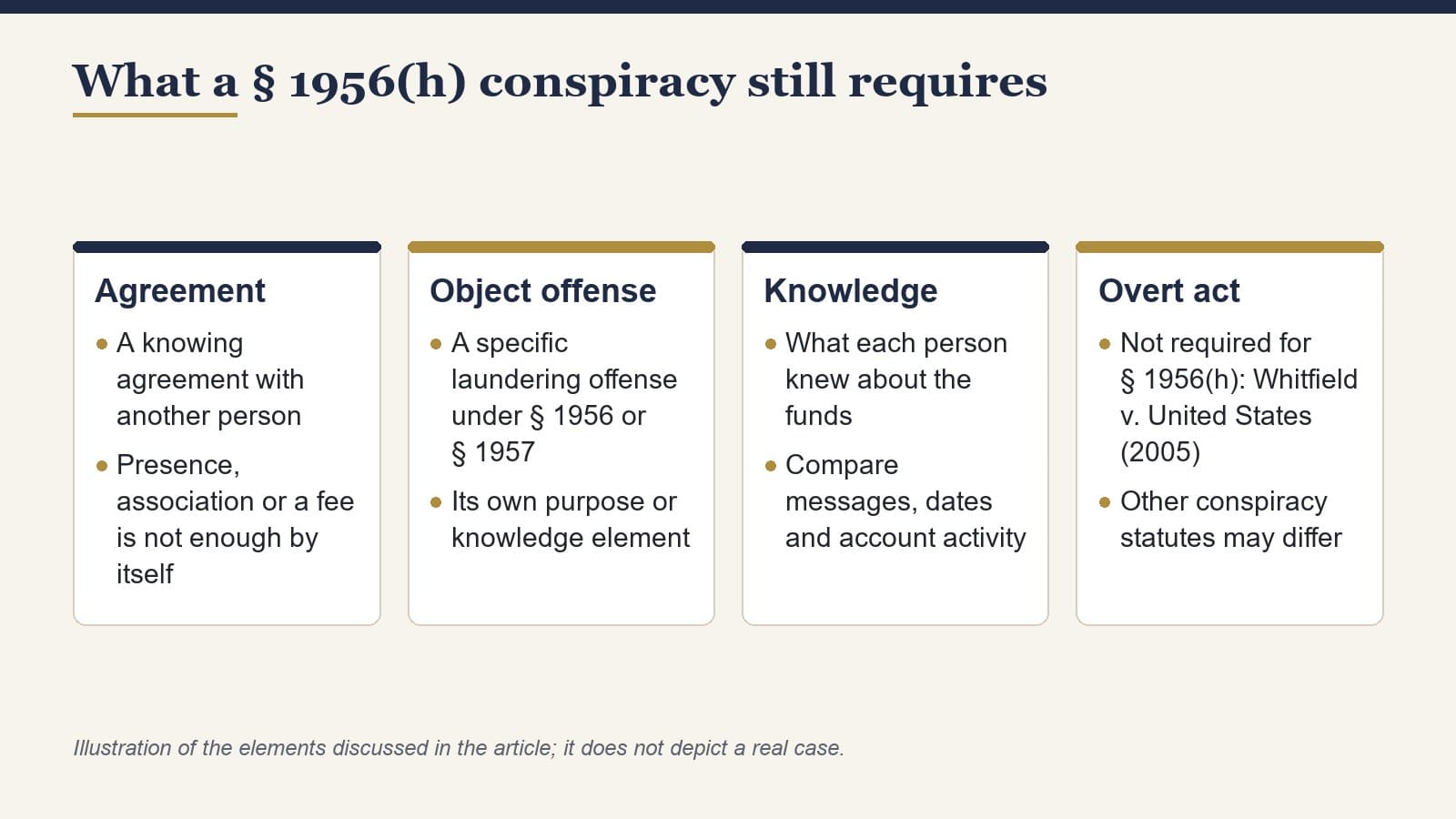
No. A conviction for conspiracy to commit money laundering under 18 U.S.C. § 1956(h) doesn’t require proof of an overt act. A unanimous Supreme Court held so in Whitfield v. United States, 543 U.S. 209 (2005). The government still has to prove an agreement to commit a laundering offense and that the defendant knowingly joined it.
What Whitfield held
The petitioners in Whitfield sat on the executive board of Greater Ministries International Church. Its “gifting” program took in more than $400 million between 1996 and 1999. Investors were promised fast returns from overseas gold and diamond mines, commodities and offshore banks. The church made none of those investments.
At trial on the § 1956(h) count, the judge refused to tell the jury that the government had to prove an overt act. The jury convicted. The Eleventh Circuit affirmed, and so did the Supreme Court.
Section 1956(h) reaches anyone who “conspires to commit any offense defined in this section or section 1957.” It says nothing about an overt act. Section 371 does: one conspirator must “do any act to effect the object of the conspiracy.”
The Court followed United States v. Shabani, 513 U.S. 10 (1994). Shabani was charged in Alaska with conspiring to distribute cocaine under 21 U.S.C. § 846. His trial judge refused an overt-act instruction, the Ninth Circuit reversed, and the Supreme Court reversed the Ninth Circuit. Whitfield also held that the venue clause in § 1956(i), which mentions overt acts, doesn’t make one an element.
Here’s how the three conspiracy charges compare.
| Charge | Overt act required? | Maximum prison term |
|---|---|---|
| § 1956(h), object is a § 1956(a)(1) offense | No (Whitfield) | 20 years |
| § 1956(h), object is a § 1957 offense | No (Whitfield) | 10 years |
| § 371, conspiracy to commit a laundering offense | Yes, by statute | 5 years |
Read the statute cited in each conspiracy count before applying either rule.
The agreement and the knowledge
In Whitfield, the board members marketed the program across the country. Together they allegedly received more than $1.2 million in commissions on the money they solicited.
With no overt act to prove, the jury charge comes down to two questions:
- Did two or more people agree to commit a specific laundering offense?
- Did the defendant know what the agreement was for and join it intending to help?
The object offense adds its own mental state. Section 1956(a)(1)(B)(i) requires knowledge that the transaction was designed “to conceal or disguise the nature, the location, the source, the ownership, or the control” of the proceeds.
Say the proof against a relative with signature authority looks like this:
| Proof offered | Question I’d ask |
|---|---|
| Family tie to the owner | Which call, text or meeting turned contact into a deal to launder? |
| Signature card | Is it dated before or after the first disputed deposit? |
| $1,500 monthly bookkeeping fee | Did it go up when the money started moving? |
| Texts and ledger notes | What do they say that month? |
Fraud agreement versus laundering agreement
Section 1956(a)(1) requires a transaction that “in fact involves the proceeds of specified unlawful activity.” So the proceeds have to exist before the laundering can start. Someone in the fraud may know nothing about the later transfer.
A hypothetical file from a used-car lot:
- June 4: $75,000 is wired into the dealer’s account against an invoice for “consulting.”
- June 4: The office manager books it as consulting revenue from the invoice she was given.
- June 9: the owner sends $70,000 to his cousin’s LLC on an invoice he typed himself. No consulting was ever done.
| Person | Records I’d pull |
|---|---|
| Office manager | The invoice as it reached her desk, the ledger timestamp, any email about coding the wire |
| Owner | His invoice drafts with metadata, the June 9 wire instruction, his texts with the cousin |
Common questions
Does Whitfield apply to every federal conspiracy?
No. Charge the same plan under § 371 and the government has to show someone did “any act to effect the object of the conspiracy.”
What sentence does a § 1956(h) conspiracy carry?
Up to 20 years if the object is a § 1956(a)(1) offense, and up to 10 if it’s § 1957. The Guidelines and the facts set the actual sentence.
Sources
- 18 U.S.C. § 1956
- 18 U.S.C. § 1957
- 18 U.S.C. § 371
- Whitfield v. United States, 543 U.S. 209 (2005)
- United States v. Shabani, 513 U.S. 10 (1994)
This article provides general information, not legal advice. The law and its application depend on the facts and the law in effect on the relevant date. Consult a lawyer about a specific matter.