How Is a Texas Murder Jury Selected?
Questioning can show which panel members can’t be fair. It can’t give either side the jury it wants. Here’s how a Texas murder jury gets picked.
Mr. Heath Enix ‘Heath’ Hyde
Eligible to Practice in Texas
Attorney at Law
Bar Card Number: 00796807
TX License Date: 11/01/1996
Primary Practice Location: Dallas, Texas
Return to the Texas Murder Trial Defense Knowledge Hub
Short answer
Jury selection can show which panel members can’t be fair to your loved one. It can’t give the defense a jury of its choosing. So your lawyer questions the panel, asks the judge to remove biased jurors, and spends a fixed number of strikes with care.
| What families may assume | What the rules actually say |
|---|---|
| “The lawyers pick whoever they want.” | Ten strikes each when death isn’t sought |
| “Reading about the case disqualifies a juror.” | Not if the judge finds the juror impartial |
| “Both sides can agree to keep anyone.” | Some grounds can’t be waived |
| “A strike can be for any reason.” | Not race, and not sex |
What to do now: Tell every relative coming to court one rule before the first morning: no words, nods or posts aimed at anyone on the panel.
Who can be on the panel at all?
A 17-year-old high school senior gets a summons in the mail. She can’t serve.
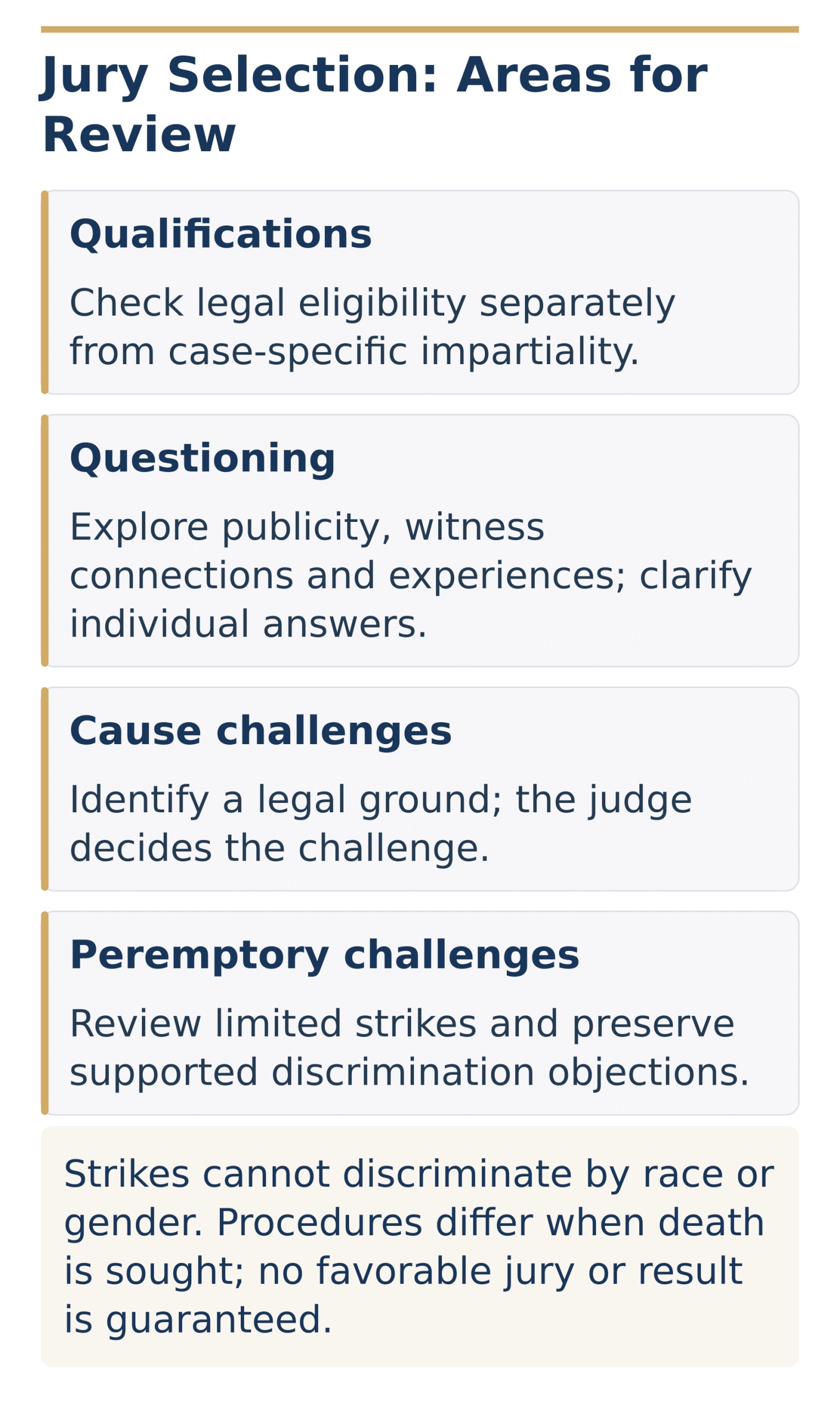
Gov’t Code §62.102(a) sets the basics. A juror must be at least 18 and a U.S. citizen. She must live in Texas and in the county, and be qualified to vote there. She must be able to read and write. A felony or misdemeanor theft conviction disqualifies her, and so does a pending indictment for one.
Some grounds can’t be waived. Under art. 35.16(a), a juror with a felony or theft conviction, a pending felony or theft accusation, or insanity can’t be seated even if both sides agree. The party a ground favors can waive the other grounds in that subsection.
Three names from one panel show how it works. Juror 14 gave police a statement the night of the shooting. Juror 22 sat on the grand jury that indicted the case. Juror 31 was on the jury in an earlier trial of the same case, which ended in a mistrial. Each can be challenged for cause under art. 35.16(a)(6) through (8).
What are the lawyers listening for?
A man in the third row says he saw the story on the news but can be fair. Much of voir dire is finding bias that a summons form won’t show.
Art. 35.16(a)(9) lets either side challenge a juror biased for or against the defendant. Under (a)(10), a juror whose conclusion on guilt would influence the verdict can be challenged. A juror who saw news coverage may still serve if the judge is satisfied the juror is impartial.
The defense can challenge a juror biased against law it relies on, such as mitigation, under art. 35.16(c)(2). The State has a matching ground under (b)(3). Under art. 35.21, the judge decides qualifications and rules on challenges without delay.
| Panel answer | Follow-up the lawyer may ask |
|---|---|
| “I saw it on the news, but I can be fair.” | How did you form a view, and will it affect your verdict? |
| “I don’t believe in self-defense when someone dies.” | Could you follow a self-defense instruction if the judge gives one? |
| “If he didn’t do it, he’d testify.” | Can you follow art. 38.08, which bars holding his silence against him? |
| “My cousin was killed in a shooting.” | Would that make it hard to judge this case on its own facts? |
How do the strikes work?
Late in the day, both lawyers sit with the clerk’s list of 40 names and cross names off in pen. A peremptory strike removes a juror without stating a reason, but the count is fixed.
In a noncapital felony, or a capital case where the State doesn’t seek death, each side gets ten strikes under art. 35.15(b). When the State seeks death, each side gets fifteen under art. 35.15(a). In a joint trial without death sought, each defendant gets six, and the State gets six for each defendant. If one or two alternates will sit, art. 35.15(d) adds one strike per side, for alternates only.
By 4:10 p.m., say, the defense has used nine of its ten. Numbers 11 and 19 both worry your lawyer. Only one can go.
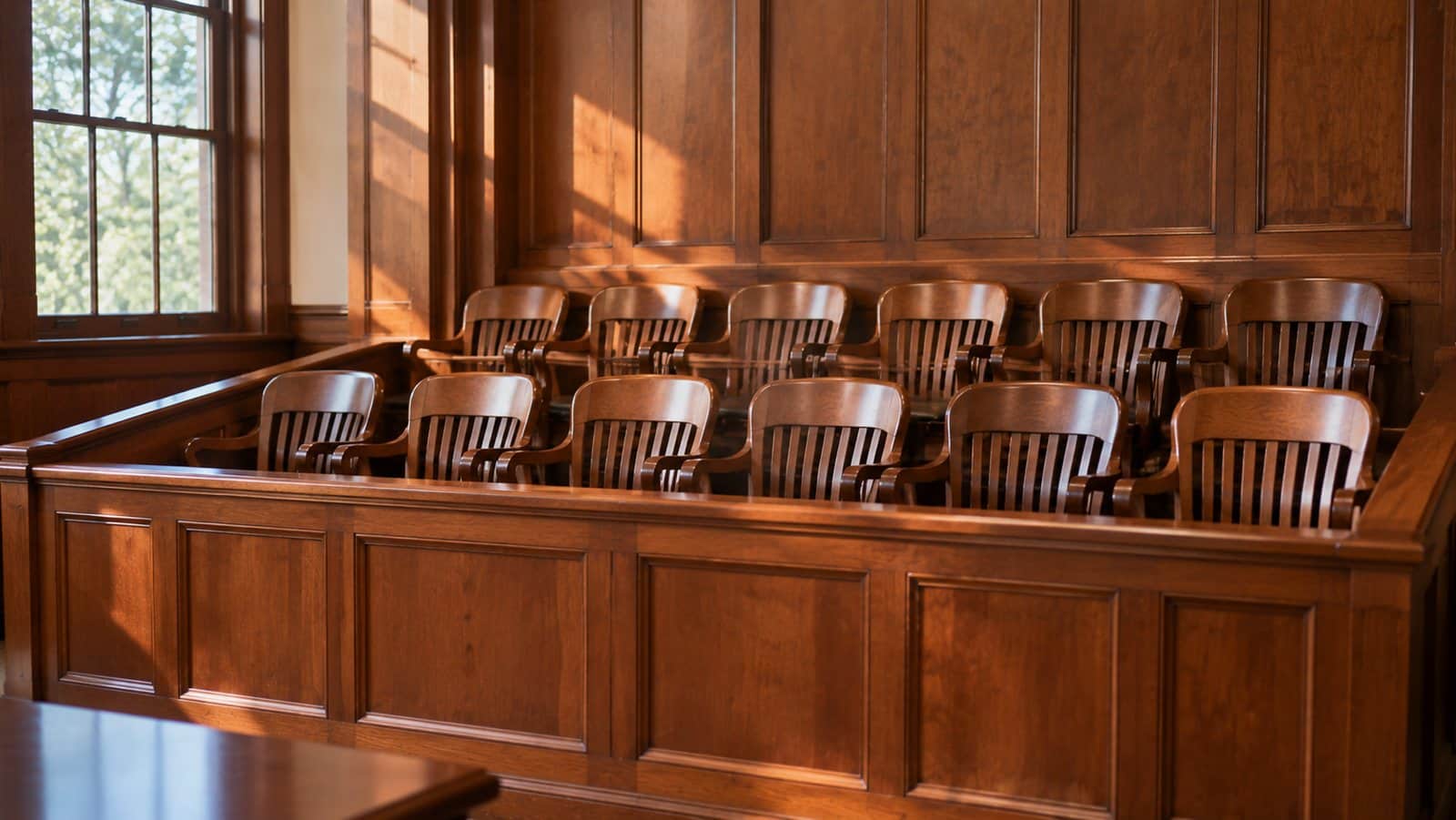
The lawyers hand their lists back. Under art. 35.26(a), the district clerk calls the first twelve names left unstruck. Those twelve are the jury.
Can a strike be used to discriminate?
Say the State uses four of its ten strikes on the only four Black panel members. Courts can look behind a strike when there’s evidence of race or sex discrimination.
| Case | What the Court held |
|---|---|
| Batson v. Kentucky (1986) | Prosecutors can’t strike jurors because of their race. |
| Georgia v. McCollum (1992) | Criminal defendants can’t use race-based strikes either. |
| J.E.B. v. Alabama ex rel. T.B. (1994) | The Equal Protection Clause also bars gender-based strikes. |
Texas adds its own procedure in art. 35.261. After the lists go to the clerk and before the jury is seated, the defendant can ask the court to dismiss the panel over the State’s race-based strikes. Once he makes a prima facie case, the State must give race-neutral reasons.
What changes when the State seeks death?
Among homicide charges, only capital murder can carry a death sentence. See what makes a murder charge capital murder.
The questioning slows down. Under art. 35.17, §2, either side can demand to question each juror alone after the court’s general questions to the panel. Under art. 35.13, each qualified juror goes first to the State and then to the defense for acceptance or challenge.
Two Supreme Court cases set the limits on death-penalty views.
| Case | What the Court held |
|---|---|
| Wainwright v. Witt (1985) | Views justify removal only if they’d prevent or substantially impair the juror’s duties. |
| Morgan v. Illinois (1992) | A capital defendant may challenge for cause a juror who’d automatically vote for death. |
In Witt, the juror’s duties are measured by the instructions and the oath. Under art. 35.26(b), the court may also seat two alternates in a death case.
What can a family do during jury selection?
Maybe you arrive at 8:30 a.m. and every gallery seat is full of prospective jurors. Maybe a woman from the panel ends up beside you in the elevator.
- A seat in the hallway until space opens
- A calm face during personal questions about guns, crime and police
- Patience during bench conferences and the strike list
- No contact with panel members, in person or online
Jurors called to the bench one at a time may be giving a private answer, or the judge may be hearing a challenge.
Frequently asked questions
How many jurors decide a murder case?
Twelve. In district court, the clerk calls the first twelve names left after strikes under art. 35.26(a).
Can the defense ask jurors about the possible punishment?
Often. Questions about whether a juror could consider the full murder punishment range can be part of voir dire, and the judge controls how far they go.
Does reading about the case disqualify a juror?
Not by itself. Under art. 35.16(a)(10), the judge decides whether the juror can still be impartial.
Can family members talk to people on the panel?
Stay away from panel members in the hallway, the parking lot and online, even for small talk.
Talk with Heath Hyde
Jury selection is the only time the defense gets to talk with the jurors before trial. Call Heath Hyde, P.C. at 903.439.0000 or request a free consultation. The jury selection section of the knowledge hub covers how trial preparation fits in.
Legal sources
- Tex. Code Crim. Proc. ch. 35
- Tex. Gov’t Code §62.102
- Batson v. Kentucky, 476 U.S. 79 (1986)
- Georgia v. McCollum, 505 U.S. 42 (1992)
- J.E.B. v. Alabama ex rel. T.B., 511 U.S. 127 (1994)
- Wainwright v. Witt, 469 U.S. 412 (1985)
- Morgan v. Illinois, 504 U.S. 719 (1992)
- Tex. Code Crim. Proc. art. 38.08
- Texas Judicial Branch, Jury Service in Texas
This article provides general educational information, not legal advice. Every case depends on its facts, evidence, court, deadlines and governing law. Past results do not guarantee a similar outcome.