
What Evidence Should Be Preserved Immediately in a Murder Investigation?
Video gets recorded over, phones get reset, and people forget. Here’s what to protect in the first days, and what you should never touch yourself.
Mr. Heath Enix ‘Heath’ Hyde
Eligible to Practice in Texas
Attorney at Law
Bar Card Number: 00796807
TX License Date: 11/01/1996
Primary Practice Location: Dallas, Texas
Return to the Texas Murder Trial Defense Knowledge Hub
Short answer
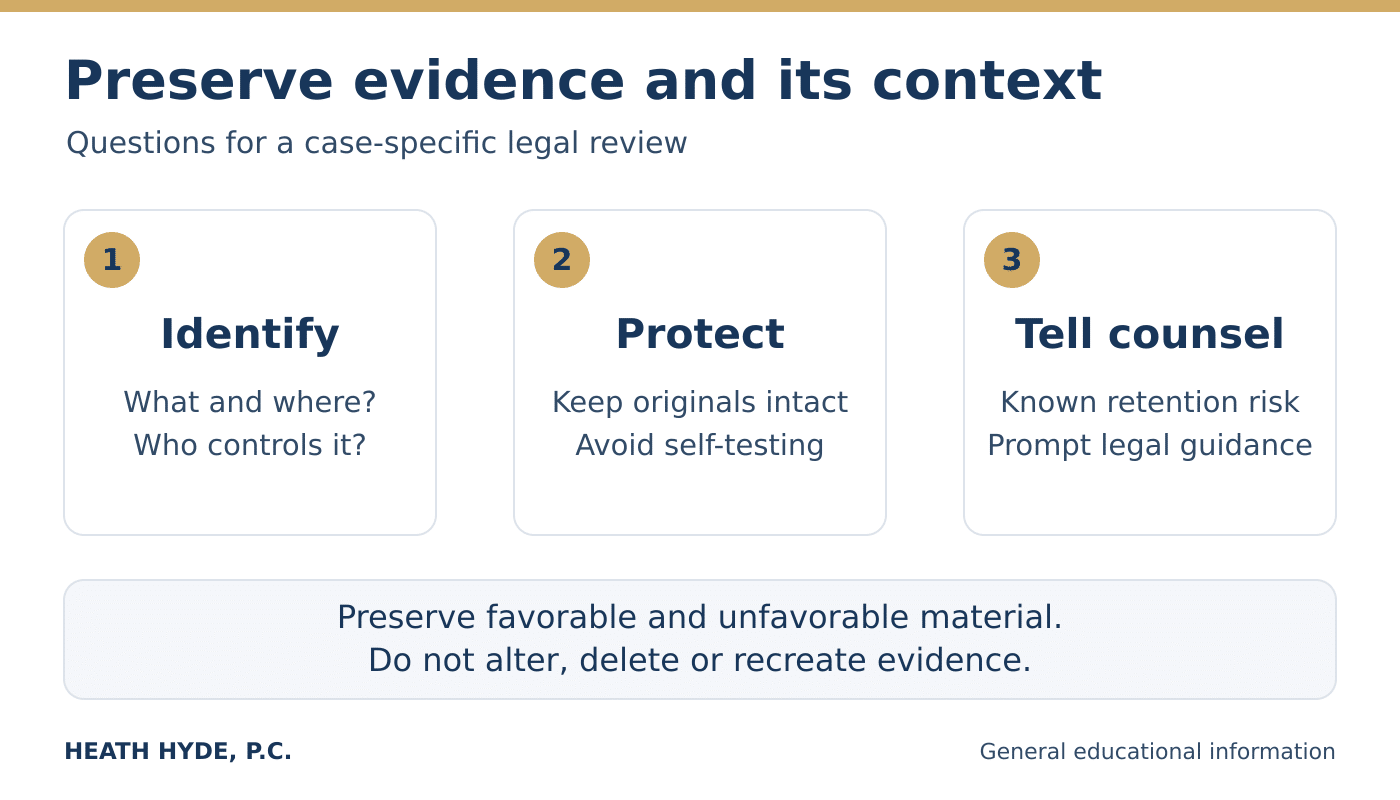
Whatever erases itself first: camera video, phones, messages, location history. You can’t collect or change any of it yourself. You can write down where each item is and who has it, and your lawyer sends the requests.
| Item | What can happen to it |
|---|---|
| Store or doorbell video | Recorded over on a loop |
| Texts and app messages | Lost to auto-delete or account changes |
| A shirt or a knife | Loses value if cleaned or home-tested |
What to do now: Tonight, walk the block where it happened and write down every camera you can see, with the address it hangs on. Give the list to your lawyer tomorrow.
What belongs on a preservation list?
Write it so a stranger could find it. Your cousin’s note might say: “Doorbell cam, 2214 Oak Lane, points at the street. Mr. Reyes’s. Clips live in the app’s cloud, 30 days. Need 9 p.m. to 1 a.m. Original is in his account, not his phone.”
Item, holder, time window, risk, and where the original sits. All in one line.
Keep the original, not a copy. A screenshot is a picture of a text; the phone holds the rest. Forward three messages and the dates and senders can fall away. Post a photo and the data stored with the file may go with it. Leave the phone alone and save the photo file as it is.
Which records can help the defense?
Ordinary paper can place people. A receipt, a ride log, or a text from earlier that night may matter for an alibi or a self-defense claim.
| Record | What it may show |
|---|---|
| Gas receipt at 10:02 p.m., 12 miles away | He was somewhere else at a key moment. |
| Doorbell clip of a man running at his car | He faced a threat. |
What should you never touch?
It’s 2 a.m. His sister is at the kitchen table, scrolling the group chat, deciding what to delete. She should put the phone down.
Texas makes some changes a crime. Penal Code §37.09(a)(1) covers someone who alters, destroys, or conceals a record with intent to impair its availability as evidence, knowing an investigation is pending. It’s a felony. Section 37.09(a)(2) also covers making or using a record you know is false to affect an investigation. Rebuilding a missing text thread “the way it was” can fall there.
And don’t reset his phone, wash his clothes, or compare stories with the other people who were there. Each of those can cost the defense something it can’t get back.
Does the State have to keep evidence?
For some items, yes. Biological evidence and interrogation recordings have their own rules.
| Rule | What it requires |
|---|---|
| CCP art. 38.43(c) | Keeping biological evidence from a felony investigation for set periods, including through the sentence after a conviction |
| CCP art. 38.43(d) | Mailed notice to the defendant, last attorney of record, and court, then a 91-day wait for written objection |
| CCP art. 38.22, §3(b) | Keeping custodial interrogation recordings until the conviction is final, appeals end, or prosecution is barred |
A swab from a back door handle has sat in the county property room for two years since the conviction. The clerk can’t just toss it. A letter has to go to the defendant, the last lawyer of record, and the convicting court. A written objection from any of them before the 91st day stops the destruction.
There’s a catch. Under Arizona v. Youngblood (1988), losing potentially useful evidence isn’t a due process violation unless the defendant shows police acted in bad faith.
Production is a separate duty. Ask in time, and art. 39.14(a) makes the State hand over material evidence it holds. Favorable evidence comes regardless, under art. 39.14(h).
How does your lawyer reach evidence the State doesn’t hold?
Much of the useful video sits with a store manager or an apartment office, not the police. Your lawyer uses written requests and court process to reach it.
| Who holds it | What your lawyer can do |
|---|---|
| A store or apartment complex with cameras | Send a written request to keep the footage, then a subpoena |
| A phone carrier or app company | Ask it to hold records while legal process moves forward |
| The crime lab or property room | Ask the court for an order to keep items for later testing |
A preservation letter only asks. It doesn’t by itself give anyone a right to the item.
What can a family do in the first week?
Families often know where the cameras are before police do. Maybe the fight started in the lot behind a laundromat on Gentry Parkway, and your cousin remembers a camera over its side door.
Write that down first. Then add who was there that night and how to reach them, any receipts or toll records from that day, and where his phone, car and clothes are now.
Frequently asked questions
Should I give my phone to police if they ask?
Call a lawyer before you do. Officers generally need a warrant or consent to search a phone under Riley v. California (2014) and CCP art. 18.0215. Handing it over is the consent.
Can I post on social media asking for video of the area?
Not before you ask your lawyer. A post in the neighborhood Facebook group can reach witnesses, and the post can become evidence itself.
What if I already deleted something?
Tell your lawyer exactly what and when. Don’t try to recover or recreate it on your own.
Will police keep everything they collect?
Not always. Biological evidence has retention rules under art. 38.43. A jacket, a phone, or a set of keys may not have the same protection.
Talk with Heath Hyde
Video loops. Phones get reset. If someone you love is under investigation, call Heath Hyde, P.C. at 903.439.0000 or request a free consultation. The family resources page and the Texas Murder Trial Defense Knowledge Hub have more on what to do next.
Legal sources
- Tex. Code Crim. Proc. art. 38.43
- Tex. Code Crim. Proc. art. 38.22
- Tex. Code Crim. Proc. art. 39.14
- Tex. Code Crim. Proc. art. 18.0215
- Tex. Penal Code §37.09
- Arizona v. Youngblood, 488 U.S. 51 (1988)
- Riley v. California, 573 U.S. 373 (2014)
This article provides general educational information, not legal advice. Every case depends on its facts, evidence, court, deadlines and governing law. Past results do not guarantee a similar outcome.