

BANK FRAUD · WIRE FRAUD · MONEY LAUNDERING
When Federal Bank Fraud Charges Include Wire Fraud and Money Laundering
Three statutes can come out of one loan file, but each count has its own elements, its own ceiling and its own place in the guideline math. Read them one at a time.
Eligible to Practice in Texas
Attorney at Law
Bar Card Number: 00796807
TX License Date: 11/01/1996
214 Connally St Ste A
Sulphur Spgs, TX 75482-2612
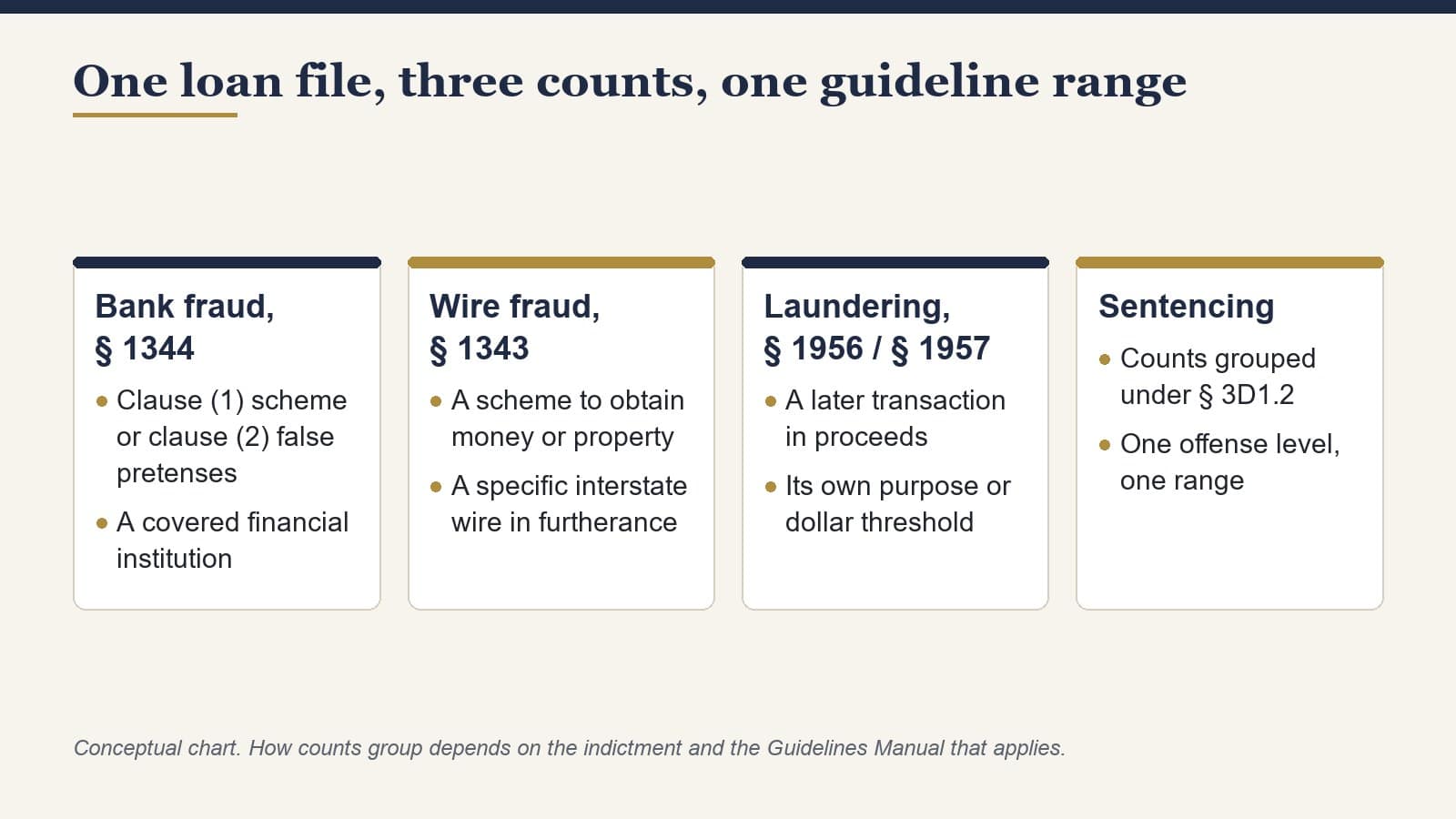
A nine-count indictment out of the Eastern District of Texas might read: four bank fraud counts under 18 U.S.C. § 1344, three wire fraud counts under § 1343, one laundering count under § 1956 and one § 1957 count.
The client’s first question is whether nine counts means nine sentences stacked end to end. It doesn’t. Each count has to stand on its own elements. The judge calculates one advisory guideline range for the whole case, and counts that grew out of the same money usually group together.
The charge map
- Bank fraud, § 1344: a scheme “to defraud a financial institution” or to get bank property by false pretenses. Up to 30 years per count.
- Wire fraud, § 1343: a scheme for money or property carried out by a wire “in interstate or foreign commerce.” Up to 20 years, or 30 if the violation “affects a financial institution.”
- Laundering, § 1956(a)(1): existing proceeds, knowledge and a purpose of promotion, concealment or reporting avoidance. Up to 20 years.
- Monetary transaction, § 1957: a transaction “of a value greater than $10,000” in criminally derived property from specified unlawful activity. Up to 10 years.
- Conspiracy, § 1349: “the same penalties as those prescribed for the offense” that was its object. Section 1956(h) does the same for laundering conspiracies.
This guide deals mainly with § 1956(a)(1), the domestic transaction offense.
Why prosecutors combine counts
Hypothetical, a revolving line at a community bank:
| Date | Movement | Amount | Count |
|---|---|---|---|
| March 3 | Borrower uploads an inflated borrowing-base certificate through the bank’s portal | None | § 1343 wire |
| March 6 | Bank wires a draw | $640,000 | § 1344 execution |
| March 9 | Transfer to an affiliate on an invoice for work nobody did | $210,000 | § 1956(a)(1)(B)(i) concealment |
| March 20 | Truck purchase | $48,000 | § 1957 |
Four entries on one bank statement became four counts. If the March 3 email is strong but the bank-property question is weak, the § 1343 count is the government’s fallback.
Whether a count was properly pleaded is a Rule 12 question. Whether the evidence proves it is a trial question. Grouping, loss, restitution and forfeiture come later, and a defendant can lose the first two and still win on those. Dismissing a laundering count may not take those transfers out of relevant conduct.
The count ledger
One row per charged count:
- statute and subsection: § 1344(1) or (2); § 1343; § 1956(a)(1)(A)(i) or (B)(i); § 1957
- property and owner: what moved (loan principal, deposit balance or fee) and who held it
- representation: the document, the words and the sender
The March 6 draw and the March 20 truck purchase need separate rows, because one completes the fraud and the other spends money already obtained.
Bank fraud depends on which clause is charged
Section 1344 reaches whoever “knowingly executes, or attempts to execute, a scheme or artifice” under either clause.
| Clause | What the government must prove | Common defense question |
|---|---|---|
| § 1344(1) | A scheme “to defraud a financial institution,” knowingly executed | Did the scheme target property the bank owned or held? |
| § 1344(2) | A scheme to obtain property “owned by, or under the custody or control of, a financial institution” by “false or fraudulent pretenses” | Was the falsehood the means of getting bank property, or only nearby? |
The facts of Loughrin v. United States (2014):
- Kevin Loughrin stole checks from Salt Lake City mailboxes and altered them.
- He made six out to Target for amounts up to $250.
- He bought goods with the checks and returned the goods for cash.
- Target presented the checks to the banks.
The Court held that § 1344(2) “does not require the Government to prove that a defendant intended to defraud a financial institution,” but bank property must be obtained “by means of” the lie.
A lie to get a valid check that never reaches the bank generally isn’t enough.
The facts of Shaw v. United States (2016):
- Lawrence Shaw obtained a Bank of America customer’s account numbers.
- He used them to move the customer’s money to accounts at other institutions.
- He was convicted under clause (1).
The Court held that a bank has property rights in customer deposits and that clause (1) “demands neither a showing of ultimate financial loss nor a showing of intent to cause financial loss.”
A client who says only the customer lost money hasn’t answered a clause (1) count.
Is the lender a financial institution?
Coverage is an element. Section 20 starts with “an insured depository institution,” tied to “section 3(c)(2) of the Federal Deposit Insurance Act.” It also lists credit unions, Federal Reserve and Federal Home Loan banks, holding companies and a “mortgage lending business,” which § 27 defines.
A borrower who applied through a phone app may never have dealt with a bank. The app’s program agreement with its partner bank, and the funding ledger for the charged date, show whose money moved. An FDIC certificate has to show insured status on that date, not today.
How many executions?
- Separately funded loan draws can each be a count.
- Background steps can’t be relabeled as executions.
- Each charged date controls limitations, venue and jury unanimity.
Wire fraud needs a particular wire
- Section 1343 covers a “scheme or artifice to defraud” or a scheme for obtaining “money or property by means of false or fraudulent pretenses.”
- The scheme must use a transmission “in interstate or foreign commerce.” An email between two Tyler offices isn’t interstate just because it touched the internet.
- The wire needn’t contain the lie, but the indictment has to name it.
- The deception must be material, and the author of the false statement must intend to defraud.
- A violation that “affects a financial institution” moves the ceiling from 20 years to 30.
Three recent Supreme Court cases mark where “money or property” starts and stops:
| Case | What happened | Result |
|---|---|---|
| Kelly (2020) | Officials cut Fort Lee’s George Washington Bridge toll lanes from three to one in 2013 to punish a mayor | Reversed: lane realignment was regulation, and staff time wasn’t the object |
| Ciminelli (2023) | A Buffalo bid process was rigged so LPCiminelli won the $750 million Riverbend job | Reversed: the right-to-control theory isn’t property fraud |
| Kousisis (2025) | Alpha Painting won two PennDOT painting contracts in Philadelphia after lying about a disadvantaged paint supplier | Affirmed: fraudulent inducement is enough even though PennDOT got the painting it paid for |
In a contract case the line runs between a broken promise and a false statement of present intent. Neither Ciminelli nor Kousisis is about guideline loss or restitution.
The March 3 certificate in the example above can feed both a bank count and a wire count, but Shaw’s deposit holding helps only the bank count.
The charged wire
For the March 3 upload, I want the portal’s server log and the cloud region it landed in, not the PDF the agent printed from discovery. For the March 6 draw, I want the Fedwire message itself. An internal book transfer between two accounts at the same bank isn’t an interstate wire just because the government’s chart draws an arrow.
A defendant needn’t know the network path for interstate use to be foreseeable. Fifth Circuit law should be checked for the specific count, with one routing diagram per count.
Hypothetical, a mortgage broker’s office in Tyler:
- June 2, 9:10 a.m.: the client submits an online form to the broker.
- June 2, 11:40 a.m.: the broker’s assistant emails an out-of-state lender a different version of the file.
- Four employees share one login, so the IP address points to a router in the back room.
- The browser auto-uploads attachments from a synced folder.
The question is which version the lender relied on. Login history, device activity and messages from that day answer it. An event at 12:30 a.m. UTC lands on the previous calendar day in Texas, and that can move a count’s date.
Digital records at trial
| Question | Rule |
|---|---|
| Is the record what the government says it is? | Fed. R. Evid. 901: evidence “sufficient to support a finding that the item is what the proponent claims it is” |
| Can a certificate replace a witness? | Rules 902(13) and (14): machine-generated records and copied data can self-authenticate by certification |
| Does a certified export prove what a person typed? | No. It shows the data wasn’t altered |
| Can a chart stand in for the records? | Rule 1006: summaries of voluminous records are allowed, and the underlying records must be made available |
Laundering needs more than moving money
The facts of Regalado Cuellar v. United States (2008):
- Humberto Regalado Cuellar was stopped driving through Texas toward Mexico.
- Officers found nearly $81,000 in plastic bags covered with animal hair.
- The bags sat in a secret compartment under the rear floorboard.
The Court held that the international transportation provision isn’t satisfied “solely by evidence that the funds were concealed during transport.” The purpose, “not merely its effect,” had to be concealment.
Bank fraud and wire fraud are specified unlawful activities. Under § 1956(a)(1) the government must prove four elements:
- Proceeds that already existed. Section 1956(c)(9) defines proceeds as “any property derived from or obtained or retained, directly or indirectly, through some form of unlawful activity,” including gross receipts.
- Knowledge that the property came from “some form, though not necessarily which form, of activity that constitutes a felony,” § 1956(c)(1).
- Intent to promote, a tax purpose or a design to conceal or avoid a reporting requirement.
- A financial transaction affecting interstate or foreign commerce, or involving a financial institution so engaged.
The facts of United States v. Santos (2008):
- Efrain Santos ran an illegal lottery in Indiana.
- The government charged his payments to runners and winners as laundering.
- A plurality of the Court read “proceeds” as “profits.”
Congress added § 1956(c)(9) in 2009, so Santos no longer supports a business-expense exclusion. A deposit can qualify as proceeds, but a deposit alone doesn’t prove intent to promote or conceal.
Section 1957 rules
- Section 1957(a) reaches anyone who “knowingly engages or attempts to engage” in a qualifying transaction.
- The transaction must be “of a value greater than $10,000,” so exactly $10,000 falls short.
- Section 1957(c): the government needn’t prove the defendant knew the source was specified unlawful activity.
- Section 1957(f)(1) defines a monetary transaction as a deposit, withdrawal, transfer or exchange “of funds or a monetary instrument” by, through or to a financial institution.
- Section 1957(f)(1) excludes “any transaction necessary to preserve a person’s right to representation” under the Sixth Amendment.
- Section 1957(f)(2) covers property “constituting, or derived from, proceeds obtained from a criminal offense.”
- Tracing has to tie more than $10,000 of the transaction to criminally derived property. Several small transfers aren’t added together automatically.
Timing, concealment and promotion
Hypothetical, a second borrower with two LLCs and a trust account:
- June 2: a $310,000 draw posts. That posting date is usually when the money becomes proceeds.
- June 5: $90,000 goes to Red Oak Services LLC, owned by the borrower’s cousin since 2019.
- June 8: Red Oak sends $60,000 to a Longview lawyer’s trust account.
- June 10: the trust account pays a $12,000 “referral fee” to the loan officer who originates the next false loan.
The chart looks bad. Cuellar construed a different subsection, but its purpose-versus-effect line still applies, and Red Oak’s seven years of tax returns and invoices cut against design to conceal. The $12,000 fee is the stronger count, on promotion, because it paid for the next false loan.
Statutory exposure, count by count
Under 18 U.S.C. § 3571(d), an alternative fine of up to twice the gross gain or gross loss can apply instead.
| Count | Maximum prison term | Fine language for an individual | Example |
|---|---|---|---|
| § 1344 bank fraud | 30 years | “not more than $1,000,000” | One conviction does not mean a 30-year guideline range |
| § 1343, ordinary | 20 years | Fine “under this title”; § 3571(b)(3) caps a felony fine at $250,000 unless another measure applies | The indictment sets which penalty clause is in play |
| § 1343 affecting a financial institution | 30 years | “not more than $1,000,000” | “Affects” needs a factual basis |
| § 1956(a)(1) | 20 years | “not more than $500,000 or twice the value of the property involved in the transaction, whichever is greater” | A $400,000 transaction supports a fine ceiling of $800,000 |
| § 1957 | 10 years | Title 18 fine, or up to “twice the amount of the criminally derived property involved in the transaction” | A $40,000 transaction gives an $80,000 twice-property figure; another provision may be higher |
Stacked statutory maximums:
- one § 1344, one ordinary § 1343 and one § 1956(a)(1) conviction: 70 years
- the same three with the wire count under the financial-institution clause: 80 years
- either set plus a § 1957 count: 80 or 90 years
Nobody gets 90 years on a loan file. Whether terms run back to back is decided under 18 U.S.C. § 3584 and §5G1.2.
How the guideline range is actually calculated
- Manual: the one in effect at sentencing, under USSG §1B1.11(a), unless that raises an ex post facto problem.
- The November 1, 2026 manual raised every §2B1.1 loss threshold. The first step went from $6,500 to $9,000.
- Guideline: §2B1.1 for bank and wire fraud, §2S1.1 for laundering.
- Base level: 7 under §2B1.1(a)(1), because bank and wire fraud carry 20 years or more.
- Loss: the greater of actual or intended loss, a rule moved into the guideline text in 2024.
- Specific offense characteristics such as loss come next, then relevant conduct and the Chapter Three adjustments for role, obstruction and acceptance.
- Closely related counts group under §3D1.2 into one combined offense level, which meets the criminal history category on the Sentencing Table.
A worked example under both manuals
Hypothetical: one § 1344 conviction, $600,000 in guideline loss, Criminal History Category I and no other adjustments.
| November 1, 2025 manual | November 1, 2026 manual | |
|---|---|---|
| Base level, §2B1.1(a)(1) | 7 | 7 |
| Loss bracket | More than $550,000: add 14 | More than $350,000: add 12 |
| Offense level | 21 | 19 |
| Range, Category I | 37–46 months | 30–37 months |
The same $600,000 moves the floor from 37 months to 30. Both numbers are far below the 30-year statutory ceiling.
What a laundering conviction adds
- Section 2S1.1(a)(1) uses “the offense level for the underlying offense from which the laundered funds were derived” when the defendant committed or is accountable for that offense and the level “can be determined.”
- Section 2S1.1(b)(2)(B) adds 2 levels for a § 1956 conviction. A § 1957 conviction adds 1. Under the 2026 manual the example moves from 19 to 21, or 37–46 months.
- Section 2S1.1(a)(2) applies when the defendant didn’t commit the underlying offense: 8 plus the loss-table levels for the laundered funds. Because it borrows the §2B1.1 table, the 2026 threshold changes reach it too.
- Section 2S1.1(b)(3) adds 2 for sophisticated laundering only when (b)(2)(B) applies.
- Application Note 6 says “the counts shall be grouped pursuant to subsection (c) of §3D1.2.” The group takes the higher level, and Chapter Three adjustments are decided based on the laundering offense.
Acceptance and other adjustments
Acceptance under §3E1.1 can take off up to three levels:
- fraud only: 19 to 16, or 21–27 months
- fraud plus § 1956: 21 to 18, or 27–33 months
- the third level: an offense level of 16 or more before the reduction and a government motion saying the timely plea spared it trial preparation
Other adjustments on the worksheet:
- victim count or substantial financial hardship under §2B1.1
- sophisticated means
- large gross receipts from a financial institution
- role, abuse of trust and obstruction under Chapter Three
The guidelines have been advisory since United States v. Booker, 543 U.S. 220 (2005), but a miscalculation can still get a sentence reversed. The record needs findings on every disputed amount and a clear statement of the grouping and each count’s sentence.
Loss, restitution and forfeiture are separate calculations
The facts of Honeycutt v. United States (2017):
- Tony Honeycutt owned a Tennessee hardware store. His brother Terry managed sales and inventory on salary.
- The store made $269,751.98 selling Polar Pure, an iodine water purifier used to make methamphetamine.
- Tony pleaded guilty and agreed to forfeit $200,000.
- The government sought the other $69,751.98 from Terry, who didn’t personally benefit.
The Court held that forfeiture under 21 U.S.C. § 853(a)(1) “is limited to property the defendant himself actually acquired.” How far that reaches other forfeiture statutes varies by circuit.
The facts of Hughey v. United States (1990):
- Hughey was charged with stealing credit cards and using them.
- He pleaded guilty to one count, for using one card.
- The district court ordered $90,431 in restitution, covering losses on many cards he wasn’t convicted of using.
The Court cut the order back to the loss caused by the offense of conviction. Congress answered later that year in the restitution statute then in force, and § 3663A(a)(2) carries the same rule today. It reaches anyone “directly harmed by the defendant’s criminal conduct in the course of the scheme” when a scheme is an element.
Back to the April 3 draw, with numbers on the far side of it:
- Sept. 30: the borrower defaults with $520,000 of the $600,000 still unpaid.
- Nov. 14: the bank sells the pledged equipment for $180,000.
- Jan. 9: the owner’s personal guarantor pays the bank $100,000.
| Measure | Where it comes from | In this example |
|---|---|---|
| Guideline loss | USSG §2B1.1(b)(1), with collateral credit | About $340,000 on an actual-loss theory |
| Restitution | 18 U.S.C. §§ 3663A and 3664 | $240,000 to the bank, $100,000 to the guarantor |
| Fraud forfeiture | § 982(a)(2)(A) | Proceeds the defendant obtained, limited by Honeycutt in circuits that apply it here |
| Laundering forfeiture | § 982(a)(1) | The $250,000 lake-house wire and what it bought |
Proving the bank fraud counts
A Dallas pallet maker’s credit file, as a superseding indictment might use it:
| Date | Document or event | Figure |
|---|---|---|
| Feb. 28 | Controller’s aging report | $3.1 million eligible receivables |
| Mar. 5 | CEO signs the borrowing-base certificate (Count One) | $2.2 million availability |
| Mar. 12 | Field examiner flags invoices past 90 days | $410,000 |
| Apr. 3 | Loan committee funds the draw anyway (Count Two) | $600,000 |
| Apr. 4 | Wire to a supplier (Count Five) | $48,000 |
| September | Charge-off | $1.4 million |
On Count Two, clause (1) puts the target of the scheme in play, and clause (2) puts the March certificate’s role in getting the money out the door in play. A count that pleads both clauses can go to the jury on either theory. Only the executions named in the counts go to the jury, even when discovery shows twenty emails and ten transfers.
The government will lead with the $1.4 million. It proves a default in September and nothing about what the CEO believed on Mar. 5.
What should the defense ask the bank for?
Start with invoices 3318 through 3361. Real invoices that were merely old make a very different case from invented ones.
Then the Mar. 12 field exam and the Apr. 2 committee minutes. If the committee read about the $410,000 and funded anyway, the certificate looks less like the means of getting the money.
Then the credit memo. A memo saying the bank lent on the owner’s personal guarantee makes a sales projection hard to call the driver of the loan. A forged guarantee is another matter.
Rule 17(c) subpoenas get narrow fast. “Every internal file” draws a motion to quash. “The Mar. 12 exception approval, with its author” usually gets produced. Suspicious activity reports are confidential by statute, so ask for the records under them.
Proving the laundering counts
The $600,000 April 3 draw moved three more times in 17 days:
| Date | Movement | Amount | Possible count |
|---|---|---|---|
| Apr. 3 | Bank funds the draw | $600,000 | § 1344 execution |
| Apr. 4 | Wire to an existing supplier | $48,000 | Count Five; not concealment by itself |
| Apr. 10 | Transfer to the CEO’s brother’s LLC, formed the week after the draw | $15,000 | § 1956(a)(1)(B)(i) concealment |
| Apr. 20 | Wire to a title company for a lake house | $250,000 | § 1957 |
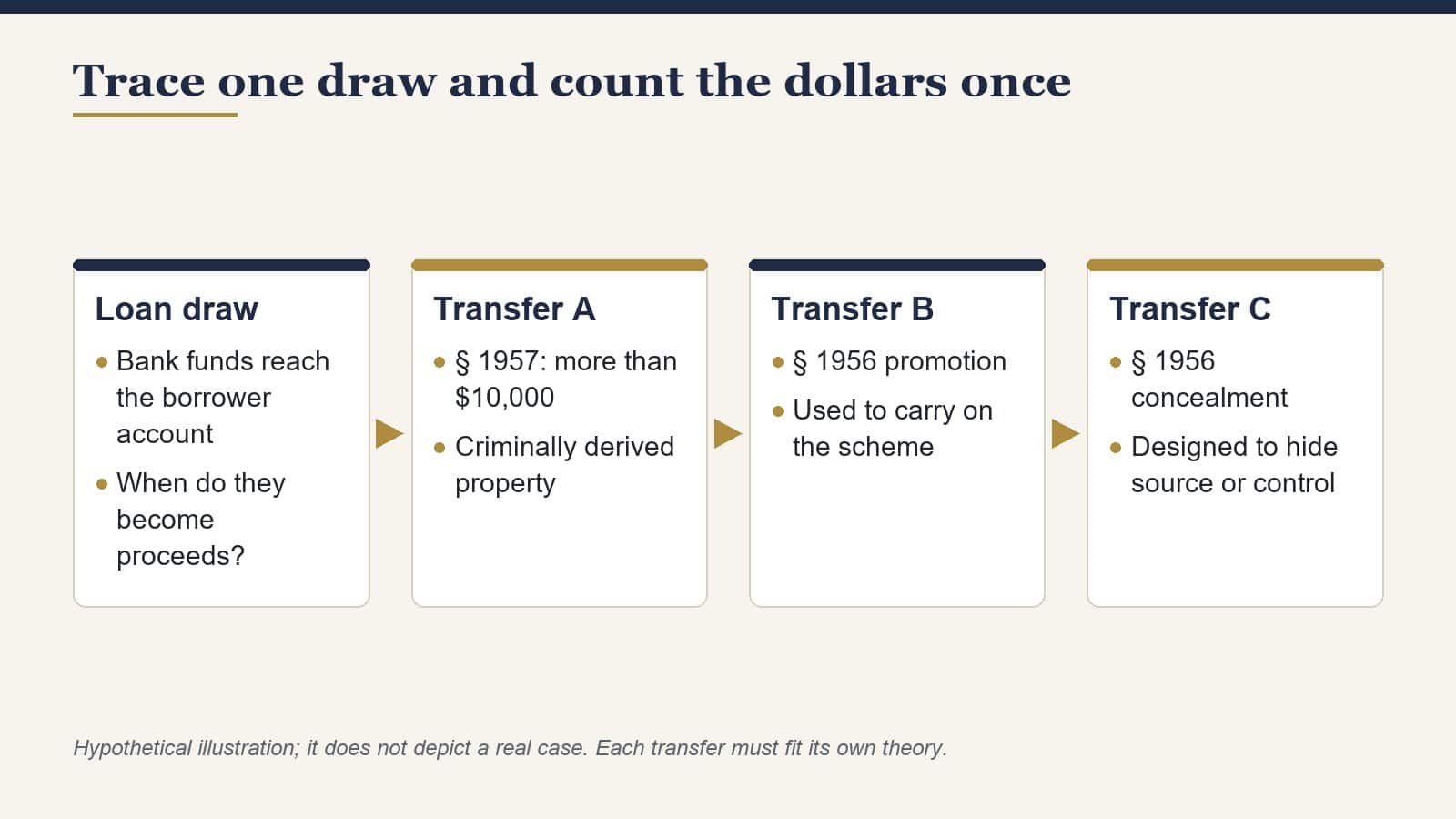
| Theory, § 1956(a)(1) | What the government needs | In the April trace |
|---|---|---|
| Promotion, (A)(i) | A payment that funded more of the fraud | Nothing yet |
| Concealment, (B)(i) | A transaction designed “to conceal or disguise” the proceeds | Apr. 10: $15,000 to an LLC formed after the draw |
| Reporting avoidance, (B)(ii) | A design to dodge a specific reporting rule | Nothing |
The Apr. 4 supplier wire is the weakest laundering fact in the file. It paid a real vendor on an existing contract.
The Apr. 20 lake-house wire needs no purpose at all. Section 1957 counts it because $250,000 of criminally derived property went through a title company’s bank. At $9,900 it wouldn’t count under § 1957(a).
A smaller account, three entries long:
- May 1: it opens at $80,000, all from customer payments on invoices 2201–2240.
- May 3: the disputed $20,000 loan draw posts, and the balance reaches $100,000.
- May 9: check 4417 for $15,000 goes to an equipment dealer for a shop press, and the balance drops to $85,000.
Commingling alone doesn’t decide whether check 4417 involved criminal property. Three things do:
- the tracing rule the circuit applies and the government’s stated theory
- transaction order, from the posting times on the statement
- pending deposits and overnight sweeps, from the bank’s sweep reports
Last-in, first-out puts check 4417 on the loan money. First-in, first-out puts it on customer payments from invoices 2201–2240. A defense accountant runs both and shows the jury the spread. Watch, too, for a government chart that counts the same $20,000 again each time it changes accounts.
Building the financial schedules
Three spreadsheets, each reconciled to the bank statements down to the penny:
- Offense transactions: each charged execution, wire and monetary transaction, built from the indictment.
- Guideline loss: each victim’s payment, credits, collateral, repayments and recoveries, with the method stated.
- Restitution and forfeiture: victim by victim, and asset by asset with its statutory basis.
Trial preparation for a three-statute indictment
Proof-chart row for Count Two, the April 3 draw:
- Element: clause (2), the draw obtained “by means of” the March receivables figure.
- Government’s best exhibit: the signed certificate, sponsored by the loan officer.
- Admissibility issue: the agent’s summary chart, because Rule 1006 needs the invoices made available.
- Defense exhibits: the invoices and payment records for the $410,000 questioned.
- Unanimity: if a count lists several representations, current Fifth Circuit law on whether jurors must agree on one.
Under Fed. R. Crim. P. 24 the judge controls voir dire, so the defense submits questions. Mine for this case would start with: “If a bank lost money after a business failed, what else would you need to know before deciding whether anyone lied when the loan was made?”
Requests for the charge conference:
- a Loughrin “by means of” instruction for Count Two
- a Shaw bank-property instruction for any clause (1) count
- a verdict form that makes jurors name the execution
After the verdict
- Motion for judgment of acquittal, Fed. R. Crim. P. 29: at trial, or “within 14 days after a guilty verdict or after the court discharges the jury, whichever is later.”
- New-trial motion on newly discovered evidence, Rule 33(b)(1): “within 3 years after the verdict or finding of guilty.”
- New-trial motion on other grounds, Rule 33(b)(2): “within 14 days after the verdict or finding of guilty.”
- Notice of appeal, Fed. R. App. P. 4(b)(1)(A): within 14 days after the later of the judgment or the government’s notice of appeal.
At sentencing the presentence report’s choice of manual, relevant conduct, loss method, credits, victim count and enhancements get tested against source documents. Restitution and forfeiture get separate proposed schedules. A plea agreement may waive some of these rights.
Common questions
Can I be convicted of laundering even if the concealment theory fails?
The $250,000 lake-house wire in the trace above is a § 1957 count, and § 1957 has no concealment element.
Will nine counts mean nine sentences served back to back?
Counts built on the same money group under §3D1.2, and under §5G1.2 the sentences generally run concurrently unless the top statutory maximum is below the guideline total.
Can the government freeze my bank accounts before trial?
Section 982(b)(1) brings in the restraining-order procedure of 21 U.S.C. § 853(e). In Luis v. United States (2016), a case alleging a nearly $45 million health care fraud, a plurality held that freezing untainted funds needed to hire counsel violates the Sixth Amendment.
Sources
- 18 U.S.C. § 20
- 18 U.S.C. § 27
- 18 U.S.C. § 981
- 18 U.S.C. § 982
- 18 U.S.C. § 1343
- 18 U.S.C. § 1344
- 18 U.S.C. § 1349
- 18 U.S.C. § 1956
- 18 U.S.C. § 1957
- 18 U.S.C. § 3663A
- 18 U.S.C. § 3664
- 21 U.S.C. § 853
- 28 U.S.C. § 2461
- 31 U.S.C. § 5324
- U.S. Sentencing Commission, Guidelines Manual §§1B1.11, 2B1.1, 2S1.1 and 3D1.2
- U.S. Sentencing Commission, 2026 Amendments to the Sentencing Guidelines
- Federal Rules of Criminal Procedure 12, 16, 17, 24, 29, 30 and 33
- Federal Rules of Evidence 702, 901, 902 and 1006
- Federal Rule of Appellate Procedure 4
- Loughrin v. United States, 573 U.S. 351 (2014)
- Shaw v. United States, 580 U.S. 63 (2016)
- Kelly v. United States, 590 U.S. 391 (2020)
- Ciminelli v. United States, 598 U.S. 306 (2023)
- Kousisis v. United States, 605 U.S. ___ (2025)
- United States v. Santos, 553 U.S. 507 (2008)
- Regalado Cuellar v. United States, 553 U.S. 550 (2008)
- Hughey v. United States, 495 U.S. 411 (1990)
- Honeycutt v. United States, 581 U.S. 443 (2017)
This article provides general information, not legal advice. The law and its application depend on the facts and the law in effect on the relevant date. Consult a lawyer about a specific matter.