
What Questions Matter When Cross Examining a Forensic Expert?
A forensic expert can say what one method found on one sample. Cross-examination asks whether the file behind that opinion holds up.
Mr. Heath Enix ‘Heath’ Hyde
Eligible to Practice in Texas
Attorney at Law
Bar Card Number: 00796807
TX License Date: 11/01/1996
Primary Practice Location: Dallas, Texas
Return to the Texas Murder Trial Defense Knowledge Hub
Short answer
One method, one sample, one result: that’s what the report shows. Whether the method fits this sample is a separate question, and the lab file answers it. Your lawyer sorts each weak spot into admissibility, for the judge, or weight, for the jury.
| What the State may say | What it may actually show |
|---|---|
| “The lab confirmed it.” | One analyst, one method, one sample |
| “She’s testified hundreds of times.” | Experience, not a method that fits this case |
| “One in a million.” | A number built on modeling choices |
| “The detective sent it for testing.” | An assignment that may assume the answer |
What to do now: Ask the lawyer whether the written art. 39.14 request has gone out, and whether it names the full lab file, not just the report.
What did the expert actually do?
The detective’s request form reads “confirm suspect’s DNA on knife handle.” That line tells the analyst what answer the case needs before any testing starts. Your lawyer asks for the form and asks who wrote it.
Small admissions on the stand can matter more than big ones.
| What the analyst admits | Why it matters |
|---|---|
| She read the offense report first. | Case facts may have shaped her search. |
| She explains how the victim fell. | That may reach past her training. |
| Another analyst ran the extraction. | She may be relaying that work. |
| A reviewer flagged the data. | The report never says so. |
Each admission opens a follow-up. Who sent her the offense report, and when? What training covers how a body falls? Where is the second analyst’s worksheet?
How does a Texas judge decide if a method is reliable?
It’s 9 a.m. and the jury box is empty. The analyst takes the witness chair for a hearing the jury never sees.
That’s the Rule 702 gatekeeper hearing. The State offered the expert, so the State carries the burden. Under Kelly, it must show reliability by clear and convincing evidence, outside the jury’s presence.
| Case | What the Court held |
|---|---|
| Kelly v. State (1992), applied in Beard v. State (2002) | The theory, the technique, and its application that day must all be valid. |
| Weatherred v. State (2000), applying Nenno | For a “soft” science: a legitimate field, testimony within it, and proper use of its principles. |
| Hernandez v. State (2003) | Courts may take judicial notice of a well-established method, but earlier testimony alone doesn’t prove reliability. |
Cross often aims at the third Kelly question. A valid method can still be applied badly to one sample.
Say the lab validated its software on two-person mixtures, and the swab in your case holds DNA from at least four people. Did anyone test the method on a sample like this one? Your lawyer will ask.
What should the defense have in hand before cross?
Page 2 of the report gives one number. The bench notes behind it may show three runs, a failed control, and a repeat at 7:40 the next morning.
Art. 39.14(a) reaches material held by the State or by anyone under contract with it. That can include an outside lab. Start with the bench notes, worksheets and raw instrument files. Add the positive and negative controls. Then get the chain-of-custody and seal records, the validation studies, the written protocol, and the analyst’s proficiency tests.
| Rule | Deadline or duty |
|---|---|
| Art. 39.14(b) | A request by day 30 before jury selection; Rule 702, 703 and 705 witnesses named by day 20 |
| Art. 39.14(h) | Favorable information in the State’s possession, custody or control, with no request needed |
How does the defense test the numbers?
The report says a DNA mixture is “1 million times more likely” under one theory than another. Your lawyer asks which two theories the analyst compared. Then she asks which people the analyst assumed were in the mixture, and why.
NIST notes that likelihood ratios depend on modeling choices, data processing and expert judgment. It also says there’s no single correct likelihood ratio in a given case. So the next question is whether a different model or software setting would change the number.
Ask the same of any “error rate.” NIST treats method error, measurement uncertainty and interpretation error as different things. Which one does the quoted rate measure, and from what study?
Then count. The report lists 14 items; the worksheets show 17. Items 15 through 17 were inconclusive and never made the report. Who dropped them, and were they run on the same swab?
What does Rule 705 let the defense reach?
The prosecutor asks for the analyst’s opinion, and she gives it in one sentence. Rule 705 lets your lawyer get under that sentence.
| Rule | What it lets the defense do |
|---|---|
| TRE 705(a) | Make the expert disclose the underlying data on cross |
| TRE 705(b) | Question her on that data outside the jury’s hearing |
| TRE 705(c) | Object that the data aren’t a sufficient basis |
| TRE 703, 705(d) | Keep out inadmissible bases when prejudice outweighs their help; get a limiting instruction |
| TRE 104(a), (e) | Offer the jury evidence on weight after the judge rules |
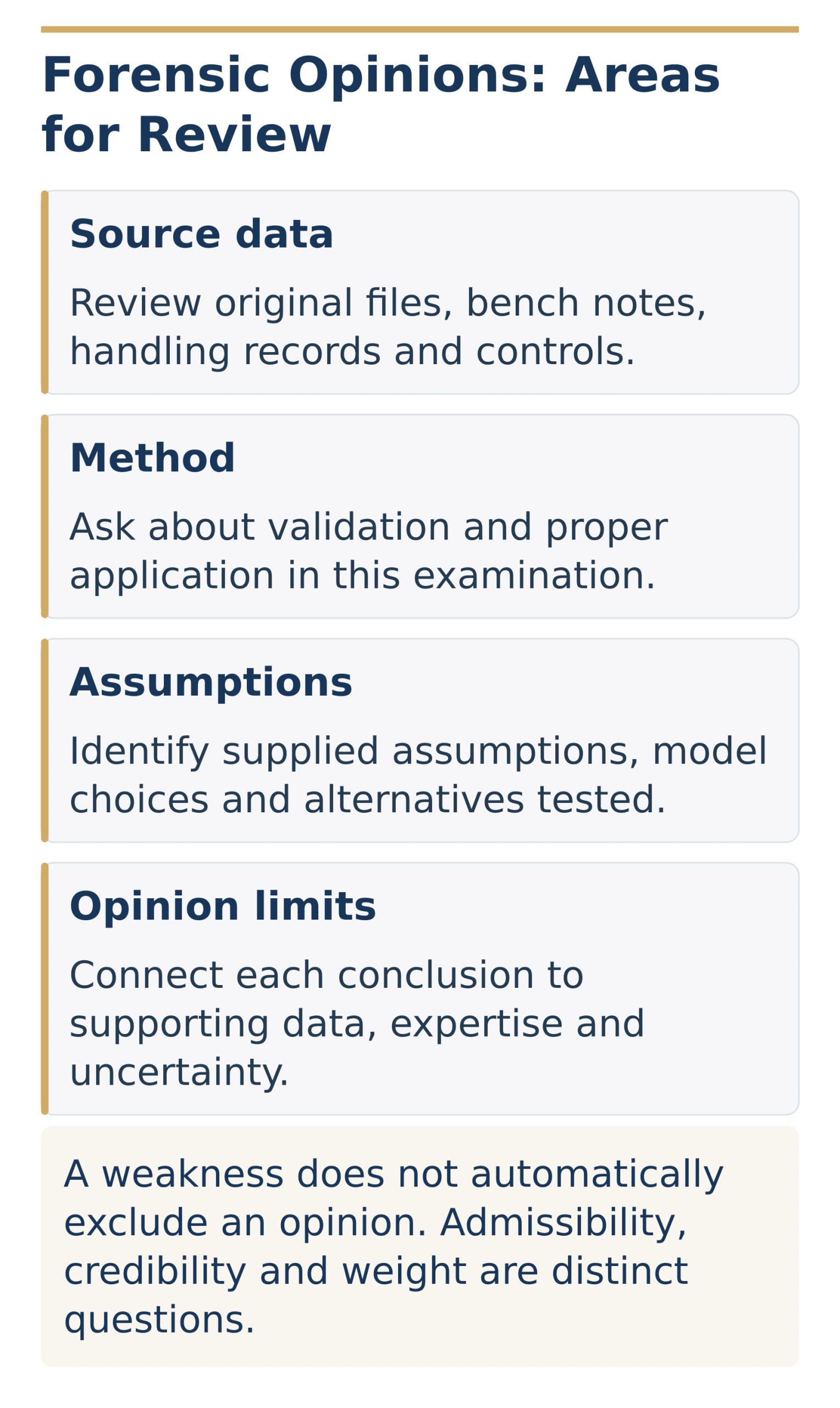
A gap in the file doesn’t mean the judge will exclude the opinion. An unvalidated method may call for a Rule 702 objection and a Kelly hearing. Unchecked facts under the opinion may call for a Rule 705(c) objection. A sound opinion with unexplained limits is a weight question for cross.
What can a family do while the lab work is under review?
Maybe your nephew keeps rereading page 2 of the lab report at the kitchen table. Maybe a friend who works in a hospital lab offers to “look it over.”
- Names of everyone who handled the item before police took it
- Dates the item was used, moved or cleaned
- Written questions about the report, for the lawyer
- Lab papers kept off social media and away from friends
Hand those notes to the lawyer, not to the lab or the detective.
Frequently asked questions
Does the defense need its own expert to cross-examine the State’s expert?
Not always. A consulting expert often helps your lawyer read the raw data and find the right questions, and the need depends on the evidence.
Can the judge keep a forensic opinion out entirely?
If the method isn’t shown to be reliable, or the opinion lacks a sufficient basis, the judge can exclude it under Rules 104(a), 702 and 705(c).
What if the expert has testified about this method many times?
Not by itself. Hernandez says earlier testimony doesn’t prove reliability, so the record in this trial has to support it.
When should the defense ask for the lab file?
Early. A timely art. 39.14 request gives a consulting expert time to read the raw data before trial.
Talk with Heath Hyde
If a lab report or expert opinion is central to the State’s case, the file behind it deserves a close look. Call Heath Hyde, P.C. at 903.439.0000 or request a free consultation. You can also read about what the State must prove in a Texas murder case, how causation and concurrent causation work, and the rest of the Texas Murder Trial Defense Knowledge Hub.
Legal sources
- Tex. R. Evid. 104, 702–705
- Tex. Code Crim. Proc. art. 39.14
- Beard v. State, No. 0282-00 (Tex. Crim. App. 2002)
- Weatherred v. State, No. 291-99 (Tex. Crim. App. 2000)
- Hernandez v. State, No. 2053-01 (Tex. Crim. App. 2003)
- NIST, Evidential Statistics
- NIST, Butler, DNA Error Rates (2016)
This article provides general educational information, not legal advice. Every case depends on its facts, evidence, court, deadlines and governing law. Past results do not guarantee a similar outcome.