
How Are Search Warrants for Phones Homes and Accounts Challenged?
The defense lines up what a judge approved against what officers actually searched. The gaps between the two can keep evidence out of a murder trial.
Mr. Heath Enix ‘Heath’ Hyde
Eligible to Practice in Texas
Attorney at Law
Bar Card Number: 00796807
TX License Date: 11/01/1996
Primary Practice Location: Dallas, Texas
Return to the Texas Murder Trial Defense Knowledge Hub
Short answer
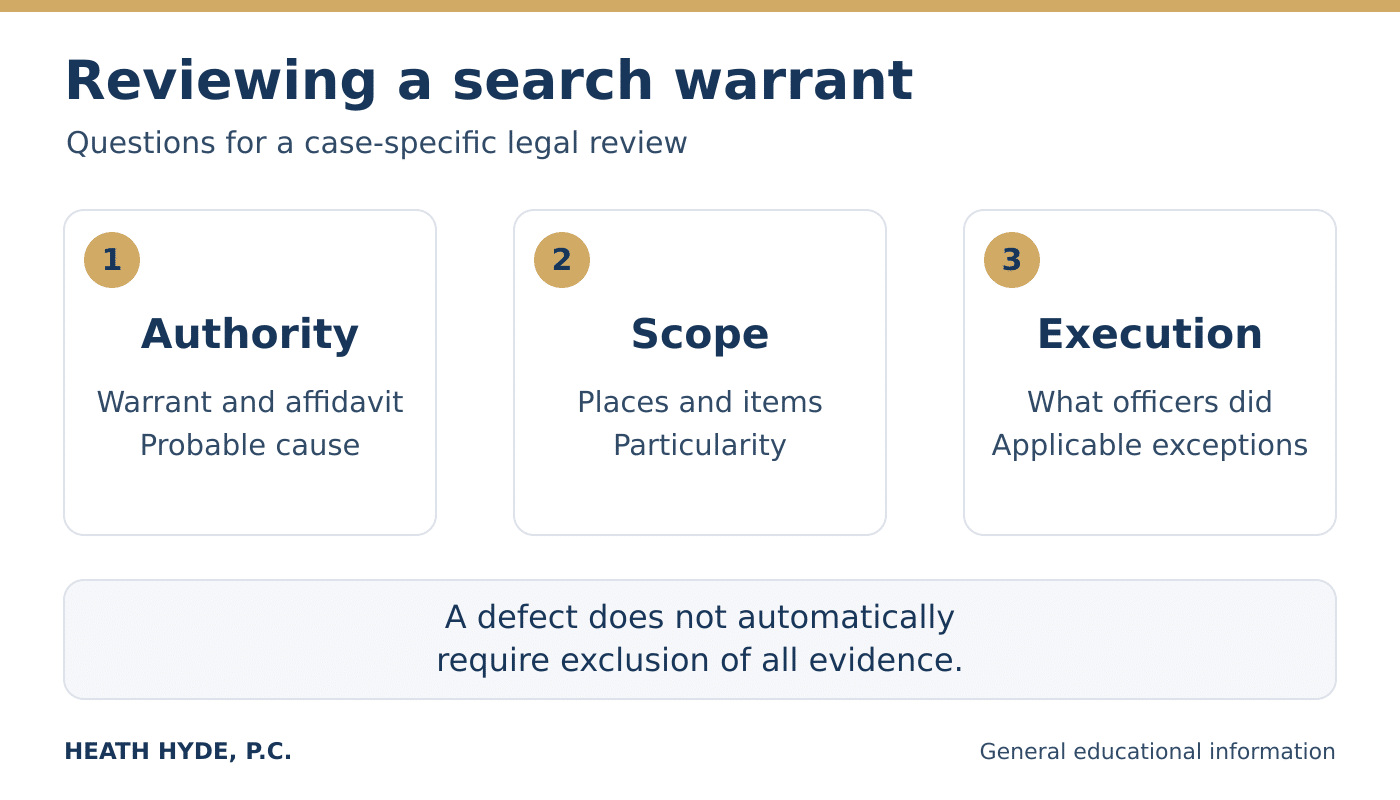
By comparing two things: what the judge approved, and what officers actually did. Where they don’t match, evidence can be kept out, though the case usually goes on.
| Paper in the packet | What the defense checks |
|---|---|
| The search warrant | The place, device, or account, and items allowed |
| The affidavit | The facts officers gave for probable cause |
| The return and inventory | What officers took, and when |
| Extraction report or provider production | What data officers actually pulled |
What to do now: Find any paper officers left behind after the search, put it in an envelope without writing on it, and give it to your lawyer.
What has to be on a Texas search warrant?
The copy left on the kitchen counter may be two pages and a stapled list. Each piece has a job under Chapter 18 of the Code of Criminal Procedure.
A filed affidavit comes first. Under CCP art. 18.01(b), it needs substantial facts establishing probable cause. The warrant itself has to identify, as near as may be, what’s to be seized and the person, place, or thing to be searched. That’s art. 18.04(2). Under art. 18.04(4), the magistrate must date and sign it.
| After the search | Rule |
|---|---|
| Inventory | Written, before property is taken, copy to the owner or possessor (art. 18.06(b)) |
| Return | Back to the court within three whole days (art. 18.10(a)) |
Not every slip helps, though. Under art. 18.10(a), a late return or a missing inventory doesn’t by itself keep the evidence out under art. 38.23.
Why is a phone harder to search than a house?
A phone extraction report can run 4,200 pages. The phone sits in a shielded box, cabled to a laptop, and years of a life come out at once. Phones get their own rules for that reason.
Riley v. California (2014) held that officers generally need a warrant to search a phone found on someone at arrest. Texas wrote its own version into CCP art. 18.0215.
| Texas rule | What it says |
|---|---|
| Art. 18.0215(a) | No phone search incident to a lawful arrest without a warrant |
| Art. 18.0215(b) | Only a judge in the agency’s district, or the phone’s likely location, can issue it |
| Art. 18.0215(d) | Exceptions: consent, reported stolen, fugitive with a felony warrant, immediate threat to life |
The emergency exception has a back end. After a fugitive or emergency search, art. 18.0215(e) has the officer apply for a warrant as soon as practicable. If the judge finds no qualifying situation and declines the warrant, the evidence isn’t admissible.
What if officers searched more than the warrant allowed?
Scope matters as much as the warrant. Your lawyer reads the file looking for places where the search ran past the paper.
| What the file shows | The question it raises |
|---|---|
| Warrant covers May 1–3 texts; extraction lists two years of photos | Did the search go beyond the approval? |
| Affidavit says the phone “likely contains evidence,” nothing more | Probable cause for that device? |
| Search at 2:15 p.m.; judge signed at 4:40 p.m. | Which exception applies, if any? |
| Warrant names Apartment 4B; officers also opened the storage unit downstairs | Was the storage unit described? |
How do police get online accounts and carrier records?
Data a company holds usually comes through a different door than the phone in an evidence bag.
Stored content means messages, photos, and similar files on a provider’s servers.
| Record | What officers need |
|---|---|
| Stored messages and photos | A district judge’s warrant on a probable-cause affidavit (arts. 18B.351(a), 18B.354) |
| Subscriber and account-use records | Subpoena, court order, warrant, or consent (art. 18B.351(b)) |
| Historical cell-site location | Generally a warrant (Carpenter v. United States, 2018) |
Article 18B.354(c) limits an account warrant to the data the affidavit describes. A request for May texts shouldn’t bring back a whole cloud account.
When can the defense attack the affidavit itself?
Take paragraph 7 of an affidavit: a neighbor saw “a gray Tahoe matching the suspect’s” at 11:40 p.m. The neighbor’s own recorded statement: “a dark SUV, maybe black.” The judge signed at 1:05 a.m.
Under Franks v. Delaware (1978), the defense has to make a substantial preliminary showing of three things:
- A false statement in the affidavit
- Put there knowingly and intentionally, or with reckless disregard for the truth
- Needed for the probable cause finding
Negligence won’t do. Neither will an innocent mistake. And the defense brings an offer of proof, such as affidavits or witness statements, or explains why it can’t.
What happens if the search was illegal?
Texas has its own exclusionary statute. Under CCP art. 38.23(a), evidence obtained in violation of the Texas or U.S. Constitution or laws can’t be admitted against the accused at trial.
The jury has a role too. When the evidence raises the issue, jurors must disregard evidence they believe, or have a reasonable doubt, was obtained illegally.
Two limits apply:
- Good faith. Under art. 38.23(b), the rule doesn’t apply when an officer relied in objective good faith on a warrant a neutral magistrate issued on probable cause.
- Standing. The defense generally has to show the search intruded on the accused’s own privacy or property.
Suppression reaches only the evidence tied to the violation. Your lawyer weighs what a motion would actually remove, against what the State must prove in a Texas murder case.
What can a family do after a search?
You may have seen more of the search than anyone outside the police. Maybe officers spent four hours in your son’s apartment and left a sheet of paper on the counter, and his girlfriend signed something at the door before anyone called you.
Write these down for the defense lawyer:
- The date, and the times officers arrived and left
- Any warrant, inventory, or consent form left behind
- The person who let them in, and anything signed
- Photos of each room after officers left
That list goes to your lawyer. Not the police.
Frequently asked questions
Can police keep my phone while they get a warrant?
Often. In Riley, both defendants conceded officers could seize and secure a phone while seeking a warrant. Searching what’s on it is the step that generally needs the warrant.
Does a mistake in the warrant get the case dismissed?
No. A wrong apartment number may lead to suppression of specific evidence, and the case can continue on other proof.
Who decides a motion to suppress?
The judge, usually at a pretrial hearing. Under art. 38.23, the jury can also decide a disputed fact about how police got the evidence, such as whether your nephew really signed a consent form.
Does a roommate’s consent cover a home search?
Not always. Whether someone else’s consent covered the search depends on the facts. Tell your lawyer who agreed, what they signed, and what officers said at the door.
Talk with Heath Hyde
If police searched a phone, a home, or an online account in a murder investigation, the warrant packet is one of the first things to review. Call Heath Hyde, P.C. at 903.439.0000 or request a free consultation. The post on the first 48 hours of a murder charge and the Texas Murder Trial Defense Knowledge Hub cover related steps.
Legal sources
- Tex. Code Crim. Proc. arts. 18.01, 18.04, 18.06, 18.10
- Tex. Code Crim. Proc. art. 18.0215
- Tex. Code Crim. Proc. arts. 18B.351, 18B.354
- Tex. Code Crim. Proc. art. 38.23
- Franks v. Delaware, 438 U.S. 154 (1978)
- Riley v. California, 573 U.S. 373 (2014)
- Carpenter v. United States, 585 U.S. 296 (2018)
This article provides general educational information, not legal advice. Every case depends on its facts, evidence, court, deadlines and governing law. Past results do not guarantee a similar outcome.