


BANK FRAUD · WIRE FRAUD
Can Bank Fraud and Wire Fraud Be Charged for One Application?
One loan application can show up in a bank fraud count and a wire fraud count. Which clause of § 1344 is charged, and which wire is named, decides what the government has to prove for each.
Eligible to Practice in Texas
Attorney at Law
Bar Card Number: 00796807
TX License Date: 11/01/1996
214 Connally St Ste A
Sulphur Spgs, TX 75482-2612
One $250,000 equipment loan in Longview can produce a bank fraud count under 18 U.S.C. § 1344 and a wire fraud count under § 1343. Each count has to meet its own elements. The bank fraud count looks at the lender, and the wire count looks at a single transmission.
The two bank fraud clauses
Kevin Loughrin went door to door in Salt Lake City posing as a Mormon missionary and stole checks from mailboxes. He altered six of them, made them out to Target and bought goods at a local store. Then he walked back in and returned the goods for cash. In Loughrin v. United States (2014), the Supreme Court upheld his § 1344(2) conviction without proof that he meant to defraud a bank.
For a fuller explanation of the two clauses, see the federal bank fraud guide.
Lawrence Shaw used the account numbers of a Bank of America customer, Stanley Hsu, to move Hsu’s money into accounts at other institutions. In Shaw v. United States (2016), the Court held that § 1344(1) reached the scheme because the bank has a property interest in its customers’ deposits.
| Clause | Text, in short | Supreme Court reading |
|---|---|---|
| § 1344(1) | Knowingly executing a scheme to defraud a financial institution | Shaw v. United States (2016): a bank has a property interest in deposited funds; no proof of final financial loss, or intent to cause one, is required |
| § 1344(2) | Knowingly executing a scheme to obtain money or property owned by, or in the custody or control of, a financial institution by false or fraudulent pretenses, representations or promises | Loughrin v. United States (2014): no intent to defraud the bank is required, but the false statement must be the means of obtaining the bank’s property |
The clause named in the count decides whether the lie has to reach the bank.
Loughrin read “by means of” to require that the lie be the mechanism that naturally induces a bank, or a custodian of bank property, to part with money in its control. A lie told only to a third party, which never reaches the bank, fits clause (2) poorly. Under 18 U.S.C. § 20, “financial institution” covers insured depository institutions, insured credit unions and mortgage lending businesses, among other categories.
Elements of a wire count
Section 1343 reaches a person who “transmits or causes to be transmitted” a wire in interstate or foreign commerce “for the purpose of executing” a scheme to defraud. A count names one transmission: an emailed bank statement, a portal upload or a funds transfer.
The federal wire fraud guide explains how to read the communication identified in a count.
For each charged wire:
| Question | Where the answer is |
|---|---|
| Who prepared the document? | Draft files and their metadata. |
| Who clicked upload? | The portal user log and the email login history. |
| Did it cross a state line? | Server location records and wire routing data. |
| Where does it fall between application and funding? | The loan file’s dated entries. |
Hypothetical: one equipment loan
- A Longview business owner applies for a $250,000 equipment loan at an insured community bank.
- He uploads tax returns through the bank’s portal, which runs on servers in another state.
- Prosecutors say the returns were altered to show higher income.
- The bank wires the loan proceeds to the equipment dealer.
If the indictment charges three counts off that one file:
- The § 1344(2) count turns on the credit memo, and on whether the altered return reached the bank and produced the loan.
- The upload count turns on the portal log and the hosting records.
- The proceeds-wire count turns on the wire instruction and the closing timeline.
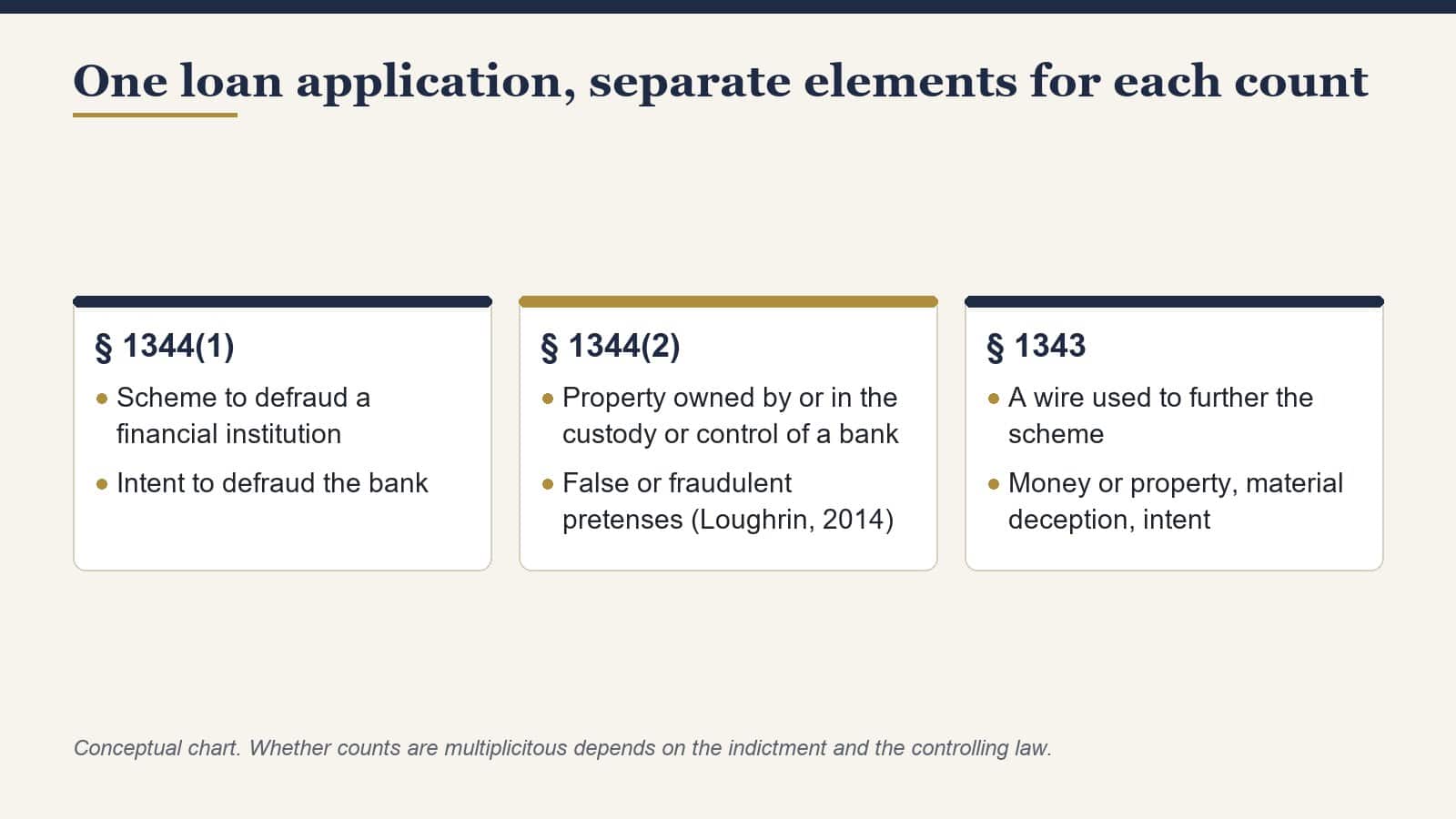
Can both counts stand?
Ellis Neder, a Jacksonville lawyer and developer, used inflated appraisals to get bank loans on land he’d flipped through shell companies. He hid his control of those companies and kept more than $7 million. He was indicted on 9 mail fraud, 9 wire fraud and 12 bank fraud counts. In Neder v. United States (1999), the Supreme Court held that “materiality of falsehood is an element” of all three statutes.
For a side-by-side approach, see how to compare bank and wire fraud counts.
Under Blockburger v. United States, two counts can stand if each statute “requires proof of an additional fact which the other does not.” Bank fraud’s extra fact is a financial institution, and wire fraud’s is an interstate wire. In the Longview file both counts usually survive, though multiplicity inside each statute still needs a check.
Section 3293 sets a 10-year limitation period for bank fraud and for wire fraud affecting a financial institution. Section 3282 sets the general period at five years.
Records to pull
- The application exactly as submitted, attachments included.
- The upload or email log with each document’s sender, time and server.
- The credit memo, approval record and underwriting guidelines.
- The disbursement ledger showing where the loan funds went.
- Every draft exchanged with the broker or preparer. The earliest draft with the disputed figure often shows who typed it.
Common questions
If I lied to a broker, not the bank, is that bank fraud?
It depends on the clause. Loughrin requires that a § 1344(2) false statement be the means of obtaining bank property, which usually means the lie reaches the bank.
I paid the loan back. Does that end the case?
Not by itself. In Shaw, the Supreme Court held that § 1344(1) doesn’t require proof that the bank suffered a final financial loss.
Does the false number have to matter to the bank?
Yes. Neder made materiality an element, so the government has to show the figure could influence the lender’s decision.
Sources
- 18 U.S.C. § 1343
- 18 U.S.C. § 1344
- 18 U.S.C. § 20
- 18 U.S.C. § 3282
- 18 U.S.C. § 3293
- Loughrin v. United States, 573 U.S. 351 (2014)
- Shaw v. United States, 580 U.S. 63 (2016)
- Blockburger v. United States, 284 U.S. 299 (1932)
- Neder v. United States, 527 U.S. 1 (1999)
This article provides general information, not legal advice. The law and its application depend on the facts and the law in effect on the relevant date. Consult a lawyer about a specific matter.