
Can Texas Prosecutors Seek the Death Penalty in Every Capital Murder Case?
A capital murder indictment opens two possible sentences. Whether death is one of them depends on the State’s choice, on who the accused is, and on what role the State can prove.
Mr. Heath Enix ‘Heath’ Hyde
Eligible to Practice in Texas
Attorney at Law
Bar Card Number: 00796807
TX License Date: 11/01/1996
Primary Practice Location: Dallas, Texas
Return to the Texas Murder Trial Defense Knowledge Hub
No. A capital murder indictment does not mean the State is seeking death. Under Penal Code §12.31(a) the punishment depends on whether the State seeks the death penalty, and a person who was under 18 at the time of the offense receives a life sentence.
A grand jury returns a capital murder indictment on a Tuesday. The family reads “capital” on the paper and assumes the State has already asked for death. It hasn’t, and in some cases it can’t.
Penal Code §19.03(b) makes every capital murder “a capital felony.” Section 12.31(a) then turns on whether “the state seeks the death penalty.” If it does, the punishment is death or life without parole. If it doesn’t, an adult gets life without parole and a person who was under 18 gets life.
Who makes the choice, and when?
Say the prosecutor tells the judge at the first setting that her office hasn’t decided about death. No rule makes her decide that morning.
The decision is the State’s. I haven’t found a list of factors in the Code of Criminal Procedure that a district attorney must weigh, or a deadline for choosing.
What the Code does is tie consequences to paperwork.
| Provision | What it turns on |
|---|---|
| Art. 26.052(e) | Two appointed lawyers for an indigent client “as soon as practicable after charges are filed.” |
| Art. 38.43(j) | A DNA meet-and-confer, unless the State “has affirmatively waived the death penalty in writing.” |
| Art. 1.13(b) | A jury waiver after a no-death notice, with the prosecutor’s consent “in writing and in open court.” |
| Penal Code §12.31(b) | If notice comes before voir dire, jurors hear the State isn’t seeking death and the sentence is mandatory. |
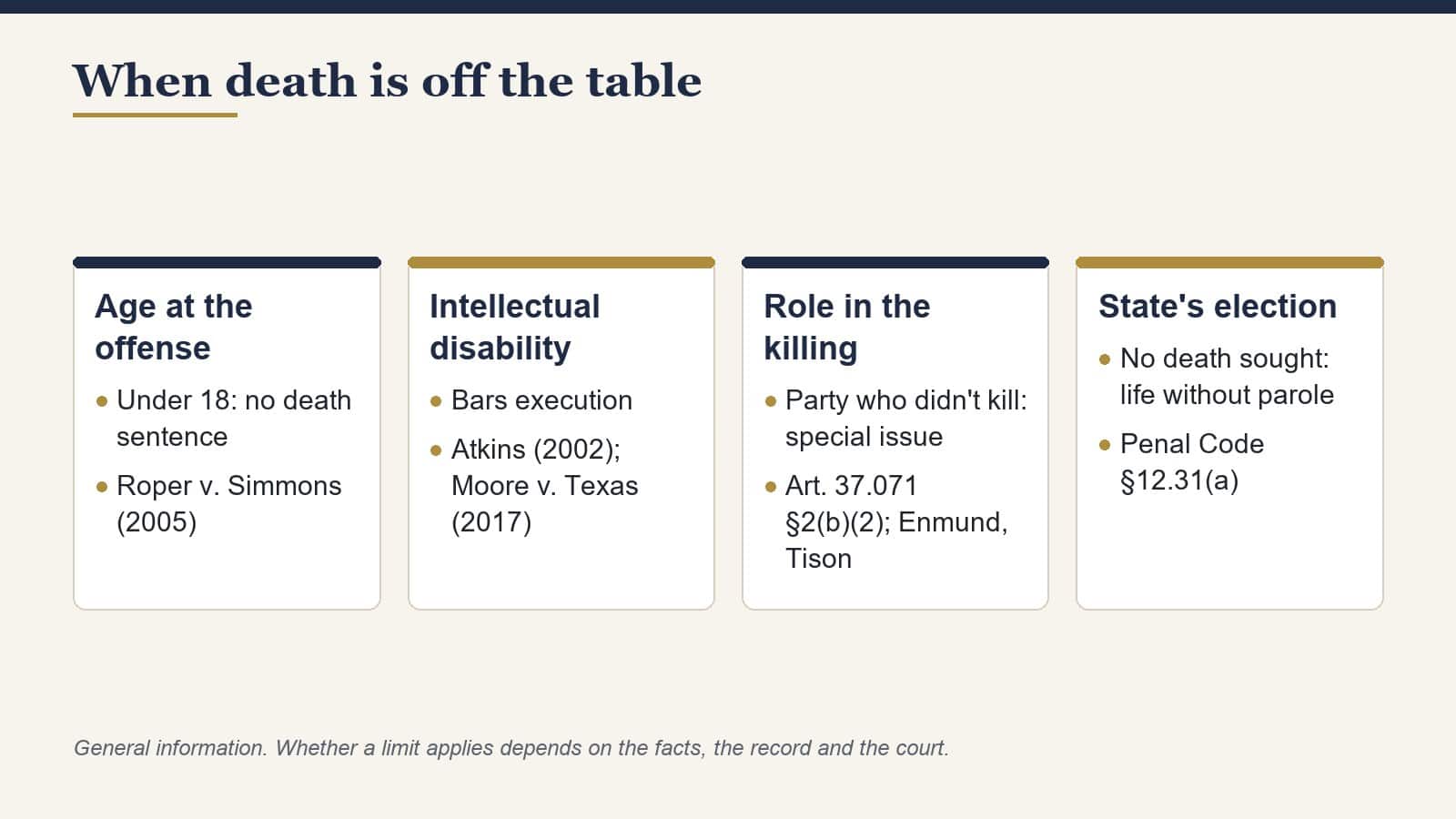
When the law takes death off the table
Some limits don’t depend on anyone’s discretion.
| Limit | Source | What the defense gathers early |
|---|---|---|
| Under 18 at the offense | Roper v. Simmons (2005); Penal Code §8.07(c) | A certified birth record fixing age on the offense date |
| Intellectual disability | Atkins v. Virginia (2002); Moore v. Texas (2017) | School testing, special-education files, prior IQ scores |
| Charge rests only on §19.03(a)(9) | Art. 37.071, §1(b) | The indictment’s exact paragraph |
Two Supreme Court cases sit behind the first two rows.
Christopher Simmons was 17 when he and a friend bound Shirley Crook with duct tape and threw her from a railroad trestle into the Meramec River in Missouri. He turned 18 about nine months later, before his trial, and was sentenced to death. In 2005 the Supreme Court, 5 to 4, barred “the death penalty on offenders who were under the age of 18 when their crimes were committed.”
Penal Code §8.07(c) says the same thing: “No person may, in any case, be punished by death for an offense committed while the person was younger than 18 years.”
Daryl Atkins and an accomplice abducted Eric Nesbitt in Virginia in August 1996, took him to an ATM, then shot him eight times. A defense psychologist measured Atkins’s full-scale IQ at 59. The Supreme Court held in 2002 that executing people with intellectual disability is cruel and unusual punishment. It left states to develop “appropriate ways to enforce the constitutional restriction.”
Bobby James Moore was 20 when he shot a clerk during a 1980 Texas grocery robbery. A state habeas court found him intellectually disabled. The Court of Criminal Appeals rejected that finding under the Ex parte Briseno factors. In 2017 the Supreme Court called those factors “an invention of the CCA untied to any acknowledged source” and vacated the ruling. The medical community’s current diagnostic framework has to inform the analysis.
The Code of Criminal Procedure has no separate intellectual-disability chapter, so the issue is litigated under these cases.
When the accused didn’t do the killing
Thomas and Eunice Kersey were 86 and 74 when two men shot them at their central Florida farmhouse in 1975. Earl Enmund was in a car about 200 yards away, waiting to drive the robbers off. Two other men, the Armstrongs, fired the shots, and there was no direct evidence that Enmund intended anyone to die. In 1982 the Supreme Court held his death sentence unconstitutional.
On July 30, 1978, Ricky and Raymond Tison, 20 and 19, carried a chest of guns into the Arizona State Prison at Florence. They armed their father, Gary, and his cellmate Randy Greenawalt, and all of them drove off. When their car blew a tire in the desert, Raymond flagged down John Lyons, who was driving with his wife, his 2-year-old son and his 15-year-old niece.
Gary Tison and Greenawalt shot all four. Neither brother fired, and Arizona sentenced both to death anyway, under its felony-murder and accomplice laws. Five justices said in Tison v. Arizona (1987) that “major participation” in the felony plus “reckless indifference to human life” can be enough. The cases went back to Arizona.
Penal Code §7.02(b) makes a conspirator guilty of another’s felony “though having no intent to commit it,” if it “should have been anticipated.” That can support a capital conviction.
Art. 37.071, §2(b)(2) adds a Texas question at punishment. If the jury could convict as a party, it must also find the defendant caused the death, “intended to kill the deceased or another or anticipated that a human life would be taken.”
Take a pickup sale that goes wrong:
- A 20-year-old arranges it, paying with counterfeit cash.
- His co-defendant brings a pistol he says he never saw.
- At the shot, he runs for the car.
- His phone has no texts about a gun.
Twelve jurors could convict him as a party and still answer “no” on §2(b)(2).
Under §2(g), a “no” on future dangerousness or on the anti-parties issue, a “yes” on mitigation, or a jury that can’t answer, all lead to life without parole. Party liability at the guilt stage has its own article: can someone be convicted of murder under the Texas law of parties.
These are the records I’d want in the file before the State decides:
- the indictment, marked by §19.03(a) paragraph
- a certified birth record set beside the offense date
- school testing and special-education files, requested by name
- the client’s phone records for the day of the offense
How a death trial then differs, from jury selection through automatic appeal, is covered in our article on what is different about a death penalty trial. The basics of the charge are in what makes a murder charge capital murder in Texas.
Common questions
If the State doesn’t seek death, is life without parole automatic?
For an adult, §12.31(a)(2) makes it life without parole. Someone who was under 18 at the offense gets life under §12.31(a)(1), and the jury can still convict of a lesser offense under §19.03(c).
My son was 17. Could he ever be paroled?
He’d get life, not life without parole. Government Code §508.145(b) bars parole until he has served 40 actual calendar years, with no good conduct credit.
Can the defense ask the prosecutor not to seek death?
The defense can, usually in a letter backed by records. No statute gives the defense a hearing on it, and the decision stays with the State.
Sources
- Tex. Penal Code §§7.02, 8.07, 12.31, 19.03
- Tex. Code Crim. Proc. arts. 1.13, 26.052, 37.071, 38.43
- Tex. Gov’t Code §508.145
- Roper v. Simmons, 543 U.S. 551 (2005)
- Atkins v. Virginia, 536 U.S. 304 (2002)
- Moore v. Texas, 581 U.S. 1 (2017)
- Enmund v. Florida, 458 U.S. 782 (1982)
- Tison v. Arizona, 481 U.S. 137 (1987)
This article provides general information, not legal advice. The law and its application depend on the facts and the law in effect on the relevant date. Consult a lawyer about a specific matter.