
What Does It Mean to Prepare for Trial While Evaluating Resolution?
The defense keeps building the trial case while it weighs any offer. That trial work is how anyone can judge an offer at all.
Mr. Heath Enix ‘Heath’ Hyde
Eligible to Practice in Texas
Attorney at Law
Bar Card Number: 00796807
TX License Date: 11/01/1996
Primary Practice Location: Dallas, Texas
Return to the Texas Murder Trial Defense Knowledge Hub
Short answer
A plea offer can show what the State is willing to give up today. It can’t show how the evidence would hold up in front of a jury. So the defense keeps preparing for trial while it weighs any offer, and the accused makes the final call.
| What a family may hear | What it may actually mean |
|---|---|
| “Talking about a plea means he’s guilty.” | Weighing offers is part of the job. |
| “Twenty-five years is a good deal.” | Only next to a realistic trial picture |
| “It expires Friday.” | Ask whether more time is possible. |
| “If he says no, it’s over.” | The trial track never stopped. |
What to do now: Ask the lawyer for every offer in writing, with its deadline at the top.
Why keep preparing for trial during negotiations?
Say the State offers 25 years three months before trial. Nobody can say whether that’s a good offer without knowing what a jury would see.
Under Guideline 6.1(A) of the State Bar’s Performance Guidelines, counsel shouldn’t recommend a plea until the investigation and study of the case are done. Guideline 6.3(A) says a recommendation shouldn’t rest solely on the client’s admission of guilt, or solely on a favorable offer. Under Guideline 6.2(B), counsel and client should know the minimum and maximum punishment, and any enhancements, before negotiating.
The discovery statute adds a checkpoint. Under CCP art. 39.14(j), before a plea or trial, each side must acknowledge, in writing or on the record, what discovery was disclosed and received.
Say that in March, the defense finds that a key witness changed her statement after talking to a relative. In April, its pathologist says the autopsy doesn’t rule out a fall. Both facts may support pushing for a better offer, such as a plea to manslaughter. Both are ready for cross-examination either way.
Preparation can cut the other way, too. If video confirms the State’s timeline, the offer may be more worth considering, and the lawyer should say so.
What should you look at in a plea offer?
Say the offer is a single printed page on the conference table. The lawyer reads it line by line with your son.
- the charge: murder, or a lesser included offense like manslaughter
- punishment: an agreed number of years, or an open plea to the judge
- other terms, such as a deadly weapon finding or restitution
- later effects, including parole eligibility and appeal rights
The charge sets the range.
| Offense | Punishment range |
|---|---|
| Murder, a first-degree felony | 5 to 99 years or life (§12.32) |
| Murder with a sudden passion finding | Second-degree under §19.02(d): 2 to 20 years (§12.33) |
| Manslaughter | Generally a second-degree felony (§19.04(b)) |
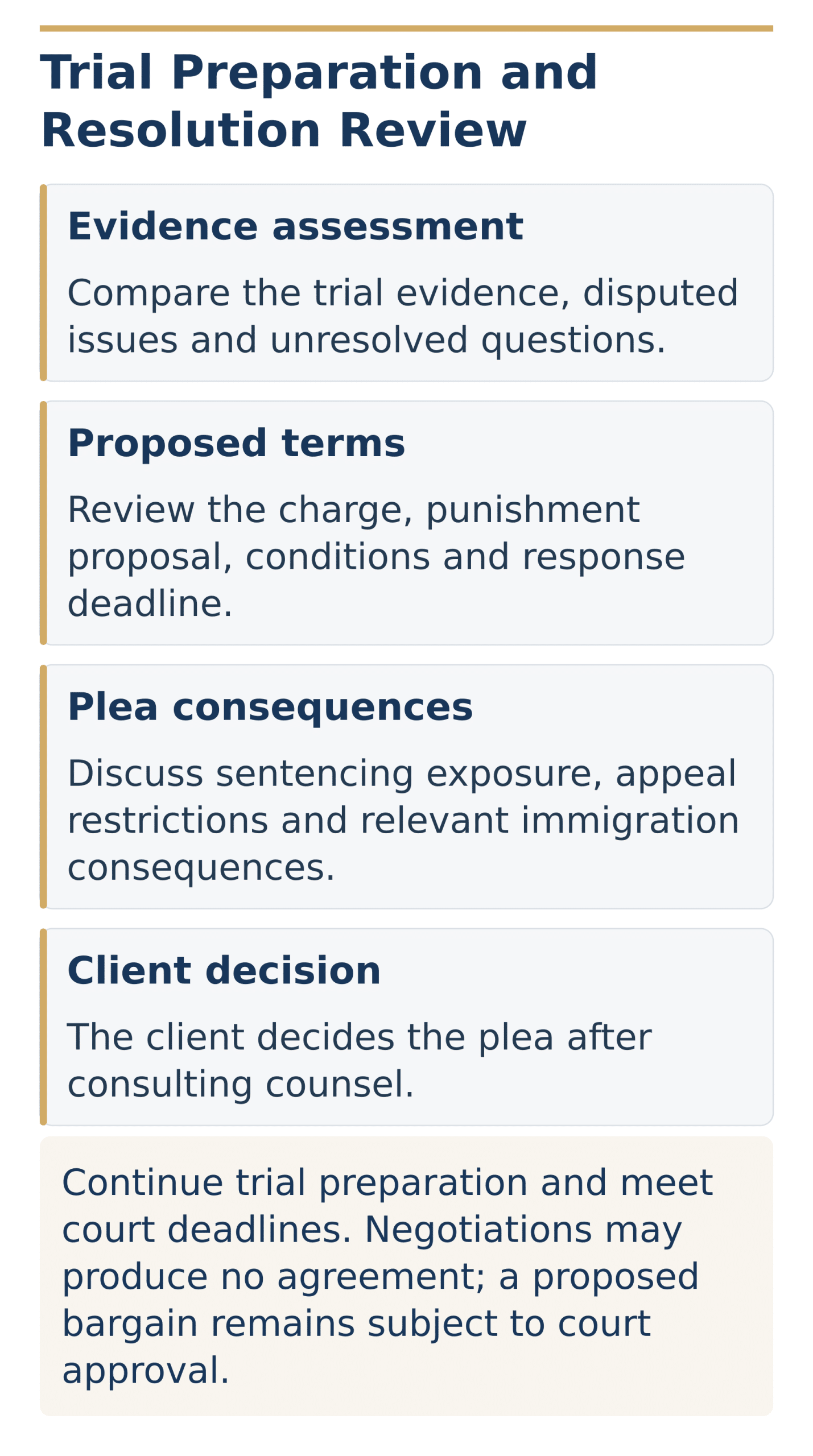
Who decides whether to take a plea?
The client does, after talking it through with the lawyer. Disciplinary Rule 1.02(a)(3) says the lawyer must follow the client’s decision about the plea, after consultation.
Under Rule 1.03, comment 1, a lawyer who receives a plea offer should promptly tell the client its substance. The exception is when earlier talks made clear the client would reject it.
In Missouri v. Frye (2012), the Supreme Court held that, as a general rule, counsel must communicate formal plea offers that may be favorable. In Padilla v. Kentucky (2010), it held that counsel must tell a noncitizen client whether a plea carries a deportation risk.
What to do now: If the accused isn’t a U.S. citizen, tell the lawyer today. That fact changes how any offer gets weighed.
What does the judge do with a plea bargain?
At the plea hearing, your son stands at the bench in a borrowed jacket, and the judge starts reading the admonishments from a printed form. The judge isn’t bound by the deal, and art. 26.13 gives him a way out if the judge rejects it.
| CCP art. 26.13 | What the court must do |
|---|---|
| (a)(1) | Admonish him of the punishment range. |
| (a)(2) | Say the deal isn’t binding; allow withdrawal if rejected. |
| (a)(3) | Explain that an agreed sentence limits appeal. |
| (a)(4) | Warn a noncitizen about immigration consequences. |
| (b) | Accept only a competent, free, and voluntary plea. |
- (a)(2): the court announces whether it’ll follow the agreement before any finding on the plea.
- (a)(3): if the sentence doesn’t exceed the agreed recommendation, an appeal needs the court’s permission, except for matters raised by written pretrial motions.
- (a)(4): the warning covers deportation, exclusion, and denial of naturalization.
What happens if there’s no deal?
The trial track never stopped, so a “no” just means staying on it:
| When | What happens |
|---|---|
| A Tuesday in May | Your son turns down the offer |
| Already in the file | Witness interviews, expert reports, cross outlines |
| 20th day before jury selection | Testifying experts named, on a timely request (CCP art. 39.14(b)) |
| Before trial | Rulings on motions to suppress or exclude evidence |
| First week of August | Jury selection, with questions and a strike plan ready |
If the State makes a new offer along the way, your son still decides.
What can a family do while an offer is pending?
Maybe your aunt thinks 25 years is a gift, and your brother thinks it’s an insult. Maybe your son calls home every night asking what everyone thinks.
Keep these ready for the lawyer:
- A copy of the written offer
- The offer’s deadline on the family calendar
- Your questions about parole and appeal
- Any facts about citizenship or immigration status
Then let your son decide, with the lawyer, and back whatever he chooses.
Frequently asked questions
Does talking about a plea mean the lawyer thinks I’m guilty?
Evaluating an offer is part of the job. The lawyer should still be preparing for trial.
Can I reject an offer and still go to trial?
The decision is yours, and rejecting an offer doesn’t end the defense.
Can I take back a guilty plea if the judge won’t follow the deal?
Under art. 26.13(a)(2), if the court rejects the plea agreement, you must be allowed to withdraw the plea.
Can I get probation on a murder plea?
It depends on the charge and the terms. See whether a person charged with murder can receive probation.
Talk with Heath Hyde
If there’s an offer on the table, or you expect one, bring the paperwork and your questions. Call Heath Hyde, P.C. at 903.439.0000 or request a free consultation. The hub section on preparing for trial while considering a resolution covers related topics.
Legal sources
- Tex. Code Crim. Proc. art. 26.13
- Tex. Code Crim. Proc. art. 39.14
- Tex. Penal Code §§19.02, 19.04
- Tex. Penal Code §§12.32, 12.33
- Tex. Disciplinary R. Prof’l Conduct 1.02, 1.03
- Missouri v. Frye, 566 U.S. 134 (2012)
- Padilla v. Kentucky, 559 U.S. 356 (2010)
- State Bar of Texas, Performance Guidelines for Non-Capital Criminal Defense
This article provides general educational information, not legal advice. Every case depends on its facts, evidence, court, deadlines and governing law. Past results do not guarantee a similar outcome.