

Why Does First Chair Jury Trial Experience Matter?
The first-chair lawyer makes the calls in front of the jury. Here’s what that seat involves, what Texas law says about it, and what a trial count can’t tell you.
Mr. Heath Enix ‘Heath’ Hyde
Eligible to Practice in Texas
Attorney at Law
Bar Card Number: 00796807
TX License Date: 11/01/1996
Primary Practice Location: Dallas, Texas
Return to the Texas Murder Trial Defense Knowledge Hub
Short answer
First-chair experience can show what a lawyer has actually done in front of a jury, not just watched. It can’t predict a verdict in your case. So you ask which trials the lawyer personally led, check them in court records, and ask how they’d prepare this one.
| What a website may say | What it may not show |
|---|---|
| “Dozens of jury trials” | Which were murder cases, or as lead |
| “Handled hundreds of homicides” | Whether any went to trial |
| A list of wins | How those cases differ from yours |
| The firm’s combined record | Who’ll handle your case |
What to do now: Ask each lawyer you meet for three jury trials they led as first chair, with the county and year.
What does the first-chair lawyer actually do?
A detective on the stand starts to repeat what an absent witness told him. The first-chair lawyer has a second or two to object and name the ground. That’s the job, stage after stage.
First chair is the lawyer who leads the trial and makes the final calls. Second chair assists and may handle some witnesses. “Counsel of record” only means the name is on the case. “Trial to verdict” means a jury decided it, not a plea or a dismissal.
The State Bar’s Performance Guidelines for Non-Capital Criminal Defense walk through each stage.
| Trial stage | What the lead lawyer handles |
|---|---|
| Jury selection (7.2) | Tailored questions and juror challenges |
| Opening (7.3) | What the evidence should show |
| State’s case (7.4) | Cross-examination and objections |
| Defense case (7.5) | Whether to put on a case, with the client |
| Closing (7.6) | Tying the evidence to reasonable doubt |
| Jury charge (7.7) | Requested instructions and objections |
Under Guideline 7.5, the client alone decides whether to testify. The charge requests can include lesser included offenses. A Texas murder trial may also have a separate punishment phase with its own witnesses and arguments.
Three moments from a hypothetical trial that land on the lead lawyer:
- Day two of jury selection: Juror 14 says she “could probably be fair.” More questions, or a strike?
- Day five: the State’s expert concedes a point on cross. Stop there, or press?
- Charge conference: the judge denies a requested instruction. The objection goes on the record, clearly.
Does Texas law treat trial experience as a qualification?
In one setting, yes. When a county appoints lead counsel in a death-penalty case, the statute spells out trial experience.
| Source | What it says |
|---|---|
| CCP art. 26.052(d)(2)(E) | Death-penalty lead counsel must have tried a significant number of felonies to verdict as lead, including homicides. |
| CCP art. 26.052(d)(2)(F) | Trial experience with mental health or forensic experts and penalty-phase mitigation |
| Guideline 1.2(B) | Complex cases only after experience or training in simpler ones |
Article 26.052(d)(2)(E) and (F) set what the appointment standards must require. They apply to appointed counsel in death-penalty cases, not to every murder case.
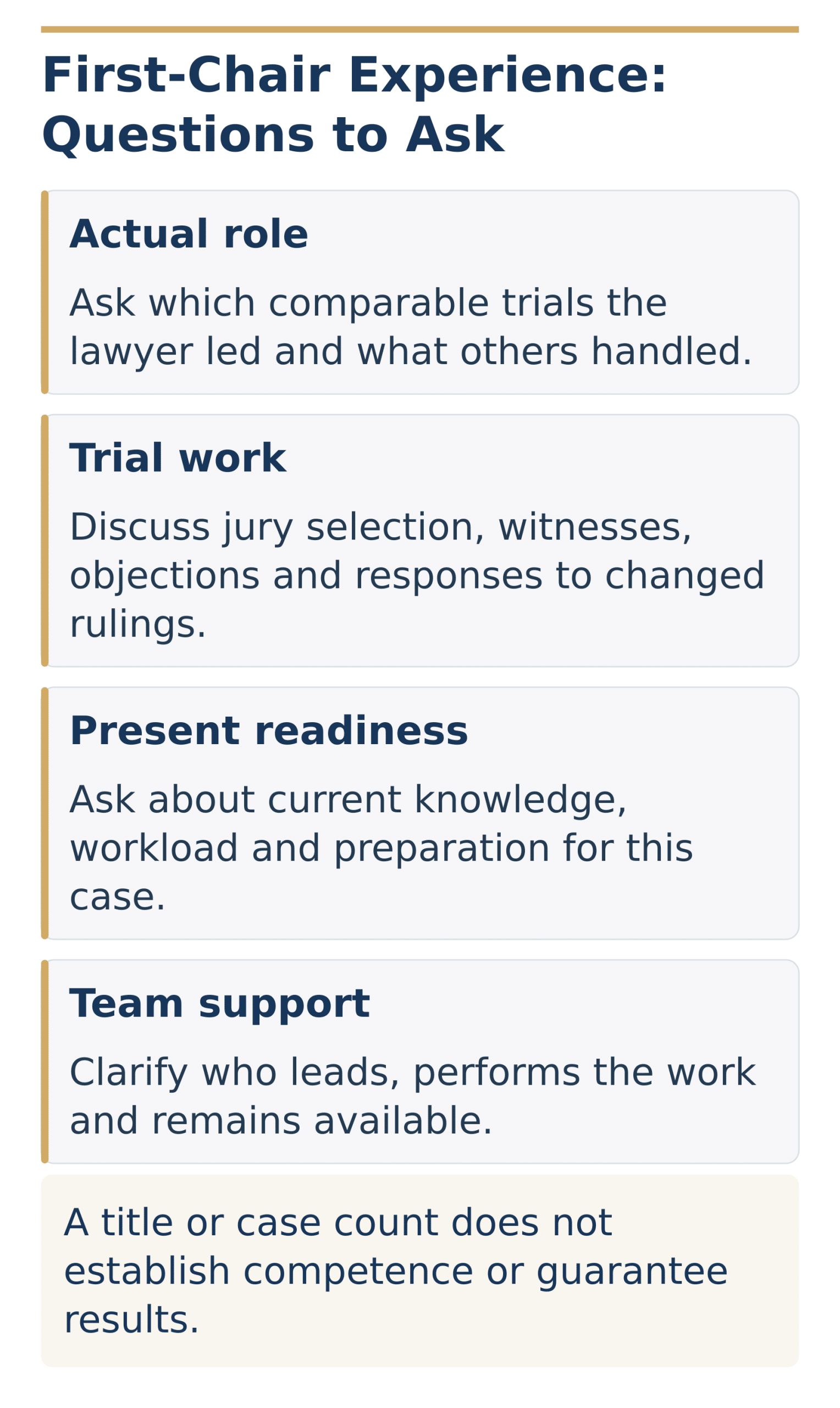
The professional rules speak to competence more generally. Comment 2 to Rule 1.01 weighs complexity, experience in the field, and preparation. Comment 3 says a newly admitted lawyer can be as competent in some matters as a lawyer with long experience. Comment 6 says a lawyer’s workload should be controlled so each matter gets diligent attention.
Experience is one factor, weighed alongside preparation and complexity. A lawyer stretched across many trials has less time for yours.
Does trial experience matter if the case might settle?
It can, because an offer is only as good as the trial it replaces. Say the State offers a plea to a lesser charge 14 days before trial. The lawyer has to judge how the evidence would actually play in front of 12 jurors before advising on it.
Performance Guideline 6.1(A) says counsel shouldn’t recommend a plea until the investigation and study of the case are done. A prosecutor who expects the defense to plead has less reason to take the case’s weak spots seriously. If the case doesn’t settle, the same preparation becomes the trial plan.
How do you check what a lawyer says about trials?
A lawyer tells you, “I tried a murder case in Gregg County in 2021.” That one can be checked:
- get the defendant’s name or the cause number
- search Gregg County’s court records for it
- raise it at the next meeting if the records name a different lead lawyer
| Ask | How to check it |
|---|---|
| Which trials did you lead, where, and when? | County court records |
| Defense counsel or prosecutor? | The case file and the judgment |
| Who’ll be first chair here? | Get the answer in writing. |
| How many trials are set before ours? | Compare with the court’s settings. |
Both prosecution and defense work are trial experience, but the roles are different. Ask which witnesses and arguments the lawyer personally handled, too.
What can a family do while comparing trial lawyers?
Maybe your brother has a list of five names from friends at work. Maybe one lawyer’s website lists “50 trials” and another’s lists none, and your mother wants to hire whoever calls back first on Saturday.
Give each lawyer one page. Across the top goes every trial the lawyer led as first chair, with the county and year. Under each one goes the court record that matches, or a blank. At the bottom go the names of first and second chair for your case, and how many trials are set ahead of it. A blank line is the next question to ask.
Frequently asked questions
Is a former prosecutor’s trial experience the same as defense experience?
Not exactly. It’s real trial experience, but the job differs, so ask what defense trials the lawyer has also led.
Does a second-chair lawyer on the team matter?
It can. Ask what that lawyer will handle and whether they’ll be at every setting.
Can a lawyer’s past results be guaranteed to repeat?
Texas disciplinary rules treat statements likely to create unjustified expectations about results as misleading, and past outcomes don’t predict yours.
Where can I check what a lawyer says?
The State Bar of Texas profile, the Texas Board of Legal Specialization, and county court records are good places to start.
Talk with Heath Hyde
If you’re comparing lawyers for a murder case, bring your questions and ask for answers you can check. Call Heath Hyde, P.C. at 903.439.0000 or request a free consultation. The hub section on choosing a lawyer for a murder case covers related questions.
Legal sources
- Tex. Code Crim. Proc. art. 26.052
- Tex. Disciplinary R. Prof’l Conduct 1.01, 7.01
- State Bar of Texas, Performance Guidelines for Non-Capital Criminal Defense
This article provides general educational information, not legal advice. Every case depends on its facts, evidence, court, deadlines and governing law. Past results do not guarantee a similar outcome.