EMAIL FRAUD · TEXAS CHARGES
What Texas Charges Can Arise from an Email Fraud Scheme?
Texas has no state version of federal wire fraud. A spoofed invoice or a hijacked inbox gets charged under a specific Penal Code section, and each section has its own elements.
Eligible to Practice in Texas
Attorney at Law
Bar Card Number: 00796807
TX License Date: 11/01/1996
214 Connally St Ste A
Sulphur Spgs, TX 75482-2612
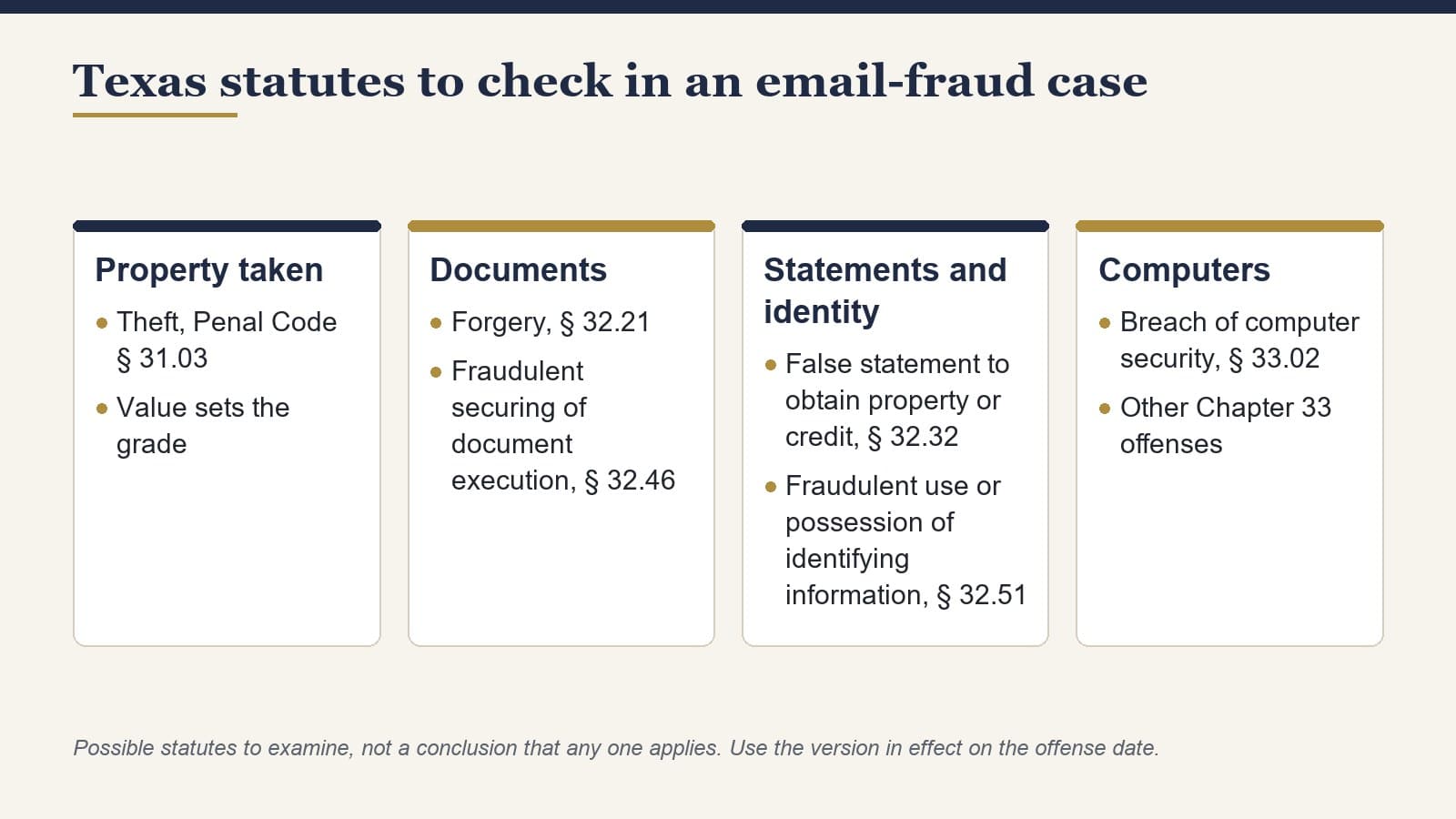
An email fraud scheme can be charged in Texas under several Penal Code sections, depending on the facts. Theft under § 31.03, forgery under § 32.21, fraudulent use or possession of identifying information under § 32.51, and the computer offenses in Chapter 33 are among them. The grade usually turns on the value taken or the number of items involved.
Hypothetical, an oilfield supply company in Longview:
At 8:52 a.m. on February 10, 2026, an email from a look-alike vendor domain says the vendor changed banks. By 1:15 p.m. the bookkeeper has wired $64,500 to a credit union account in Dallas. Two $900 invoices go to the same account on February 24. On April 2, police seize a laptop holding a scan of the vendor owner’s driver’s license.
Texas has no offense called email fraud. No Penal Code section copies federal wire fraud under 18 U.S.C. § 1343 either. The prosecutor picks a section, and the February 10 email becomes evidence of that section’s elements.
Six sections that fit an email scheme
Each section has its own key words and its own way of setting the grade.
| Section (caption) | Key words | Grade set by |
|---|---|---|
| § 31.03 (Theft) | “unlawfully appropriates property with intent to deprive the owner of property”; consent “induced by deception or coercion” isn’t effective (§ 31.01(3)(A)). | Value. |
| § 32.21 (Forgery) | Forging a writing “with intent to defraud or harm another.” | The kind of writing. |
| § 32.32 (False Statement to Obtain Property or Credit or in the Provision of Certain Services) | A “materially false or misleading written statement” made to get property or credit. | Value. |
| § 32.46 (Fraudulent Securing of Document Execution) | Causing a person, “without that person’s effective consent,” to sign a document affecting property, a service or a pecuniary interest. | Value. |
| § 32.51 (Fraudulent Use or Possession of Identifying Information) | Obtaining, possessing, transferring or using another person’s identifying information without consent, with intent to harm or defraud. | Number of items. |
| § 33.02 (Breach of Computer Security) | Accessing a computer “without the effective consent of the owner.” | Class B misdemeanor; (b-2) grades by amount when there’s intent to defraud or harm. |
Where the Longview facts point
Her consent doesn’t count. A lie is what got the $64,500, and § 31.01(3)(A) says consent “induced by deception” isn’t effective.
- The wire followed the email: § 31.03. Still open: who sent the email, and the intent to deprive.
- A license scan on the seized laptop: § 32.51. Still open: intent to harm or defraud, and the item count.
- A login to the vendor’s real mailbox, if the State can show one: § 33.02. Still open: access without the owner’s effective consent.
- An altered invoice PDF, if one turns up: § 32.21. Still open: a writing forged as § 32.21(a) defines it.
Not one of those facts proves who typed the email.
Putting a person behind the account
A message leaves an account. A person has to be tied to that account by records like these:
- the native email file with full headers, the sending server and the reply-to address
- the provider’s login history for 8:52 a.m. on February 10, with IP addresses and device IDs
- the warrant or subpoena return that produced those logs
- the name of everyone who knew the mailbox password
- the extraction report and hash values for the April 2 laptop
- the vendor contract and past invoices, which show what was really owed
- the police report with each date and amount the State alleges
Dollar figures and the grade
How the Longview numbers grade:
- Theft, § 31.03(e): the value taken. The wire alone is $64,500.
- Aggregation, § 31.09: “one scheme or continuing course of conduct” lets the State add the two $900 invoices, for $66,300.
- Identifying information, § 32.51(c): the number of items on the seized scan sets the grade.
- Computer access, § 33.02(b-2): from a Class C misdemeanor under $100 to a first-degree felony at $300,000 or more.
I’d match each figure to its wire confirmation before accepting the $66,300.
Gamble and a second prosecution
The facts of Gamble v. United States (2019):
- November 2015: a Mobile, Alabama officer stops Terance Gamble for a damaged headlight and finds a loaded 9-mm handgun.
- Gamble has a prior robbery conviction and pleads guilty under Alabama’s felon-in-possession law.
- Federal prosecutors then charge the same gun under 18 U.S.C. § 922(g)(1).
The Court held 7–2 that a crime against two sovereigns is two offenses. For the Longview file:
- A Texas plea or dismissal doesn’t bar a federal wire fraud case under § 1343.
- The Texas sections and § 1343 have different elements, so each case gets its own element chart.
Which version and which county
- Texas amends these sections often. Apply each one as it read on the alleged offense date, shown in the amendment history at the foot of the section.
- Venue: the email was opened in Longview, and the $64,500 landed in Dallas. The sender’s location data and the receiving branch’s records decide the county.
Common questions
Is sending a fake invoice by email a felony in Texas?
It can be. Theft and § 32.32 are graded by value, so a small amount may be a misdemeanor and a large one a felony.
Is getting into someone else’s email account a crime by itself?
Yes. Under § 33.02(a) it’s usually a Class B misdemeanor, and adding intent to defraud or harm brings in the (b-2) grades.
Can the State add several small invoices together?
In a theft case, yes. Three $900 invoices under one scheme can be charged as one $2,700 theft under § 31.09.
Can Texas and federal prosecutors both charge the same emails?
Yes. Gamble holds that a state case and a federal case for the same conduct are separate offenses.
Sources
- Texas Penal Code § 31.01 (Definitions), § 31.03 (Theft) and § 31.09 (Aggregation of Amounts Involved in Theft)
- Texas Penal Code § 32.21 (Forgery)
- Texas Penal Code § 32.32 (False Statement to Obtain Property or Credit or in the Provision of Certain Services)
- Texas Penal Code § 32.46 (Fraudulent Securing of Document Execution)
- Texas Penal Code § 32.51 (Fraudulent Use or Possession of Identifying Information)
- Texas Penal Code § 33.02 (Breach of Computer Security)
- 18 U.S.C. § 1343
- Gamble v. United States, 587 U.S. 678 (2019)
This article provides general information, not legal advice. The law and its application depend on the facts and the law in effect on the relevant date. Consult a lawyer about a specific matter.