


What Should a Family Do in the First 24 Hours After a Murder Arrest?
The first day comes down to a few facts you can check: where your loved one is held, who the lawyer will be, and what stays off the phone.
Mr. Heath Enix ‘Heath’ Hyde
Eligible to Practice in Texas
Attorney at Law
Bar Card Number: 00796807
TX License Date: 11/01/1996
Primary Practice Location: Dallas, Texas
Return to the Texas Murder Trial Defense Knowledge Hub
Short answer
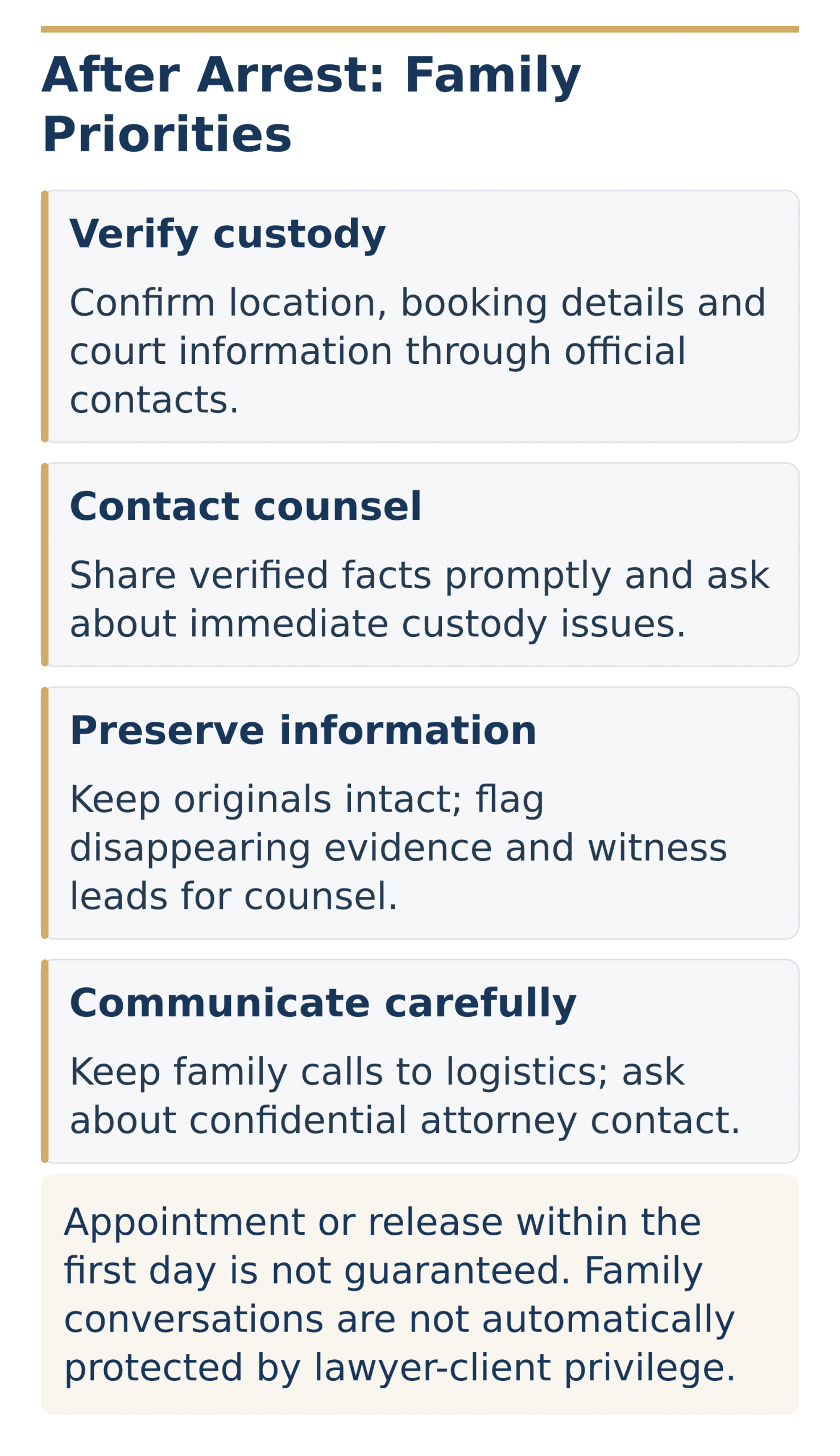
Day one has three jobs: find the jail, get the booking number, and call a defense lawyer. Witnesses, phones, and the scene wait for the lawyer.
| What a family may want to do | What to do instead |
|---|---|
| Call the detective back tonight | Take his name and number for the lawyer. |
| Delete the group chat | Leave it on the phone and tell the lawyer. |
| Talk it through on the jail call | Talk about family, not facts. |
| Post bail right away | Wait for the magistrate’s bail order. |
What to do now: Open one notebook. Write the jail name, the booking number, and the time of every official call in it.
Where is he, and what happens in the first 48 hours?
Say the arrest happened at 9:15 p.m. on a Tuesday. Texas law starts the first deadlines from that moment.
| Due by 9:15 p.m. Thursday | Source |
|---|---|
| Hearing before a magistrate, without unnecessary delay | CCP art. 15.17(a) |
| Warnings: the accusation, a lawyer, silence | CCP art. 15.17(a) |
| Reasonable help with the appointed-counsel forms | CCP art. 15.17(a) |
| Bail order: personal bond, surety or cash bond, or denial | CCP art. 17.028(a) |
| Public safety report | CCP art. 17.022 |
If the jail site still says “hold” at noon Wednesday, call the jail and write down three things:
- the clerk’s name and the time
- whether a magistrate has ruled on bail
- the bond amount and any conditions
Bail in a murder case can be high and can come with strict conditions. Ask counsel what the order says before you call a bonding company. If the bond carries a no-contact condition, ask exactly who it covers, including family members.
How do you get a lawyer fast?
Say your loved one asks for a lawyer at the magistrate hearing on Wednesday morning. You can hire a lawyer at any time. If he can’t afford one, a magistrate with that authority appoints a lawyer under art. 1.051 when he asks.
| Situation | Appointment deadline |
|---|---|
| Magistrate can’t appoint | Forms sent within 24 hours (art. 15.17(a)) |
| County of 250,000 or more | End of the first working day (art. 1.051(c)(2)) |
| County under 250,000 | End of the third working day (art. 1.051(c)(1)) |
The working days count from the day the appointing authority receives his request. On an out-of-county warrant, ask which county will appoint counsel and when he’ll be moved.
The Texas Indigent Defense Commission says families can contact the indigent defense coordinator, court coordinator, or judge in the charging county. Our Texas family arrest guide walks through the same steps.
Have these in front of you for the first call with a lawyer:
- his full legal name and date of birth
- the jail and booking number
- the listed charge
- any warrant, bond paper, or court notice
- the names of officers who called
What changes when the arrest is for capital murder?
The jail website shows “capital murder” next to your loved one’s name, and there’s no bond amount. The 48-hour magistrate rules above still apply. What changes is who the court appoints, and how soon the defense has to start working on punishment.
Article 26.052 of the Code of Criminal Procedure answers the appointment questions for an indigent defendant. The court appoints “two attorneys, at least one of whom must be qualified” (art. 26.052(e)). It does so “as soon as practicable after charges are filed,” unless the State gives written notice that it won’t seek death. A selection committee in each administrative judicial region keeps the qualified list (art. 26.052(c)–(d)). If the county has a public defender’s office, that office’s guidelines can control (art. 26.052(b)).
Many Texas counties belong to the Regional Public Defender for Capital Cases, which Lubbock County administers. Ask the court coordinator which route yours uses.
Here’s how the first stretch can run in a hypothetical case:
| When | What happens | Rule |
|---|---|---|
| Day 1 | Arrest on the warrant; magistrate warnings | Arts. 15.17 and 17.028, as in any murder arrest |
| Days 2–5 | Charges filed; the judge appoints two lawyers | Art. 26.052(e), unless the State has said in writing that death is off the table |
| Week 2 | A sealed motion for investigation money | Art. 26.052(f): a “pretrial ex parte confidential request for advance payment of expenses to investigate potential defenses” |
| Later, no set date | The State says whether it will seek death | Sets the Penal Code §12.31 sentences and changes jury selection |
I haven’t found a statute that gives the State a fixed deadline for the death decision. It may come early, or months later. Until a written notice says the State won’t seek death, I’d treat the case as one where it might.
That means the life-history work starts right away. Under art. 37.071, a jury deciding between death and life without parole weighs the person’s “character and background.” That kind of proof takes a long time to gather. The State Bar of Texas Guidelines and Standards for Texas Capital Counsel (2006) call for a team of at least two qualified lawyers, an investigator and a mitigation specialist. In the first week, the most useful thing a family can give counsel is a private list of schools, doctors, counselors, employers and places the person lived, with dates where you know them. Give it to the lawyer, not on a phone call.
If you hire a lawyer rather than accept an appointment, the art. 26.052 list doesn’t control who you choose. Ask any lawyer you’re considering how they’d staff a capital case and when they’d bring in a mitigation specialist.
What should you keep, and what should you leave alone?
Say your brother’s phone holds a group chat from the night of the arrest. Leave it exactly as it is. Take screenshots if you want, but keep the original messages on the original phone.
Penal Code §37.09 makes it a crime to alter, destroy, or conceal evidence while knowing an investigation is pending. Section 36.05 makes it a crime to offer a benefit to a witness, or coerce one, to testify falsely or withhold testimony.
Well-meant moves can look bad on paper.
| What a family member might do | Why it’s risky |
|---|---|
| Deletes the chat “to protect” him | Can look like tampering under §37.09 |
| Offers a witness rent money to “remember better” | Can look like witness tampering under §36.05 |
| Moves his car to a cousin’s garage | Raises concealment questions, so ask counsel first |
If someone already did one of these:
- tell the lawyer before anything else
- leave footage and items where they are
- stay off social media about the case
What can you say on jail calls?
At 8 p.m. the county jail number lights up your mother’s phone, and she grabs it before the second ring, already crying. Treat that call, and every one after it, as recorded. Bexar County, for example, tells clients that every inmate phone call is recorded.
| Fine to talk about | Keep off the call |
|---|---|
| Health, family news, and commissary money | What happened, or who was there |
| Visiting times and the lawyer’s name | Witnesses, alibis, or what anyone saw |
| Court dates you already know | Anything the lawyer said about strategy |
Texas Rule of Evidence 503 protects confidential communications made to get legal services. A regular family call isn’t one of those. A call with the lawyer on an approved attorney line can be privileged, if it stays confidential and is for legal advice.
One caution: if he repeats the lawyer’s advice to you, voluntarily sharing a significant part of it can waive the privilege under TRE 511.
What can a family do the first evening at home?
Your aunt is texting the cousins, and your uncle wants to drive past the scene. Nobody drives anywhere tonight.
Page one of the notebook gets every official call, with the time. Page two gets the cameras near the scene that may record over, like the gas station on the corner or a neighbor’s doorbell. Page three gets the people who may know something. The warrant and bond papers go in a folder, and the lawyer gets the notebook and folder at the first meeting.
Frequently asked questions
Will my son be released in the first 24 hours?
Don’t count on it. A magistrate has up to 48 hours to make the bail decision, and release depends on the amount and conditions.
Can we talk to the lawyer for him?
You can share information and arrange the hiring, but the lawyer represents the accused, and some details should come straight from him.
Should we talk to the detective if he calls?
Take his name and number, then give both to the lawyer.
What if we already said something on a jail call?
Tell the lawyer. Don’t try to explain it away on another recorded call.
Talk with Heath Hyde
If someone you love was just arrested for murder, call Heath Hyde, P.C. at 903.439.0000 or request a free consultation. Read what happens in the first 48 hours of an East Texas murder charge and visit the family resources page.
Legal sources
- Tex. Code Crim. Proc. art. 15.17
- Tex. Code Crim. Proc. art. 1.051
- Tex. Code Crim. Proc. arts. 17.022, 17.028
- Tex. Penal Code §36.05
- Tex. Penal Code §37.09
- Tex. R. Evid. 503, 511
- Texas Indigent Defense Commission: My rights
- Bexar County: Information for clients
- Tex. Code Crim. Proc. art. 26.052
- Tex. Code Crim. Proc. art. 37.071
- Tex. Penal Code §12.31
- State Bar of Texas, Guidelines and Standards for Texas Capital Counsel, 69 Tex. B.J. 966 (2006)
- Texas Indigent Defense Commission, Regional Public Defender for Capital Cases
This article provides general educational information, not legal advice. Every case depends on its facts, evidence, court, deadlines and governing law. Past results do not guarantee a similar outcome.