


MONEY LAUNDERING · FEDERAL CHARGES
How Are Laundering and Bank or Wire Fraud Bundled?
One scheme can produce fraud counts and laundering counts. The order of events decides which money supports which count, and the same dollars shouldn’t be counted twice.
Eligible to Practice in Texas
Attorney at Law
Bar Card Number: 00796807
TX License Date: 11/01/1996
214 Connally St Ste A
Sulphur Spgs, TX 75482-2612
Prosecutors often add laundering counts to a bank fraud or wire fraud indictment, and the law allows it. Each count still needs its own event. The fraud count covers how the money came in. The laundering count covers a later transaction with money that was already proceeds.
Hypothetical: a landscaping contractor in Tyler is indicted on four counts. Count 1 charges bank fraud and count 2 wire fraud. Counts 3 and 4 charge money laundering, and all four rest on one $100,000 credit-union loan.
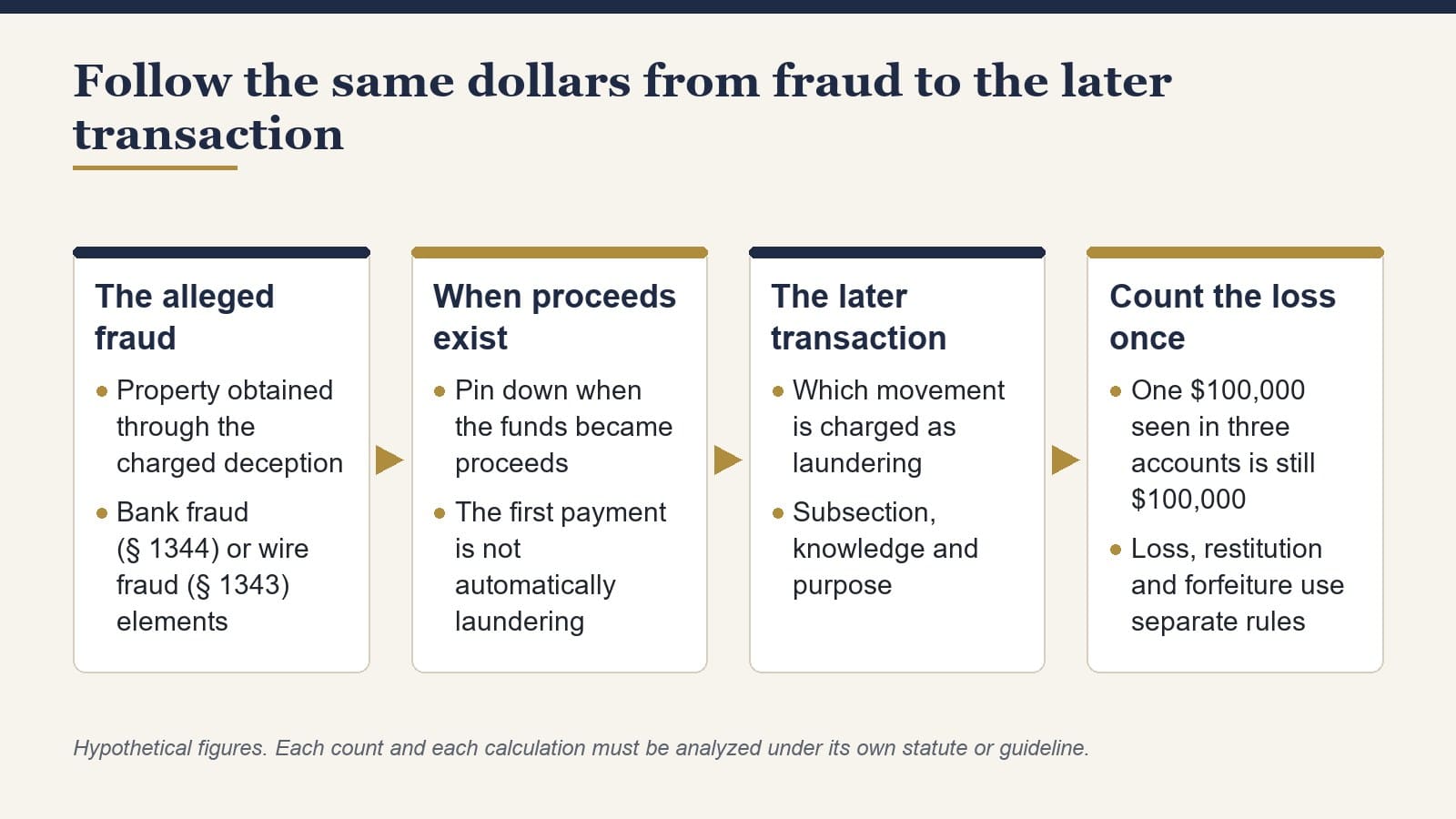
Fraud, then proceeds, then a transaction
The facts of United States v. Santos (2008):
- Efrain Santos ran an illegal lottery in Indiana.
- The government charged his payments to runners and winners as laundering.
- A plurality of the Supreme Court read “proceeds” as profits, so those payouts didn’t qualify.
Congress later rewrote the definition.
Section 1956(c)(9) now defines proceeds as property obtained or retained through the unlawful activity, “including the gross receipts of such activity.” Wire fraud under 18 U.S.C. § 1343 needs a wire sent “for the purpose of executing such scheme or artifice.” Bank fraud under § 1344 needs knowing execution, or an attempt, of a scheme under clause (1) or (2). Section 1956(c)(7)(A) makes both specified unlawful activity through the list in § 1961(1).
Can the victim’s own deposit be both the fraud’s last step and a laundering transaction? That turns on the subsection and the circuit’s cases, and I wouldn’t concede it.
The subsection sets the proof
Humberto Regalado Cuellar was stopped driving through Texas toward Mexico with nearly $81,000 in plastic bags. The bags were covered in animal hair and hidden under the rear floorboard. In Cuellar v. United States (2008), the Supreme Court reversed his conviction. Hiding cash during the trip wasn’t enough. The government had to prove the transport was “designed” to conceal the funds’ nature, location, source, ownership or control.
Section 1956(a)(1)(B)(i) uses the same “designed” language for concealment transactions. The subsection number also sets the ceiling on the sentence.
| Count | Mental state or extra element | Maximum prison term |
|---|---|---|
| § 1956(a)(1)(A)(i) promotion | Intent to promote carrying on the unlawful activity | 20 years |
| § 1956(a)(1)(B)(i) concealment | Knowledge the transaction was designed to hide nature, location, source, ownership or control | 20 years |
| § 1957 | Monetary transaction over $10,000 in criminally derived property; no concealment purpose | 10 years |
| § 1343 wire fraud | Scheme plus a wire for the purpose of executing it | 20 years; 30 if it affects a financial institution |
| § 1344 bank fraud | Execution of a scheme under clause (1) or (2) | 30 years |
A § 1957 count is the easiest to charge and carries the lowest cap.
Hypothetical: if the Tyler contractor’s April 15 payment had been $9,800, a § 1957 count on it would fail the amount element. The government would need § 1956 and proof of promotion or concealment. The overlap of the two fraud statutes on one loan application is covered in the companion article on bundled bank and wire fraud counts.
Hypothetical: one loan, three accounts
The credit union approved the Tyler loan on overstated receivables.
| Date | Movement | Amount | Count |
|---|---|---|---|
| April 2 | The credit union wires the loan into the operating account. | $100,000 | Counts 1 and 2 |
| April 9 | Transfer to his personal savings. | $60,000 | Count 3 |
| April 15 | Payment to a mulch supplier his brother-in-law owns. | $40,000 | Count 4 |
Add the three rows and you get $300,000. The credit union lent $100,000 once, and only the April 2 wire caused new pecuniary harm.
Counting the loss once
The Tyler presentence report gets one loss line, not three. Section 2B1.1’s Notes to Table (A) and (C)(i)–(ii) set loss at “the greater of actual loss or intended loss.” Actual loss means “the reasonably foreseeable pecuniary harm that resulted from the offense.” Intended loss is “the pecuniary harm that the defendant purposely sought to inflict.”
Section 2S1.1(a)(1) uses the offense level of the underlying offense when the defendant committed it and that level can be determined. Application Note 6 to § 2S1.1 groups the laundering count with the fraud count under § 3D1.2(c).
Section 1B1.11(a) tells the court to use “the Guidelines Manual in effect on the date that the defendant is sentenced.” If that would violate the Ex Post Facto Clause, § 1B1.11(b)(1)–(2) applies the offense-date manual in its entirety. The Tyler contractor, sentenced after November 1, 2026, gets the inflation-adjusted loss table.
Restitution follows the victim’s loss under the restitution statutes. Forfeiture follows proceeds or property involved, depending on the statute. Neither adds up each account the money touched.
The chart to bring
I’d bring one transaction chart, reconciled to the bank’s and the victim’s records, with one line per movement of money:
- Date and amount, cited to the statement page.
- Status: obtained, moved, repaid, returned or recovered.
- Every count that relies on the line.
- The source record: bank statement, wire confirmation or victim ledger entry.
- Payoff letters, collateral credits or refunds to the lender.
Common questions
Can someone be convicted of fraud and laundering for one scheme?
Yes, if the government proves each offense. In the Tyler case, it has to show the April 9 and April 15 transfers moved money that was already proceeds.
Does each transfer between accounts raise the loss?
No. Under § 2B1.1 the Tyler loss stays at $100,000, though the money moved twice after April 2.
Can the government take property the money went into?
It can try. On a § 1956 or § 1957 conviction, 18 U.S.C. § 982(a)(1) requires forfeiture of property “involved in such offense” and property traceable to it.
Sources
- 18 U.S.C. § 1343
- 18 U.S.C. § 1344
- 18 U.S.C. § 1956
- 18 U.S.C. § 1957
- 18 U.S.C. § 982
- Federal Rule of Criminal Procedure 7(f)
- U.S. Sentencing Guidelines §§ 1B1.11, 2B1.1, 2S1.1 and 3D1.2
- U.S. Sentencing Commission, Amendments to the Sentencing Guidelines effective November 1, 2026
- United States v. Santos, 553 U.S. 507 (2008)
- Cuellar v. United States, 553 U.S. 550 (2008)
This article provides general information, not legal advice. The law and its application depend on the facts and the law in effect on the relevant date. Consult a lawyer about a specific matter.