

BANK FRAUD · FEDERAL OR STATE
Is Bank Fraud Always a Federal Crime in Texas?
A case involving a bank can be filed in a Texas district court, a federal courtroom or both. The statute the prosecutor picks decides the forum, the proof and the punishment range, and the word "bank" doesn’t.
Eligible to Practice in Texas
Attorney at Law
Bar Card Number: 00796807
TX License Date: 11/01/1996
214 Connally St Ste A
Sulphur Spgs, TX 75482-2612
Hypothetical: In March 2025 a Hopkins County contractor applies for a $90,000 line of credit. On Oct. 6, 2026, a sheriff’s investigator leaves her a voicemail about the application. On Oct. 20 her bank closes the business account and mails her a “suspected fraud” letter.
Her first call to me: state or federal?
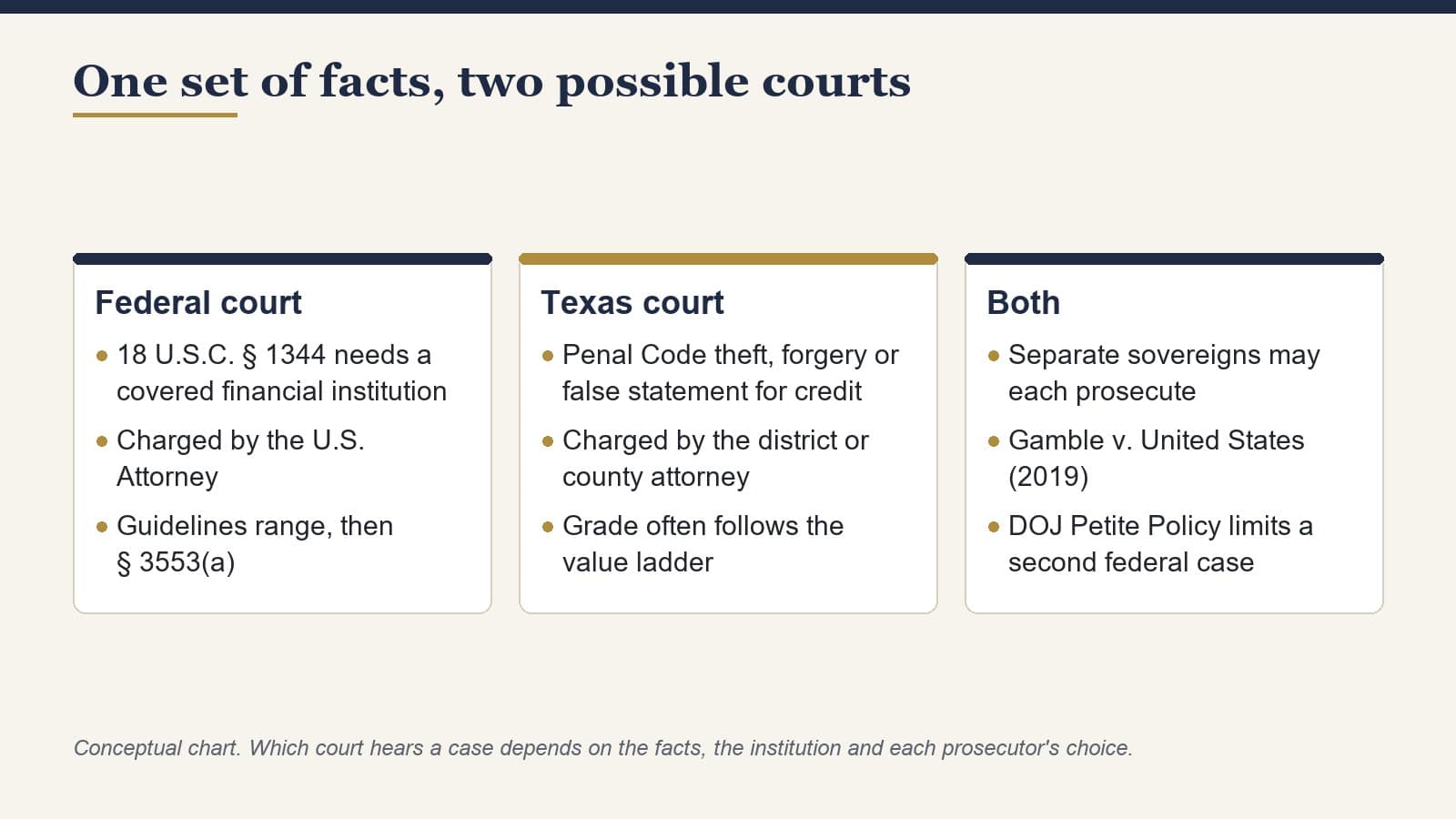
It can be either. Sometimes it’s both. Congress created one federal bank fraud offense: 18 U.S.C. § 1344. Texas charges the same conduct as theft, forgery, false statement to obtain credit or card abuse under the Penal Code. The courtroom depends on which statute’s elements the facts fit and which prosecutor takes the file.
The charge map
The first three statutes below are federal and are tried in a U.S. district court. The rest are Texas offenses tried in a county or district court.
- Bank fraud, 18 U.S.C. § 1344: up to 30 years and a $1,000,000 fine per count.
- Wire fraud, 18 U.S.C. § 1343: up to 20 years, rising to 30 years and $1,000,000 if the violation “affects a financial institution.”
- False statement on a loan or credit application, 18 U.S.C. § 1014: up to 30 years and $1,000,000.
- Theft, Tex. Penal Code § 31.03: anywhere from a Class C misdemeanor to a first-degree felony, depending on value.
- Forgery, Tex. Penal Code § 32.21: a state jail felony by default, and higher for certain instruments or values.
- False statement to obtain property or credit, Tex. Penal Code § 32.32: Class C misdemeanor to first-degree felony, by amount.
- Credit card or debit card abuse, Tex. Penal Code § 32.31: a state jail felony, or third degree if it’s committed against an elderly individual.
- Fraudulent use or possession of identifying information, Tex. Penal Code § 32.51: from a state jail felony to first degree, depending on the number of items.
- Misapplication of fiduciary property or property of financial institution, Tex. Penal Code § 32.45: graded by the value misapplied.
What makes a case federal under § 1344
Section 1344 punishes whoever “knowingly executes, or attempts to execute, a scheme or artifice” with one of two aims.
Lawrence Shaw used the account numbers of a Bank of America customer, Stanley Hsu, to move Hsu’s money into accounts at other institutions. Shaw argued he meant to cheat Hsu, not the bank. In Shaw v. United States (2016), the Supreme Court held that a bank has a property interest in its customers’ deposits. Section 1344(1), the scheme “to defraud a financial institution,” reached him. The government didn’t have to prove the bank lost money.
Kevin Loughrin posed as a Mormon missionary in a Salt Lake City neighborhood and stole checks from mailboxes. He altered six of them, made them out to Target for amounts up to $250, bought goods and walked back in to return them for cash. Target presented the checks to the banks. In Loughrin v. United States (2014), the Court held that “Section 1344(2) does not require the Government to prove that a defendant intended to defraud a financial institution.” The lie still has to be the means of getting the bank’s property.
| Where the paper went | Route to the bank |
|---|---|
| Forged check handed to a teller. | Reaches the bank directly. |
| Forged check given to a merchant who deposits it. | Reaches the bank through the deposit. |
| Lie to a private buyer, no bank in the chain. | Usually outside § 1344. |
The bank has to fit the federal definition
18 U.S.C. § 20 lists ten categories of “financial institution.” Four come up most in Texas files. Category (1) is “an insured depository institution.” Category (2) is “a credit union with accounts insured by the National Credit Union Share Insurance Fund.” Category (7) is “a Federal Reserve bank or a member bank of the Federal Reserve System.” Category (10) covers “a mortgage lending business” or a person that makes “a federally related mortgage loan.”
The list also reaches Federal Home Loan Banks, Farm Credit System institutions, small business investment companies, bank holding companies and U.S. branches of foreign banks. A logo or trade name doesn’t prove status. I’d ask for the charter, the FDIC or NCUA certificate and the loan’s ownership history as of the offense date.
No state line is required
Section 1343 requires a wire “in interstate or foreign commerce.” Section 1344 has no such element.
Hypothetical: at 9:40 one morning, a Dallas company hand-delivers a payment instruction to the Dallas branch of an FDIC-insured bank. The account holder swears he never signed it. By 2:15 the bank has released $48,000. The bank fits § 20(1), and the money sat in its custody when it left. A § 1343 count would fail on those facts for lack of an interstate wire.
The reverse mistake is just as common. An interstate email proves a wire. Whether a § 20 institution was defrauded, or lost custody of its property, is a separate question with separate proof.
When Texas brings the case
Section 31.03(a) says a person commits theft if he “unlawfully appropriates property with intent to deprive the owner of property.” In a bank or loan dispute, I’d pull three records first:
- the signature card and account agreement
- any written authorization, email or text giving consent
- the ledger or statement the state will use to prove value
Section 31.03(e) sets the value grades. Section 32.32 applies the same dollar lines to “the value of the property or the amount of credit.” Chapter 12 supplies the punishment:
| Value or amount of credit | Grade | Punishment range |
|---|---|---|
| Less than $100 | Class C misdemeanor | Fine up to $500 |
| $100 to less than $750 | Class B misdemeanor | Up to 180 days in jail and a fine up to $2,000 |
| $750 to less than $2,500 | Class A misdemeanor | Up to one year in jail and a fine up to $4,000 |
| $2,500 to less than $30,000 | State jail felony | 180 days to 2 years in a state jail; fine up to $10,000 |
| $30,000 to less than $150,000 | Third-degree felony | 2 to 10 years; fine up to $10,000 |
| $150,000 to less than $300,000 | Second-degree felony | 2 to 20 years; fine up to $10,000 |
| $300,000 or more | First-degree felony | 5 to 99 years or life; fine up to $10,000 |
Find the dollar figure, then read across. One $2,000 withdrawal sits in the Class A row. A $90,000 credit line sits in the third-degree row. Prior theft convictions, certain kinds of property and some victims move a case to a different grade. Section 31.03(f) bumps some offenses up a level. Sections 31.09 and 32.03 let the state add amounts obtained “pursuant to one scheme or continuing course of conduct.” Five $2,000 withdrawals in one month can become one $10,000 state jail felony.
Forgery has its own, steeper scale
Section 32.21 makes forgery a state jail felony unless another subsection applies. Section 32.21(d) makes a forged check third degree, along with deeds, mortgages, credit cards and any “authorization to debit an account at a financial institution.” Section 32.21(e) puts forged money, securities and government instruments at second degree.
Section 32.21(e-1) grades by value when the forgery is used to get property or a service.
| $40,000 loss | Grade |
|---|---|
| Charged as theft. | Third-degree felony. |
| Charged as value-based forgery. | Second-degree felony. |
Section 32.21(e-2) moves the offense up one grade for an elderly victim, except at the top tier. Both provisions are recent, so the offense date controls.
False statements on loan and credit applications
Hypothetical: on June 2, a borrower signs a credit application listing $1.2 million in yearly revenue. Her 2025 tax return shows $400,000.
Section 32.32(b) covers a person who “intentionally or knowingly makes a materially false or misleading written statement to obtain property or credit, including a mortgage loan.” Section 32.32(a) defines “credit” to include a loan of money, a line or letter of credit, a guaranty, a credit card and a mortgage loan. The statement must be written and material. A loan officer’s phone notes aren’t the borrower’s writing. The grade follows “the amount of credit,” which can dwarf what the lender lost.
Card abuse and identifying information
Section 32.31 reaches card use “with intent to obtain a benefit fraudulently.” It’s a state jail felony, or third degree against an elderly individual. Section 32.51 counts items. Fewer than five is a state jail felony. Fifty or more is first degree. A stolen card number can implicate either statute, and the proof is different for each.
No FDIC coverage doesn’t mean state-only
If the lender is a private equipment lender outside § 20, § 1344 is off the table. Wire fraud isn’t, and neither are § 1014 for the lenders it lists or the identity-theft statutes. When the lender is FDIC-insured, Texas can still bring a § 32.32 case.
Four fact patterns, side by side
All four files are hypothetical.
| File | Federal | Texas | First question |
|---|---|---|---|
| Disputed-signature check cashed at a Texas branch of an insured bank. | § 1344. | § 32.21(d) forgery or § 31.03 theft. | Who authorized it and who held the funds. |
| April 9: Longview buyer gives a Tyler supplier an application claiming $2 million in sales. | § 1343, if interstate email carried it. | § 32.32. | Knowing lie or failed projection. |
| $260,000 home loan closed in May by a nonbank, sold to a bank in July. | § 1344 if § 20(10) fits; § 1014. | § 32.32. | Who funded it at closing. |
| Stolen card number buys $3,100 in electronics one weekend. | Device, identity or wire statutes. | § 32.31 and § 32.51. | Who had the credentials. |
A payment network doesn’t turn card abuse into § 1344. A later sale doesn’t change what the borrower said at origination.
What a Texas sentence range means
Hypothetical: a Lufkin business owner with no record signs two applications that overstate revenue.
- Count 1, a $90,000 line of credit: third degree under § 32.32 (2 to 10 years). She pays back $60,000 before the bank complains. That helps at punishment and restitution. It doesn’t change the grade.
- Count 2, a $350,000 line with $110,000 drawn: first degree (5 to 99 years or life), because the amount of credit sets the grade. Chapter 42A of the Code of Criminal Procedure may still allow community supervision, within its limits.
I haven’t found a reliable statewide statistic for “average time served for bank fraud in Texas.” These cases are filed under several statutes and grades. A lawyer who quotes months without the count, grade, record and county is guessing.
| Outcome | What decides it |
|---|---|
| Dismissal or acquittal. | Proof of each element, value or amount included. |
| Deferred adjudication or community supervision. | Chapter 42A limits at this grade, with this record. |
| State jail. | A state jail felony conviction without supervision. |
| Prison. | A first-, second- or third-degree conviction, inside the correctly enhanced range. |
Federal sentences: from the ceiling to the guidelines
Thirty years is the § 1344 maximum, not the usual sentence. Judges start with the advisory Sentencing Guidelines. 18 U.S.C. § 3553(a) calls for a sentence “sufficient, but not greater than necessary.”
USSG §1B1.11 points to the manual “in effect on the date that the defendant is sentenced.” The offense-date manual applies if the newer one gives a higher range. Section 2B1.1 covers most bank and loan fraud. Since 2024 its text defines loss as “the greater of actual loss or intended loss.” The November 1, 2026 amendments raised the first loss step from more than $6,500 to more than $9,000. An $8,000 loss used to add 2 levels. Now it adds none.
Laundering counts bring in §2S1.1, and §3D1.2 decides which counts group. I cover that in a separate guide: When Federal Bank Fraud Charges Include Wire Fraud and Money Laundering.
According to the U.S. Sentencing Commission’s 2025 Annual Report, just over 75% of people sentenced for fraud received a prison sentence. That isn’t a bank-fraud-only figure. The average fraud sentence was 22 months, and the Commission counts probation as zero months in average sentences. It’s an average, not a median, and it predicts nothing for any one person. Economic-crime losses averaged $4.4 million, while the median was $149,856. A few very large frauds pull the average up, so neither number describes a typical case.
| Range input | Built two ways |
|---|---|
| Loss. | The government’s figure and ours. |
| Criminal history. | With and without the contested adjustments. |
| Resolution. | Plea and trial. |
Restitution and forfeiture are separate numbers on top of that.
How often federal fraud defendants win at trial
The Administrative Office of the U.S. Courts’ Table D-4 covers the 12 months ending September 30, 2025:
- All federal offenses: 82,042 defendants, 5,336 dismissed, 1,189 jury convictions and 135 jury acquittals. Acquittals were about 10.2% of jury verdicts.
- Fraud (property offenses): 6,130 defendants, 493 dismissed, 201 jury convictions and 14 jury acquittals, about 6.5% of jury verdicts.
- Financial institutions fraud: 288 defendants, 16 dismissed, 7 jury convictions and 0 acquittals.
In that last row, 265 of the 288 defendants pleaded guilty. Seven verdicts can’t support a “100% conviction rate” for bank fraud trials. The cases that reach a jury are the ones neither side would settle.
| USSC Table 12, fiscal year 2025 (fraud, theft, embezzlement) | People | Share |
|---|---|---|
| Sentenced | 5,080 | 100% |
| Pleaded guilty | 4,894 | 96.3% |
| Sentenced after trial | 186 | 3.7% |
Table 12 counts only people who were sentenced. Acquittals and dismissals never reach it.
I grade trial risk count by count. A disputed signature, missing source data or a written authorization makes a different case than signed certifications backed by the defendant’s own emails. Whether to go to trial is always the client’s decision.
When both Texas and the United States file
In November 2015 a Mobile, Alabama officer stopped Terance Gamble for a damaged headlight and found a loaded 9-mm handgun in the car. Gamble pleaded guilty to Alabama’s felon-in-possession charge. Federal prosecutors then indicted him for the same possession. In Gamble v. United States (2019), the Court declined to overturn the dual-sovereignty doctrine. The Fifth Amendment’s bar on being “twice put in jeopardy” didn’t stop the second case. Each sovereign enforces its own law.
Justice Manual 9-2.031 is the Petite Policy. It requires a “substantial federal interest” that the state case left “demonstrably unvindicated.” An Assistant Attorney General must approve in advance. The policy creates no enforceable rights.
| Two custody terms | Rule |
|---|---|
| Imposed at the same time. | Concurrent under 18 U.S.C. § 3584(a). |
| Imposed at different times. | Consecutive unless the court orders otherwise. |
| State time already served. | No automatic credit; USSG §5G1.3 and each judgment’s wording bear on it. |
Trying the case in either court
Federal discovery runs under Fed. R. Crim. P. 16, plus Brady and Giglio. Texas discovery runs under Code of Criminal Procedure art. 39.14, plus Brady. In either court I’d request:
- the native loan file with its audit log
- the underwriting notes
- the charter or FDIC certificate
- wire and ACH instructions
- account-opening records
Rule 12 governs federal challenges to the indictment and suppression. Rule 702 governs challenges to summary and accounting witnesses. Rule 29 preserves sufficiency at verdict. Texas uses the Code’s motion and suppression practice and the Texas Rules of Evidence on business records. There the charge fight is usually how value or amount gets submitted.
My federal element chart separates § 1344(1) from § 1344(2) and names the § 20 institution, the bank property and each execution date. My Texas chart names the subsection, the owner, the writing or appropriation, intent and the value that sets the grade.
| Trial moment | Focus |
|---|---|
| Jury selection. | Who believes banks don’t make mistakes, and who thinks an unpaid loan proves a lie. |
| Loan officer cross. | Who made the credit decision and what the bank knew at the time. |
| Agent cross. | Which numbers are face value, which are loss and which are restitution. |
| Summary charts. | Accurate cells can still mislead as a timeline. |
| Closing. | Each count’s statement, speaker, institution and missing element. |
A $2 million total on a chart can’t stand in for any one count’s elements.
Common questions
Does an FDIC-insured bank make my case federal?
Not by itself. An FDIC-insured lender makes a § 1344 charge possible, and a Texas prosecutor can still bring the same facts under the Penal Code.
Can I be charged in both state and federal court for the same thing?
Yes. Gamble v. United States (2019) kept the dual-sovereignty rule, and Justice Manual 9-2.031 gives a defendant no enforceable right to block a second case.
If I pay the bank back, does the case go away?
No. The grade under § 32.32 follows the amount of credit. Paying it back can still help at punishment and lowers what’s owed in restitution.
Sources
- 18 U.S.C. § 20
- 18 U.S.C. § 1014
- 18 U.S.C. § 1343
- 18 U.S.C. § 1344
- 18 U.S.C. § 3584
- Texas Penal Code §§ 12.21–12.23, 12.32–12.35
- Texas Penal Code §§ 31.03, 31.09
- Texas Penal Code §§ 32.03, 32.21, 32.31, 32.32, 32.45, 32.51
- Texas Code of Criminal Procedure art. 39.14 and Chapter 42A
- U.S. Sentencing Commission, Guidelines Manual §§1B1.11, 2B1.1, 2S1.1, 3D1.2, 5G1.3
- U.S. Sentencing Commission, 2026 Amendments to the Sentencing Guidelines
- U.S. Sentencing Commission, 2025 Annual Report
- U.S. Sentencing Commission, 2025 Sourcebook of Federal Sentencing Statistics, Table 12
- Administrative Office of the U.S. Courts, Judicial Business 2025, Table D-4
- U.S. Department of Justice, Justice Manual 9-2.031
- Loughrin v. United States, 573 U.S. 351 (2014)
- Shaw v. United States, 580 U.S. 63 (2016)
- Gamble v. United States, 587 U.S. 678 (2019)
This article provides general information, not legal advice. The law and its application depend on the facts and the law in effect on the relevant date. Consult a lawyer about a specific matter.