
How Are Jury Instructions Developed in a Murder Trial?
The jury charge tells jurors what the law is. Defense requests and objections shape what it says, and what can be fixed later.
Mr. Heath Enix ‘Heath’ Hyde
Eligible to Practice in Texas
Attorney at Law
Bar Card Number: 00796807
TX License Date: 11/01/1996
Primary Practice Location: Dallas, Texas
Return to the Texas Murder Trial Defense Knowledge Hub
Short answer
The jury charge can tell jurors what the law requires before they can convict. It can’t add a defense the defense never asked for, and it can’t comment on the evidence. So your lawyer requests each instruction in writing and makes specific objections on the record.
| What families may assume | What the charge rules actually say |
|---|---|
| “The judge adds self-defense if it fits.” | The defense must request it or object |
| “The charge tells jurors what the judge thinks.” | It can’t comment on the weight of the evidence |
| “Any objection saves the issue.” | Each ground must be stated distinctly |
| “A charge mistake means a new trial.” | Reversal depends on harm |
What to do now: Ask your lawyer which instructions the defense expects to request. Then you’ll know which testimony to note when it comes in.
Who writes the jury charge in Texas?
The last witness steps down at 3:15 p.m. The jurors go out, and the judge hands both sides a typed draft.
Under art. 36.14, the judge must deliver a written charge in a felony jury trial. It sets out the law that applies to the case, and it comes before argument. It can’t express an opinion on the weight of the evidence. It can’t sum up the testimony or argue for either side. The defense gets a reasonable time to examine it before it’s read.
Penal Code §2.01 sets the baseline. No one may be convicted unless each element is proved beyond a reasonable doubt.
One sentence in a charge can matter, and so can a missing one.
| Case | What the Court held |
|---|---|
| Brown v. State (2003) | Telling jurors they could infer intent from “acts done or words spoken” was error, but harmless on that record. |
| Huizar v. State (2000), citing Posey | A defensive issue isn’t “law applicable to the case” unless the defense requests it or objects to its omission. |
Which instructions can the defense ask for?
A witness testifies that the defendant fired wildly while running away. The defense may ask whether that supports a lesser-included offense such as manslaughter. The request should point the judge to the exact testimony.
Each kind of instruction has its own test.
| Instruction type | What the law requires |
|---|---|
| A “defense,” such as self-defense | Admitted evidence must support it (§2.03(c)); reasonable doubt on it requires acquittal (§2.03(d)). |
| An affirmative defense | Jurors are told the defendant must prove it by a preponderance (§2.04(d)). |
| A lesser-included offense | Art. 37.09 defines it, and courts apply a two-step test. |
The two steps are simple to say. First, courts compare the elements. Then they ask whether some evidence would let a rational jury find the defendant guilty only of the lesser offense.
Each request needs its own record. A self-defense request needs testimony or exhibits about what the defendant reasonably believed at the time. Manslaughter needs evidence that would let jurors find recklessness rather than intent or knowledge. A limiting instruction on other acts needs a request when that evidence comes in, not only at the charge conference.
Say a neighbor testifies on day three that the other man “reached toward his belt” before the first shot. That’s page 214 of the transcript. At the charge conference, the self-defense request cites page 214 by line.
Punishment comes later. In a jury-sentencing case, the jury gets a separate punishment charge after a guilty verdict, and issues such as sudden passion come up there.
How does the defense object to a draft charge?
At the charge conference the jury is out, the court reporter is typing, and your lawyer has the draft open to paragraph 4.
The objection goes in writing and names each ground distinctly. Dictating it to the court reporter in front of the judge and the prosecutor counts. It can cover something left out, not just a wrong sentence. Under art. 36.15, either side may present written instructions before the charge is read. The judge must give or refuse them. A refused special instruction preserves the error it points out, with no separate objection needed. Under art. 36.16, the defense can object again to the revised charge before it’s read.
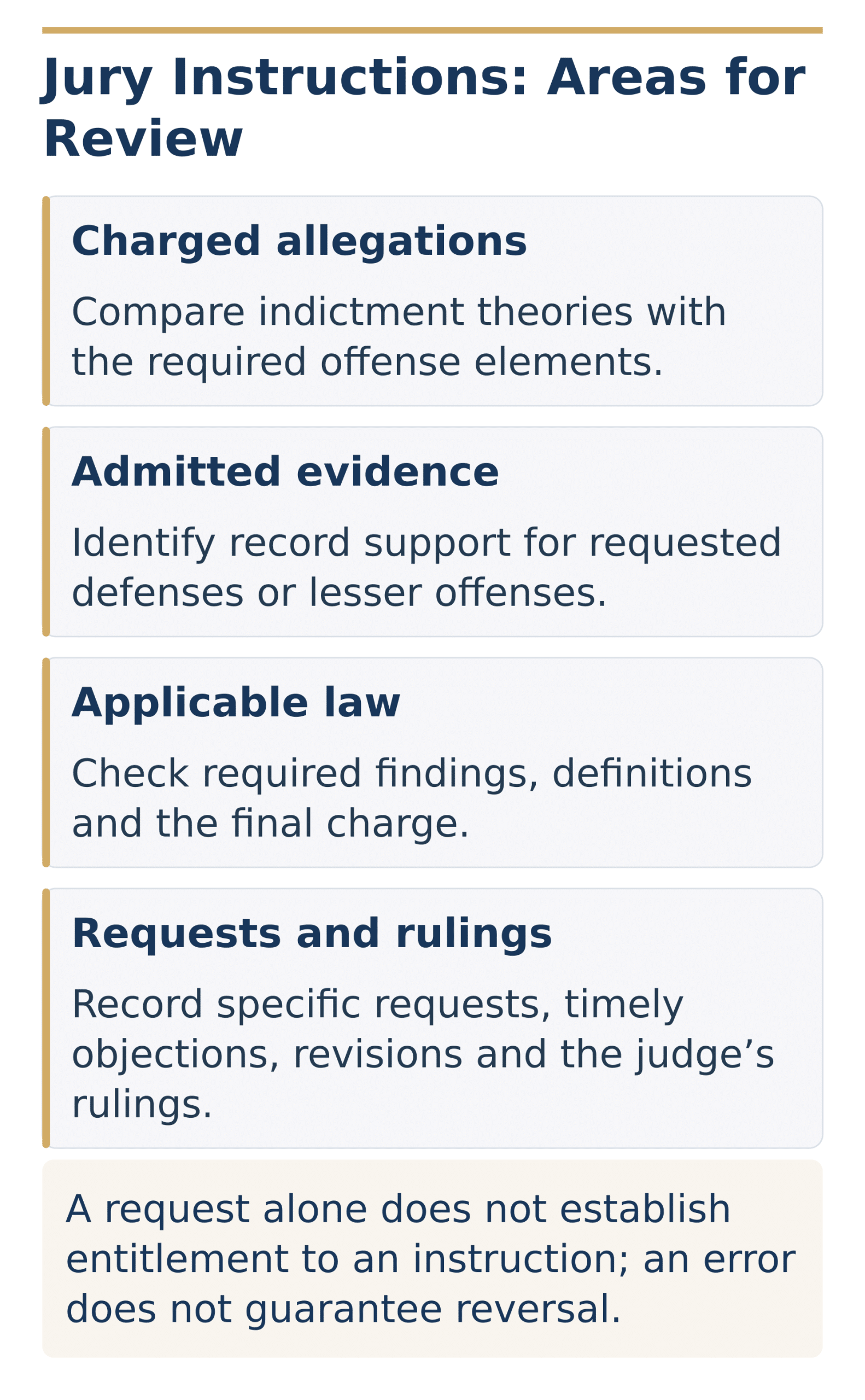
A general complaint like “we object to the charge” doesn’t tell the judge what to fix.
| Weak objection | Specific objection |
|---|---|
| “The defense objects to paragraph 4.” | Paragraph 4 omits “clearly dangerous to human life,” which §19.02(b)(2) requires. |
| “We want a self-defense charge.” | A §9.32 instruction, based on the two witnesses who saw the complainant raise the knife. |
| “The verdict form is confusing.” | The form gives no not-guilty option for the lesser offense. |
Does a charge error mean a new trial?
The jury convicts at 5:40 p.m. Later, the defense finds the self-defense instruction left a word out. That alone doesn’t undo the verdict.
Art. 36.19 and the Almanza standard, as explained in Jimenez v. State (2000), make reversal depend on harm. If the defense objected at trial, the question is whether the error caused some harm. If it didn’t object, the defendant must show egregious harm, meaning he didn’t get a fair and impartial trial. An objected-to federal constitutional error must be harmless beyond a reasonable doubt.
Same missing word, two trials. In one, the lawyer objected at the conference. In the other, nobody did. On appeal, the second defendant faces the much harder egregious-harm test.
What can a family do while the charge is being written?
Maybe a witness says something on day three that fits what your son told you. Maybe a friend in the gallery remembers he was running away when the shots were fired.
- Notes on helpful testimony, with the day and time
- Names of witnesses who haven’t testified yet
- Questions about the charge, saved for a break
- Silence in the gallery while the charge is read
Pass those notes to your lawyer the same day.
Frequently asked questions
Can the defendant see the jury charge before it’s read?
Art. 36.14 gives the defense a reasonable time to examine it and present written objections.
Will the judge add self-defense on their own?
Don’t count on it. Under Huizar, a defensive issue generally has to be requested or objected to, so your lawyer raises it.
Do jurors get the charge in the jury room?
Under art. 36.18, they may take the charges the court gave, but not any instruction the court refused.
What if the judge refuses a requested instruction?
It’s preserved. Art. 36.15 says a refused special instruction preserves the error, and art. 36.17 requires the judge to certify and file every charge given or refused.
Talk with Heath Hyde
Ask early how the defense theory will show up in the charge. Call Heath Hyde, P.C. at 903.439.0000 or request a free consultation.
Legal sources
- Tex. Code Crim. Proc. arts. 36.14–36.19
- Tex. Code Crim. Proc. art. 37.09
- Tex. Penal Code §19.02
- Brown v. State, No. 0059-03 (Tex. Crim. App. 2003)
- Huizar v. State, No. 794-98 (Tex. Crim. App. 2000)
This article provides general educational information, not legal advice. Every case depends on its facts, evidence, court, deadlines and governing law. Past results do not guarantee a similar outcome.