MONEY LAUNDERING · FEDERAL CHARGES
What Should Counsel Do After a Money Laundering Asset Seizure?
Find out which kind of proceeding took the property, mark the deadline that goes with it, and build a dated record of where each dollar came from.
Eligible to Practice in Texas
Attorney at Law
Bar Card Number: 00796807
TX License Date: 11/01/1996
214 Connally St Ste A
Sulphur Spgs, TX 75482-2612
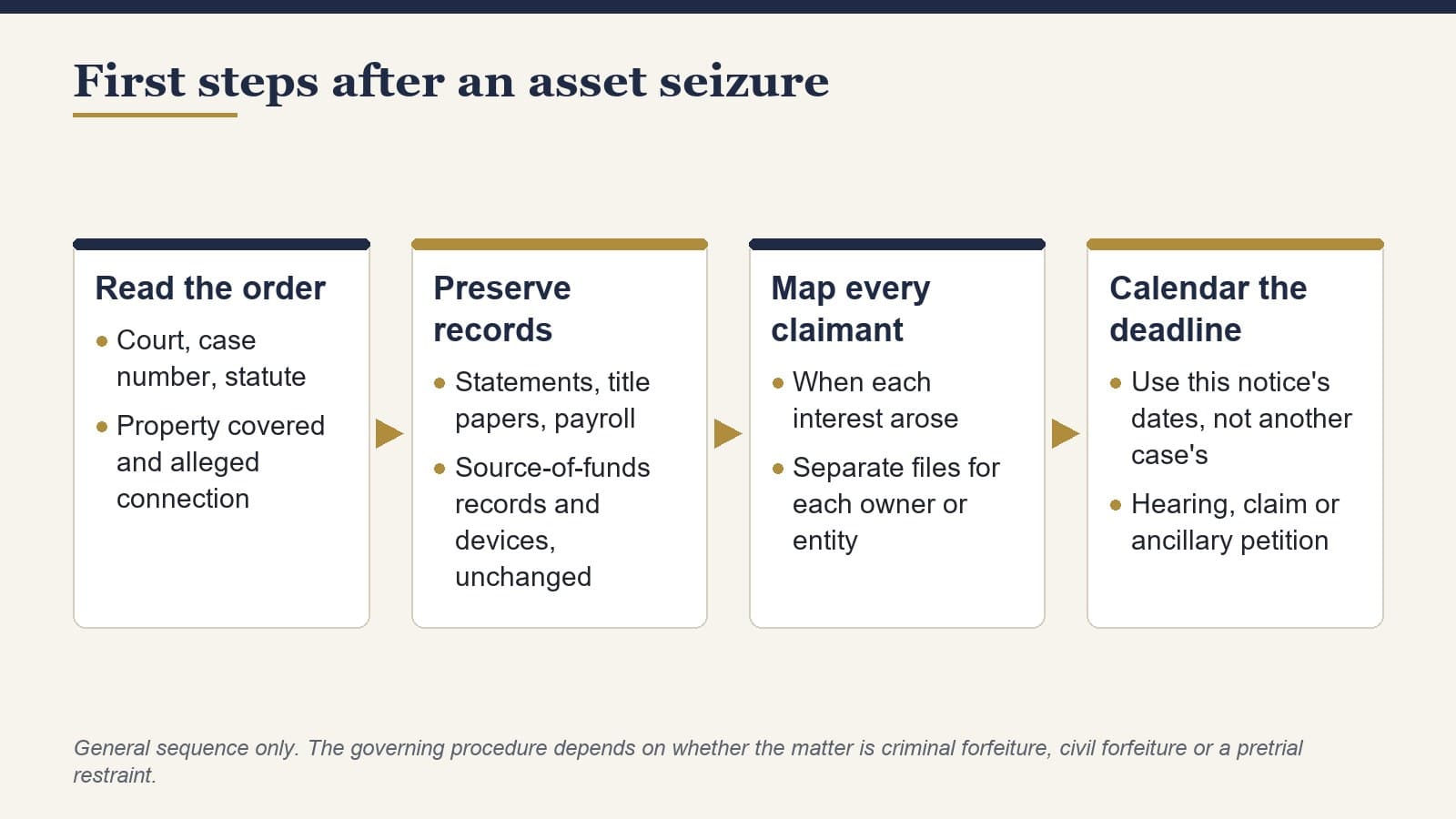
After a money laundering asset seizure, counsel’s first job is to identify which paper started it, because an agency forfeiture letter and a court restraining order run on different statutes and deadlines. Calendar the claim deadline in the notice, trace which funds the government actually ties to the alleged offense, and settle who represents whom before anyone signs a sworn claim, since that claim can be used in a criminal case.
Hypothetical, a dental practice in Tyler:
| Date | What happened |
|---|---|
| March 4 | The bank freezes the operating account with $186,000 in it |
| March 6 | An agency letter announces civil forfeiture |
| March 8 | $41,000 in payroll comes due |
The March 6 letter sets the claim deadline. The bank’s phone call doesn’t. Had a federal judge signed a restraining order instead, a different statute would control.
Agency letter or court order
Kerri Kaley sold medical devices for a Johnson & Johnson subsidiary. She and her husband, Brian, were indicted over a scheme to steal prescription devices and resell them. Before trial the government restrained their assets under 21 U.S.C. § 853(e)(1). The order covered a $500,000 certificate of deposit they planned to spend on lawyers.
In Kaley v. United States (2014), the Court held 6–3 that the Kaleys couldn’t use the restraint hearing to relitigate the grand jury’s probable cause finding. The government had conceded a hearing on traceability, and the Court left open whether one is constitutionally required.
The Kaleys’ freeze came from a judge in a criminal case. The dentist’s came by agency letter, which puts it on the civil track.
Deadlines by paper
Under 18 U.S.C. § 983(a)(1), the agency generally has to send civil notice within 60 days of the seizure. The March 6 letter fits the first row.
| Paper received | Rule | Deadline or next step |
|---|---|---|
| Agency letter starting civil forfeiture | 18 U.S.C. § 983(a)(1)–(2) | Claim due by the date in the letter, at least 35 days after mailing |
| Published notice only | § 983(a)(2)(B) | Claim due 30 days after final publication |
| Claim already filed | § 983(a)(3)(A) | Complaint within 90 days or release, unless extended |
| Pretrial restraining order in the criminal case | 21 U.S.C. § 853(e), applied by 18 U.S.C. § 982(b)(1) | Motion to the judge who entered the order |
| Preliminary order affecting a non-defendant | § 853(k), (n)(2); Fed. R. Crim. P. 32.2(c) | Ancillary petition within 30 days of final publication or direct notice, whichever is earlier |
| Forfeiture declared, no written notice received | § 983(e) | Motion to set aside within 5 years of final publication |
The date that controls is the one printed on your own notice.
The filing rules behind those rows:
- Section 983(a)(2)(C) requires a civil claim to identify the property and the claimant’s interest. It must be made “under oath, subject to penalty of perjury.”
- Section 982(a)(1) directs forfeiture, on a § 1956 or § 1957 conviction, of property “involved in such offense, or any property traceable to such property.”
- Section 853(k) bars someone claiming an interest from intervening “in a trial or appeal” of the criminal case. That person files an ancillary petition instead.
Tracing the $186,000
The government ties $70,000 of the balance to one insurer’s payments. The other $116,000 came from patient copays and other insurers. I’d match each of that insurer’s remittance advices to its claim file.
Paper that existed before anyone was investigating:
- Signature cards from the 2019 account opening, showing who could sign.
- Two years of statements, showing the normal balance and where deposits came from.
- The deed and loan closing packet, if the practice owns its building.
- The payroll register and vendor invoices. They prove debts, not ownership.
- Prior tax returns.
Each line of a ledger built from these needs a document behind it.
Luis and money for a lawyer
Sila Luis was indicted in October 2012 on health care charges that included paying kickbacks. The government said she had obtained close to $45 million and spent almost all of it. It asked a court to freeze the roughly $2 million she had left, and the order under 18 U.S.C. § 1345 covered her untainted funds too. She wanted that money for lawyers.
In Luis v. United States (2016), a plurality of four, with Justice Thomas concurring in the judgment, held that a pretrial freeze of “legitimate, untainted assets needed to retain counsel of choice violates the Sixth Amendment.” Money traceable to the charged offense stays outside that holding.
Suppose the dentist is indicted in May. The fight would be over the $116,000 that never touched the insurer.
A claim signed under oath
The government can use a sworn civil claim in a criminal case. Under 18 U.S.C. § 981(g)(2), a claimant with standing who is the subject of a related criminal investigation can seek a stay when the civil case would burden the right against self-incrimination.
Questions I’d settle before anyone signs:
- Who represents the practice, and who represents each owner?
- Has anyone moved, retitled or backdated anything since March 4?
- Could the property be frozen at all? The companion article on asset freezes and forfeiture covers that.
Common questions
What if I missed the claim deadline?
The property can be forfeited without a hearing on the merits. Section 983(e) allows a motion to set aside within five years of final publication if you were owed written notice and didn’t learn of the seizure in time. The government must also have known or had reason to know of your interest.
Can a spouse or business partner get seized property back?
In a civil case, § 983(d) lets an innocent owner prove that defense by a preponderance of the evidence. In a criminal case, a § 853(n) petitioner needs an interest superior to the defendant’s when the acts occurred, or a purchase for value without reason to believe the property was forfeitable.
Can the government keep my money if nobody’s been charged?
It can try, because civil forfeiture is a case against the property itself. You can still file a claim and contest it.
Sources
- 18 U.S.C. § 981
- 18 U.S.C. § 982
- 18 U.S.C. § 983
- 21 U.S.C. § 853
- Federal Rule of Criminal Procedure 32.2
- Luis v. United States, 578 U.S. 5 (2016)
- Kaley v. United States, 571 U.S. 320 (2014)
This article provides general information, not legal advice. The law and its application depend on the facts and the law in effect on the relevant date. Consult a lawyer about a specific matter.