
How Can Cellphone Location Evidence Affect a Murder Case?
Phone records can place a device near a tower at a moment in time. They rarely show who held the phone or exactly where it was.
Mr. Heath Enix 'Heath' Hyde
Attorney at Law · Eligible to Practice in Texas
Bar Card Number: 00796807
TX License Date: 11/01/1996
Primary Practice Location: Sulphur Springs, TX and Dallas, TX
Office Address: 214 Connally St Ste A
Sulphur Spgs, TX 75482-2612
Return to the Texas Murder Trial Defense Knowledge Hub
Short answer
Phone records show which tower a phone used, not where a person stood. Your lawyer gets the raw carrier records and checks every dot on the State’s map against them. Then come the other questions: how police got the records, who had the phone, and whether the times match.
Here’s how the State’s claims often compare with what the records can carry:
| What the State may say | What the records may actually show |
|---|---|
| “His phone put him at the house.” | A tower sector covering several square miles |
| “She was there at 9:40 p.m.” | A UTC time someone converted to local time |
| “The map proves it.” | An analyst’s drawing of records the jury hasn’t seen |
The gap between those two columns is where cross-examination starts.
What to do now: Don’t delete anything from a phone or an app account, and don’t reset any device.
What kinds of location records show up in murder cases?
Each source has its own limits.
| Source | What it can show |
|---|---|
| Carrier call records | A tower and sector, not an address |
| Carrier timing estimates | A range, not a point |
| GPS or app history | Only what the settings and signal allowed |
| Wi-Fi and Bluetooth logs | A network connection, not who held the phone |
| Tower dump | Every phone on a tower, before filtering |
Did police need a warrant for the records?
Usually, yes. Police get most location records by sending a warrant or court order to the carrier. If they skipped that step, your lawyer can ask the judge to keep the records out. Two Supreme Court cases and two Texas statutes set the rules.
| Case or rule | What it says |
|---|---|
| Carpenter v. United States (2018) | A warrant is generally needed for historical cell-site records. |
| Riley v. California (2014) | A warrant is generally needed to search a phone seized in an arrest. |
| CCP art. 18.0215 | Texas requires a warrant to search a phone after an arrest. |
| CCP art. 38.23 | Illegally obtained evidence is barred, with a good-faith exception for a warrant based on probable cause. |
Say officers take a phone during an arrest and search it on the spot, citing an emergency. Under art. 18.0215(e), they then have to apply for a warrant as soon as practicable. If the judge finds there was no emergency and refuses the warrant, the State can’t use what they found. The other exceptions in art. 18.0215(d) are consent, a stolen phone, and a fugitive with a felony warrant.
How precise is a tower record?
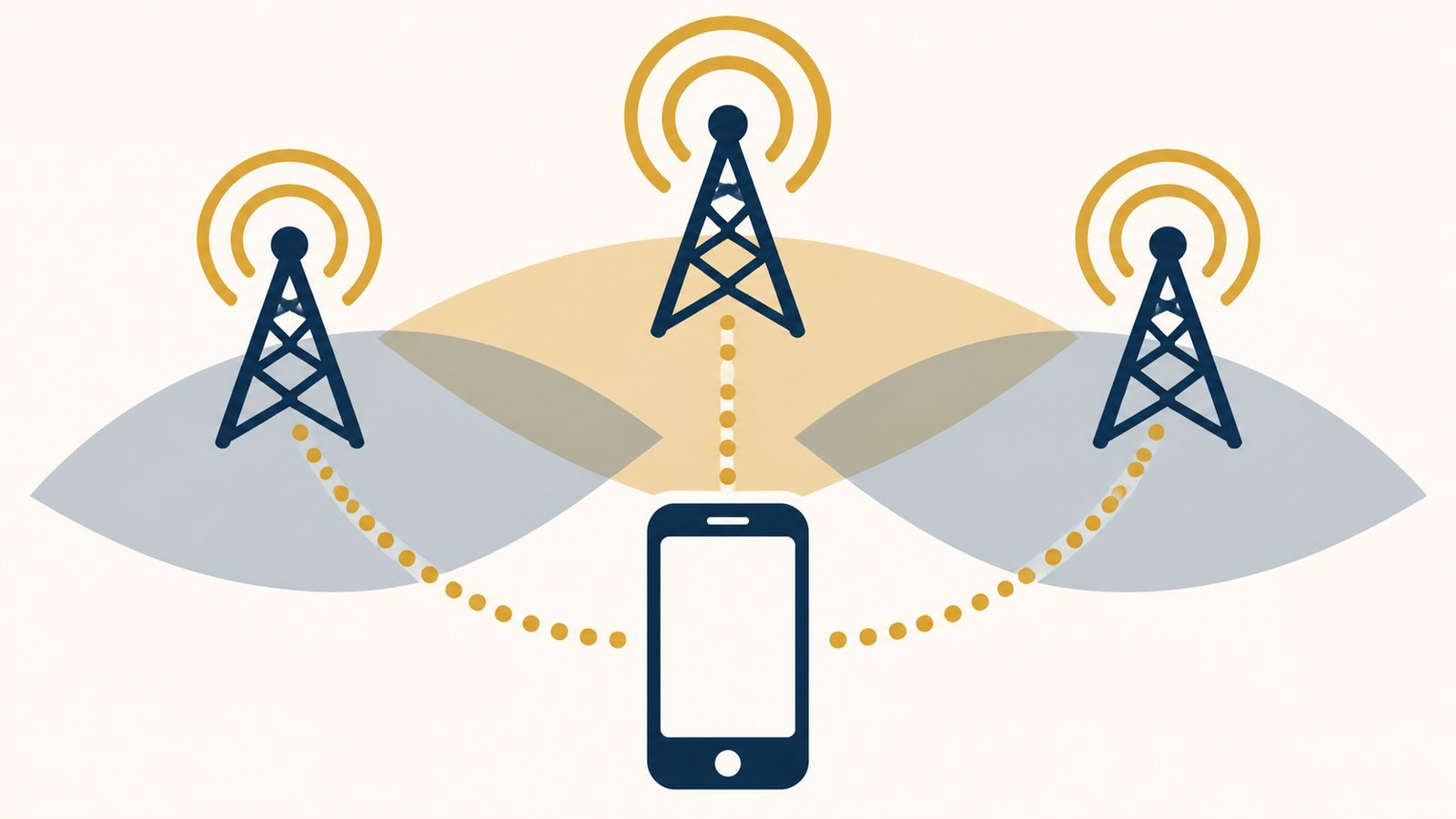
Less precise than most jurors think. On a busy Friday night, a phone may skip the nearest tower because it’s crowded, or because a hill or a parking garage is in the way.
Hypothetical: Picture a pizza slice drawn on a map. A 10:12 p.m. call used Tower 4, sector 2, and that slice covers the victim’s street, a truck stop, and two apartment complexes. The phone was somewhere inside the slice. Nobody can say where.
Other gaps show up the same way. Say two calls ten minutes apart used different towers. The connection changed, but that doesn’t prove the phone moved or say how far. If no calls show between 10:15 and 11:00 p.m., the phone made no logged network activity. It doesn’t tell you where the phone was.
Drive tests have a similar problem. An analyst drives the main road and records which towers the test phone hits. That shows how signals behaved on the test day, which may be months after the night in question.
Who was holding the phone?
Records follow a device and an account. Whether the defendant had that phone at that moment is a separate fact the State has to prove.
Picture how that plays out:
- Two brothers share one phone. The records alone can’t say which one carried it.
- A phone sits charging in a car. The car’s location isn’t the person’s location.
- Someone bought a prepaid phone with cash. The State has to link it to a person some other way.
- The texts on the phone sound like the defendant. That may support possession, and the defense can test it.
How does the defense test a location expert?
Texas Rule of Evidence 702 lets a qualified expert testify only when the testimony will help the jury. The court decides first whether the method is reliable, and the defense can challenge how the method was applied to these records.
Maps and summaries can drop rows or misread time zones, and towers get added, moved, and re-aimed. So your lawyer usually asks for:
- The raw carrier records in native format
- The carrier’s tower list and sector headings for those dates
- The analyst’s notes, software, and drafts
- Any drive-test data and the date of the test.
- Records that help the defense, which the State must disclose under art. 39.14(h).
How can location evidence help the defense?
The same records can support an alibi or point toward another person’s movements.
| Hypothetical | Possible defense use |
|---|---|
| The defendant’s phone used a tower across town at the time of the shooting. | It can support an alibi once it’s checked against witnesses and receipts. |
| A witness’s phone was nowhere near the scene. | It gives a reason to question what the witness says they saw. |
| The State’s map leaves out two calls. | It supports a completeness challenge to the analyst’s work. |
Carriers don’t keep these records forever. Ask your lawyer about a preservation letter in the first week.
What can a family do about phone evidence?
Phones get shared, borrowed, and left in cars. Families often know those details better than anyone. Write them down for the defense lawyer:
- Every number your loved one used that month, and the carrier for each
- Who else used, borrowed, or paid for each phone
- Where each phone usually stayed at night, such as a nightstand or a car charger
- Any receipts, rides, or check-ins that place your loved one somewhere that evening
Hand the list to the lawyer, not to the police.
Frequently asked questions
Can cell tower records prove someone was at a crime scene?
Not by themselves. One sector can cover a truck stop, two apartment complexes, and the victim’s street all at once.
Do police always need a warrant for location data?
Generally, yes. Say detectives want three months of a suspect’s tower records. Carpenter says they generally need a warrant. If they want to scroll through the phone itself after an arrest, Riley and art. 18.0215 say the same. Exceptions exist, and whether one fits turns on the facts.
What if the phone wasn’t mine or I didn’t have it?
The State still has to connect you to the device at the relevant time. Tell your lawyer who else used it.
Should my family delete location history to protect me?
No. Deleting or altering data can create new legal problems, so let counsel handle preservation.
Talk with Heath Hyde
If phone records are part of a murder investigation or charge, how police gathered them matters. Call Heath Hyde, P.C. at 903.439.0000 or request a free consultation. You can also review what the State must prove in a Texas murder case and the rest of the Texas Murder Trial Defense Knowledge Hub.
Legal sources
- Carpenter v. United States, 585 U.S. 296 (2018)
- Riley v. California, 573 U.S. 373 (2014)
- Tex. Code Crim. Proc. art. 18.0215
- Tex. Code Crim. Proc. art. 38.23
- Tex. Code Crim. Proc. art. 39.14
- Tex. R. Evid. 702–705, 901
This article provides general educational information, not legal advice. Every case depends on its facts, evidence, court, deadlines and governing law. Past results do not guarantee a similar outcome.