


How Does the Punishment Phase of a Murder Trial Work?
After a guilty verdict in a noncapital Texas murder trial, punishment is a separate hearing with its own evidence, instructions and decision-maker.
Mr. Heath Enix ‘Heath’ Hyde
Eligible to Practice in Texas
Attorney at Law
Bar Card Number: 00796807
TX License Date: 11/01/1996
Primary Practice Location: Dallas, Texas
Return to the Texas Murder Trial Defense Knowledge Hub
Short answer
Punishment is its own hearing, after a guilty verdict. It can show who your loved one is beyond the worst day of his life. It can’t lead to probation for a §19.02 murder, and the jury sentences only if he chose that in writing before jury selection.
| What families may assume | What the punishment rules actually say |
|---|---|
| “The jury always picks the sentence.” | Only if he elected jury sentencing in writing |
| “A jury can give him probation.” | Not for a §19.02 murder conviction |
| “Old arrests can’t come in.” | They can, if proved beyond a reasonable doubt |
| “Sudden passion means he goes home.” | It lowers murder to a second-degree felony |
What to do now: Ask the lawyer, well before jury selection, whether the defense will file a jury election, and what offense date the range and parole rules will follow.
Who decides the sentence?
Weeks before trial, the defense decides whether to file a one-page jury election. That page decides who sentences.
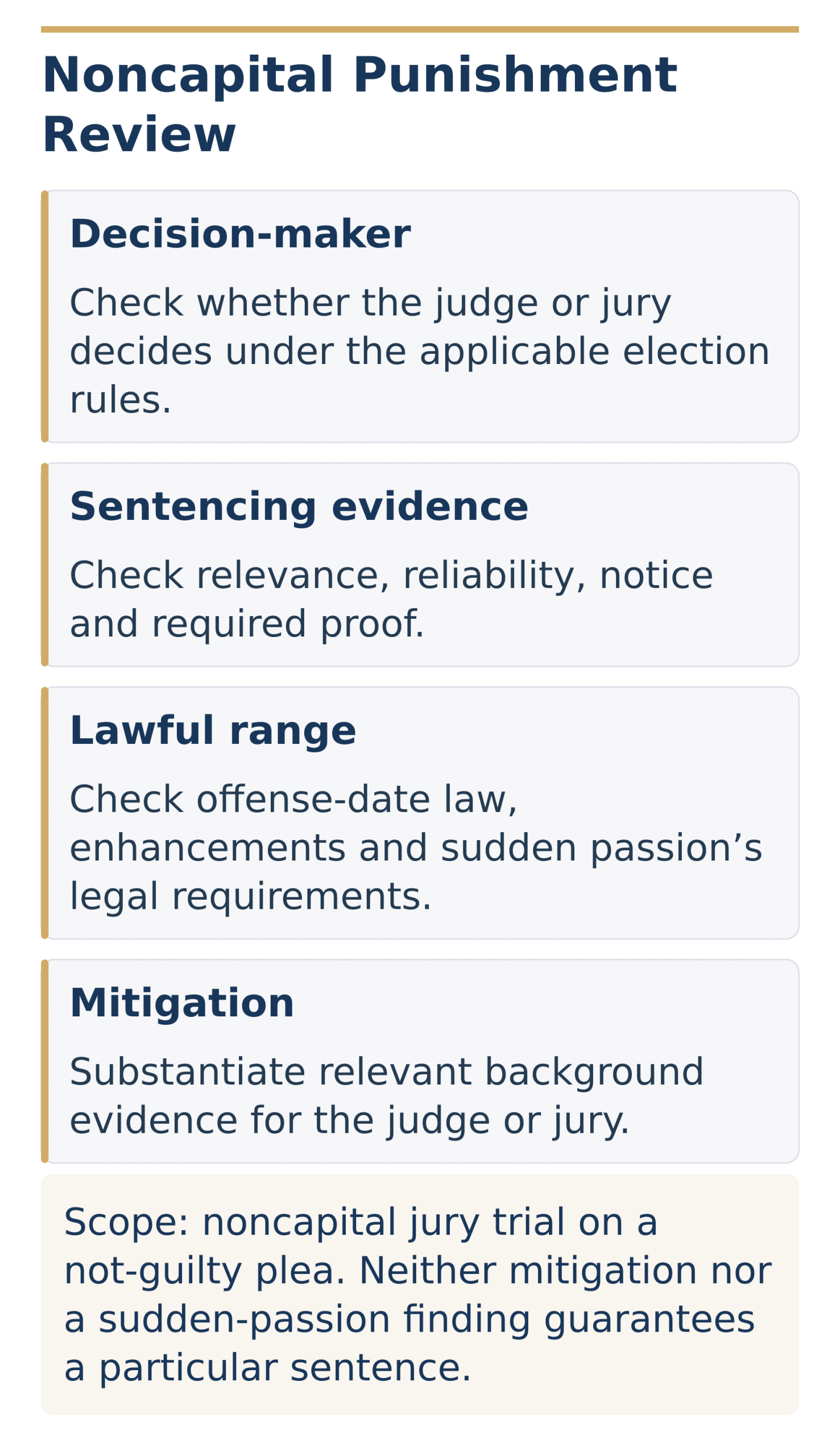
Under art. 37.07, §2, the jury decides guilt first and isn’t asked about punishment. If it finds him guilty, the judge assesses punishment by default. The same jury sentences only if the defendant elected that in writing before voir dire began. After a guilty verdict, he can change the election only with the prosecutor’s consent. Capital murder follows art. 37.071 instead.
One missed deadline, hour by hour:
- 9:00 a.m., Monday, June 8: voir dire begins
- 2:30 p.m.: the signed jury election reaches the clerk
- Result: too late, so the judge assesses punishment
Choosing a jury doesn’t open the door to probation.
| Statute | What it bars |
|---|---|
| Art. 42A.056(3) | Jury-recommended community supervision after a §19.02 murder conviction |
| Art. 42A.054(a)(2) | Judge-ordered community supervision for murder |
The offense date matters as well. The law in effect on that date controls the range and the parole rules.
What can the judge or jury hear?
The State calls a jail officer to describe a fight the defendant was never charged with. Can that come in?
Possibly. Art. 37.07, §3(a)(1) lets either side offer his prior record, reputation, character and the circumstances of the offense. Other crimes or bad acts can come in too. They have to be shown beyond a reasonable doubt to have been committed by the defendant, charged or not. On a timely defense request, §3(g) requires notice of those unadjudicated acts, with the date, county and alleged victim. Under §3(a)(2), the State may not offer race or ethnicity as a predictor of future crime.
The rules of evidence still apply.
| Rule | What the defense can do |
|---|---|
| TRE 403 | Ask to exclude evidence when unfair prejudice substantially outweighs its value |
| TRE 602 | Object when a witness lacks personal knowledge |
| TRE 702–705 | Test an expert’s qualifications, basis and method |
The defense presents mitigation too: work history, health, upbringing, and people who know him. Records and live witnesses back up each point.
A defense case might open with ten years of payroll records from one body shop. A pastor who has known the defendant since he was six testifies next. Then a psychologist walks the jury through four years of treatment records.
What sentence range applies?
Murder under Penal Code §19.02 is a first-degree felony unless sudden passion is proved.
| Finding | Range |
|---|---|
| First-degree felony, §12.32 | Life or 5 to 99 years, plus a fine up to $10,000 |
| Sudden passion proved, second degree, §12.33 | 2 to 20 years, plus a fine up to $10,000 |
| One prior felony proved, §12.42(c)(1) | Life or 15 to 99 years, plus a fine up to $10,000 |
The enhancement row excludes certain state jail felonies. A sudden-passion finding or a proved enhancement moves the case off the first row.
How does sudden passion work at punishment?
The man who was killed attacked the defendant’s child moments before the shooting. That may raise sudden passion.
Under Penal Code §19.02(d), the defendant raises it at punishment. He must prove it by a preponderance of the evidence.
Two terms carry the definition. “Sudden passion” has to come from provocation by the person killed or someone acting with him, at the time of the offense, and not only from something earlier.
“Adequate cause” is the kind that would commonly produce anger, rage, resentment or terror in a person of ordinary temper, enough that the mind can’t reflect coolly. Prove both, and the offense drops to a second-degree felony. He’s still convicted.
| Fact | Fits the definition? |
|---|---|
| The provocation came seconds before the act. | It may, if the other elements are met. |
| He brooded for days over an old insult. | No. Former provocation alone isn’t enough. |
| A stranger provoked him. | No, unless that person acted with the complainant. |
What instructions does a sentencing jury get?
After the evidence closes, the jurors are back in the box. The judge gives them a written charge under art. 37.07, §3(b).
| Instruction | What it tells jurors |
|---|---|
| Extraneous acts | Reasonable doubt applies, even without a defense request (Huizar, 2000). |
| Parole, §4(a) | For murder, no parole eligibility until actual time served equals half the sentence or 30 years, whichever is less. |
| Parole limits | Jurors may consider that parole exists, not how it applies to him. |
| Sudden passion | If raised, whether he proved it by a preponderance |
A jury verdict isn’t complete until it decides both guilt and punishment. If a sentencing jury can’t agree, art. 37.07, §3(c) requires a mistrial only on punishment, and a new jury is seated for that phase. When the judge sentences, §3(d) lets the judge order a presentence report and then announce the sentence in open court.
What can a family do before the punishment hearing?
Maybe your uncle has kept every pay stub from the shop since 2014. Maybe the pastor who baptized him has already asked whether he can speak.
Gather the pay stubs, school papers and medical records already at home, plus names and numbers of people who know his character. Hold any letters to the court until the lawyer reads them. In the gallery, keep a calm face during the State’s evidence. The lawyer decides who testifies and in what order.
Frequently asked questions
Can someone convicted of murder get probation from a jury?
Art. 42A.056(3) makes a §19.02 murder conviction ineligible for jury-recommended community supervision. Read more about probation in Texas murder cases.
Does the defendant have to testify at punishment?
Whether to testify is his call, made after advice from counsel.
Can the State use an arrest that never led to charges?
Sometimes. The judge or jury must first find beyond a reasonable doubt that he committed the act.
When could he be eligible for parole?
Not right away. The §4(a) instruction says half the sentence or 30 years of actual time, whichever is less. See how parole rules affect a Texas murder sentence.
Talk with Heath Hyde
Punishment preparation starts long before a verdict, including the jury-election decision. Call Heath Hyde, P.C. at 903.439.0000 or request a free consultation. You can also read what punishment can follow a Texas murder conviction.
Legal sources
- Tex. Code Crim. Proc. art. 37.07
- Tex. Code Crim. Proc. arts. 42A.054, 42A.056
- Tex. Penal Code §§12.32, 12.33, 12.42
- Tex. Penal Code §19.02
- Tex. R. Evid. 403, 602, 702–705
- Huizar v. State, No. 794-98 (Tex. Crim. App. 2000)
This article provides general educational information, not legal advice. Every case depends on its facts, evidence, court, deadlines and governing law. Past results do not guarantee a similar outcome.