


What Is Mitigation Evidence and When Should It Be Collected?
Mitigation evidence shows the sentencer who a person is and what shaped him. In a Texas murder case, the work starts long before any verdict.
Mr. Heath Enix ‘Heath’ Hyde
Eligible to Practice in Texas
Attorney at Law
Bar Card Number: 00796807
TX License Date: 11/01/1996
Primary Practice Location: Dallas, Texas
Return to the Texas Murder Trial Defense Knowledge Hub
Short answer
It’s the part of the case about who he is: school, work, family, health. It can’t guarantee a lower sentence or change a mandatory one. Records disappear and people forget, so your lawyer starts gathering it early.
| What families may hear | What mitigation may actually do |
|---|---|
| “The sentence only depends on the crime.” | Character and history can be weighed too |
| “It’s an excuse for what happened.” | Context for the sentence, not a defense |
| “We can gather it after the verdict.” | Records and witnesses may be gone by then |
| “A good story is enough.” | Each topic needs records behind it |
What to do now: Start a kitchen-table timeline of every school, job, move and doctor, in order. Keep it private and give it only to the lawyer.
What counts as mitigation in a Texas murder case?
Your brother’s third-grade teacher remembers him coming to school hungry every Monday. Texas law lets that kind of fact reach the sentencer.
The judge or jury deciding punishment uses mitigation at the punishment stage, after a guilty verdict or plea. In a noncapital murder case, art. 37.07, §3(a)(1) lets either side offer any matter the court deems relevant to sentencing. That includes character and the circumstances of the offense.
| Capital-case rule | What it says |
|---|---|
| Art. 37.071, §2(a)(1) | Background, character or offense circumstances that mitigate against death come in |
| Art. 37.071, §2(f)(4) | Mitigation is evidence a juror might see as reducing moral blameworthiness |
| Art. 39.14(h) | The State must disclose mitigating information that would tend to reduce punishment |
Mitigation isn’t an excuse. Each topic needs proof.
| Topic | Records and people behind it |
|---|---|
| Childhood trauma or neglect | Child-welfare files, counselor notes, relatives who saw it |
| A mental-health condition | Treatment records and a qualified evaluator |
| Steady work | Payroll records, supervisors, coworkers |
| Military service | Service records and people he served with |
| Good conduct in jail | Disciplinary records and program certificates |
Why should the work start early?
Records sit in filing rooms with shred dates. The people who remember get older.
Say the defense is hired in January. By October, the elementary school has purged its 2009 files, including the learning-disability testing. The grandmother who raised him has died. The body shop where he worked six years has closed, and nobody has the payroll.
The U.S. Supreme Court looked at a version of this problem in a capital case.
| Case | What the Court held |
|---|---|
| Wiggins v. Smith (2003) | Not looking beyond a presentence report and social-services records fell short of professional standards. |
| Wiggins, on strategy | Choices made after incomplete investigation are reasonable only as far as professional judgment supports the limits on investigation. |
Wiggins doesn’t set a checklist for every murder case. It shows why decisions should come after investigation, not before.
How does a report card become evidence?
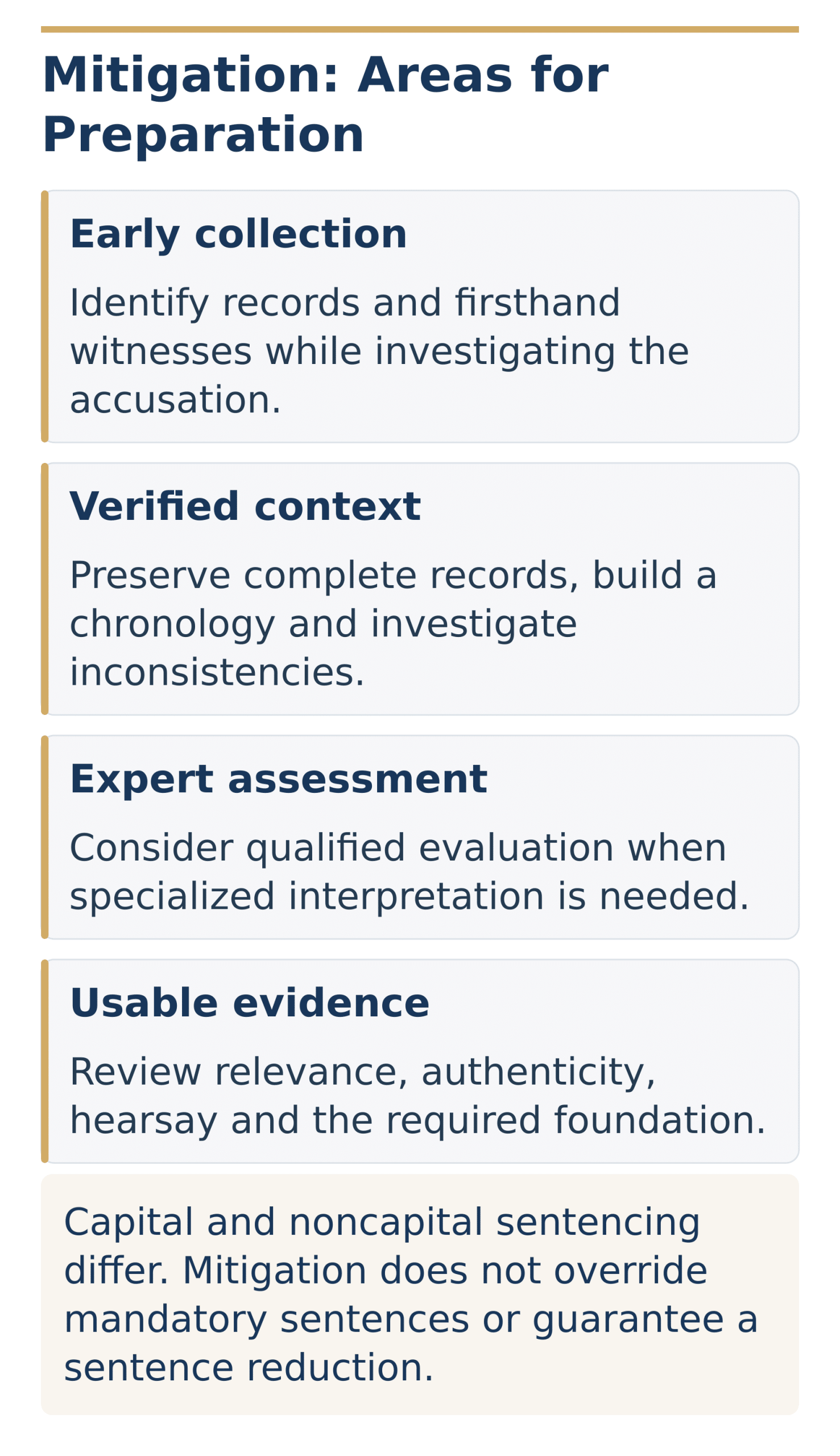
A report card in a shoebox isn’t evidence yet. Someone has to get it admitted.
TRE 901 requires evidence sufficient to support a finding that the item is what it claims to be. TRE 803(6) covers a record made at or near the time by someone with knowledge and kept as a regular practice. Under TRE 902(10), a business-record affidavit must be served on the other side at least 14 days before trial.
Medical records need a signed release first. A provider generally can’t hand them over without a valid authorization under 45 C.F.R. §164.508, and counsel handles those forms.
| Witness | What they can say |
|---|---|
| A coach | What he saw, like the boy who slept in the field house after games |
| A treating doctor | Her diagnosis and the treatment she gave |
| A defense evaluator | An opinion, if qualified under TRE 702, after reviewing records and meeting him |
| Family | What they saw, not diagnoses |
How is capital mitigation different?
A capital jury has already answered “yes” on the earlier special issues. One question is left. Do sufficient mitigating circumstances warrant life without parole rather than death?
A “yes” on that question needs at least 10 jurors. They don’t have to agree on which evidence supports it.
If the State doesn’t seek death, Penal Code §12.31 sets the sentence. It’s life without parole for an adult, or life if the offense happened before age 18. Mitigation can’t change a mandatory sentence.
Who builds capital mitigation, and where does it get used?
A year before jury selection, the mitigation specialist is at the client’s grandmother’s kitchen table. She has a records-release form and a handwritten list of six schools the client went to between kindergarten and ninth grade.
In a death case, mitigation is built by a team. The team then uses it at more than one point in the punishment phase.
The State Bar of Texas Guidelines and Standards for Texas Capital Counsel (2006) call for a defense team of at least two qualified lawyers, an investigator and a mitigation specialist. The Code of Criminal Procedure doesn’t use the phrase “mitigation specialist.” It does require lead counsel appointed in a death case to have trial experience “investigating and presenting mitigating evidence at the penalty phase of a death penalty trial” (art. 26.052(d)(2)(F)(ii)). It also gives appointed counsel a way to pay for investigation. Article 26.052(f) allows a sealed, ex parte request for advance payment. Article 26.052(h) allows reimbursement of expenses that were “reasonably necessary and reasonably incurred.”
The life-history file comes up in three places:
| Where | Source | What the defense asks |
|---|---|---|
| Future danger | Art. 37.071 §2(b)(1); §2(d)(1) has jurors weigh “the defendant’s background or character” | How has he behaved in structured settings: school, the military, work, jail? |
| Mitigation | Art. 37.071 §2(e)(1), “the personal moral culpability of the defendant” | What in his history bears on blameworthiness, and which records prove it? |
| The State’s aggravation | Rompilla v. Beard (2005) | Has counsel read the full file on every prior conviction the State will use? |
The first point is easy to miss. A jury has to answer the future-danger question “yes” before it ever reaches the mitigation question. Background evidence can matter at that first step too.
The last point comes from a case where counsel didn’t read the file. In Rompilla, the defense knew the prosecution would rely on an earlier conviction but never read that court file. The Supreme Court held that counsel “is bound to make reasonable efforts to obtain and review material” the prosecution will probably use in aggravation. The file Rompilla’s lawyers skipped held leads about his childhood, mental health and alcohol use. I’d pull every prior judgment, plea paper and prison record the State lists in its notice of extraneous conduct, because the State’s own exhibits can lead to mitigation.
For families, the practical difference is the timeline. A capital team may ask about grandparents, moves, hospital stays and lost jobs from decades back. Answer those questions to the team privately and as fully as you can, including the facts that are hard to talk about.
How is sudden passion different from mitigation?
Say he snapped seconds after the man he shot threatened his daughter. That’s sudden passion under Penal Code §19.02(d), a specific punishment issue, not a label for hard circumstances.
| Feature | Sudden passion | General mitigation |
|---|---|---|
| Burden | The defendant proves it by a preponderance. | No statute assigns one in a noncapital case. |
| Effect | The offense becomes a second-degree felony. | It may support a lower sentence in the range. |
| Source | Provocation at the time by the person killed or someone acting with him | Any relevant part of his life |
Now change one fact. The threat came by text two weeks before the shooting. Sudden passion has to arise at the time of the offense and not solely from earlier provocation, so that history may fit better as general mitigation.
What can a family do while mitigation is being gathered?
Maybe your aunt has a shoebox of report cards in the hall closet. Maybe your father wants the lawyer to hear only the good parts.
- A private timeline of schools, jobs, moves and doctors
- Documents you already have lawfully, unmarked
- Names and phone numbers of people who knew him well
- The hard facts too, told only to counsel
Don’t post about his history online, and don’t coach anyone on what to say.
Frequently asked questions
Is mitigation only for death-penalty cases?
Art. 37.07 opens the door in noncapital murder cases too. The sentencer can hear anything the court finds relevant to punishment.
Who collects mitigation evidence?
Usually a defense investigator or mitigation specialist, working under the lawyer. The family supplies names and papers.
Can mitigation help in plea talks?
Sometimes. It may help the defense explain the person to the prosecutor, and whether to share it is your lawyer’s call.
Can mental illness be mitigation?
It can, and it may also raise competency or insanity questions, which counsel should evaluate separately.
Talk with Heath Hyde
If someone you love is facing a murder charge, start gathering names and documents now and share them only with counsel. Call Heath Hyde, P.C. at 903.439.0000 or request a free consultation. You can also review what punishment can follow a Texas murder conviction, how sudden passion works, and our family resources.
Legal sources
- Tex. Code Crim. Proc. arts. 37.07, 37.071
- Tex. Code Crim. Proc. art. 39.14
- Tex. Penal Code §12.31
- Tex. Penal Code §19.02
- Tex. R. Evid. 702, 803(6), 901, 902(10)
- Wiggins v. Smith, 539 U.S. 510 (2003)
- 45 C.F.R. §164.508
- Tex. Code Crim. Proc. art. 26.052(d), (f), (h)
- Tex. Code Crim. Proc. art. 37.071 §2(b), (d), (e)
- Rompilla v. Beard, 545 U.S. 374 (2005)
- State Bar of Texas, Guidelines and Standards for Texas Capital Counsel, 69 Tex. B.J. 966 (2006)
This article provides general educational information, not legal advice. Every case depends on its facts, evidence, court, deadlines and governing law. Past results do not guarantee a similar outcome.