

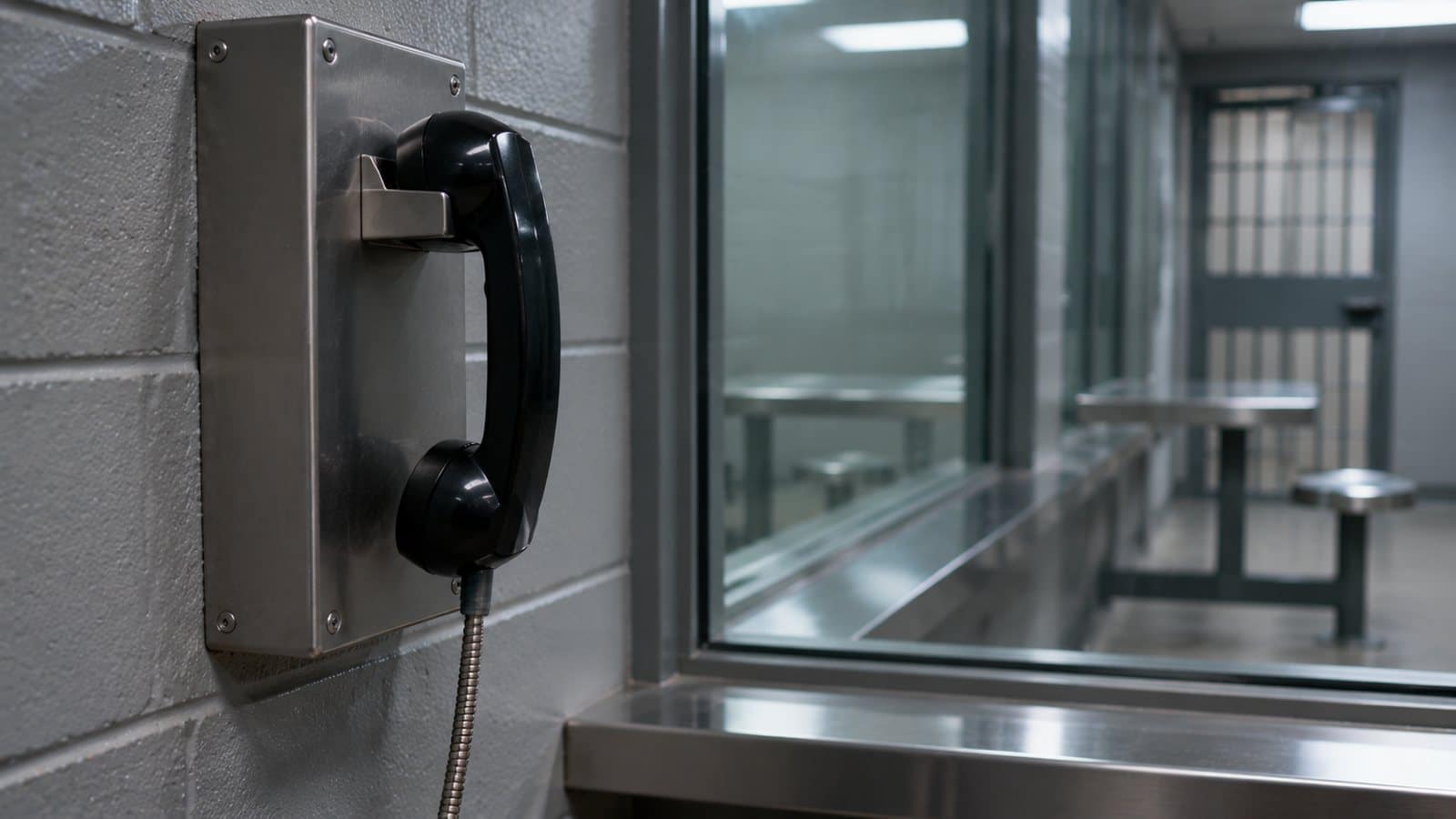
How Can Jail Calls and Recorded Messages Affect the Defense?
A jail call can put your loved one’s own words in front of a jury. It can’t say what he meant or what came before the clip.
Mr. Heath Enix ‘Heath’ Hyde
Eligible to Practice in Texas
Attorney at Law
Bar Card Number: 00796807
TX License Date: 11/01/1996
Primary Practice Location: Dallas, Texas
Return to the Texas Murder Trial Defense Knowledge Hub
Short answer
A jail call can show what your loved one said, word for word. It can’t show what he meant, who else was on the line, or what came before the clip. So your lawyer gets the full call, checks the speakers, and asks the court to play the rest.
| What the State may say | What the call may actually show |
|---|---|
| “He admitted it on the phone.” | A 40-second clip from a 15-minute call |
| “That’s his voice.” | A call placed on another inmate’s PIN |
| “The transcript says ‘gun.'” | Muffled audio and an officer’s best guess |
| “His mother knew.” | Her words, which need their own hearsay ruling |
What to do now: Agree on one family rule before the next call: news, health and commissary money only. Write down the date and time of any call that already went wrong, and give that list to the lawyer.
Why would a family phone call end up in front of a jury?
It’s 8:15 p.m. on a Tuesday. Your son calls from the county jail, and a recorded voice says the call may be monitored. Ten minutes in, he says, “I told you to get rid of that phone.”
That sentence doesn’t have to be a confession to hurt. Under TRE 801(e)(2)(A), his own statement offered against him isn’t hearsay. His sister’s words on the same call are different. They need their own hearsay analysis under TRE 801 and 802.
Family calls also aren’t privileged. TRE 503 protects confidential communications made to get legal services. A mother isn’t a lawyer, and a recorded line isn’t confidential.
Here’s how a prosecutor may frame a few lines.
| Line on the call | How the State may use it |
|---|---|
| “I told you to get rid of that phone.” | Consciousness of guilt or evidence tampering |
| “Tell Mike he didn’t see anything.” | An attempt to influence a witness |
| “I was at my cousin’s all night.” | A claim to test against phone records |
| His mother: “I know you didn’t mean to.” | Hearsay the defense can challenge |
Talking in code doesn’t fix this. Prosecutors can argue what vague words meant, and a code word can sound worse to a jury than the plain one.
Can the defense get every recorded call?
The jail keeps more than the audio.
| Record | How the defense gets it |
|---|---|
| Call log: PIN, date, start time, length | Ask for it with the recordings |
| Recordings of his calls | Discoverable on a timely request, art. 39.14(a) |
| Files the sheriff holds | Part of “the State” under State v. Heath (2024); under review in Moten |
Say that eleven days before trial, the prosecutor sends a drive with 212 calls the sheriff’s office had held for months. Call 147, 9:02 p.m., March 3: your son telling his sister where he was that night. Your lawyer can raise the late disclosure with the court.
Another inmate may also say your son talked in his cell block. If the State plans to call that inmate, art. 39.14(h-1) requires disclosure of his criminal history, any deal for his testimony, and other cases where he testified or offered to testify against a cellmate.
What if police helped set up the call?
Say the visit happens in a small room, with a detective in the corner and a recorder on the table, while the accused talks with his wife. Is that an interrogation?
| Case or rule | What it holds |
|---|---|
| Arizona v. Mauro (1987) | Recording a suspect’s talk with his wife wasn’t interrogation or its functional equivalent. |
| Art. 38.22, §5 | It doesn’t bar a statement that doesn’t stem from custodial interrogation. |
| Massiah v. United States (1964) | Government agents can’t deliberately elicit statements after indictment without counsel. |
Massiah matters when police use another inmate to draw your son out. It may also matter if a relative was working with police. Then the defense asks who arranged the call, what instructions were given, and when. Whether a call can be suppressed depends on how it was obtained and used.
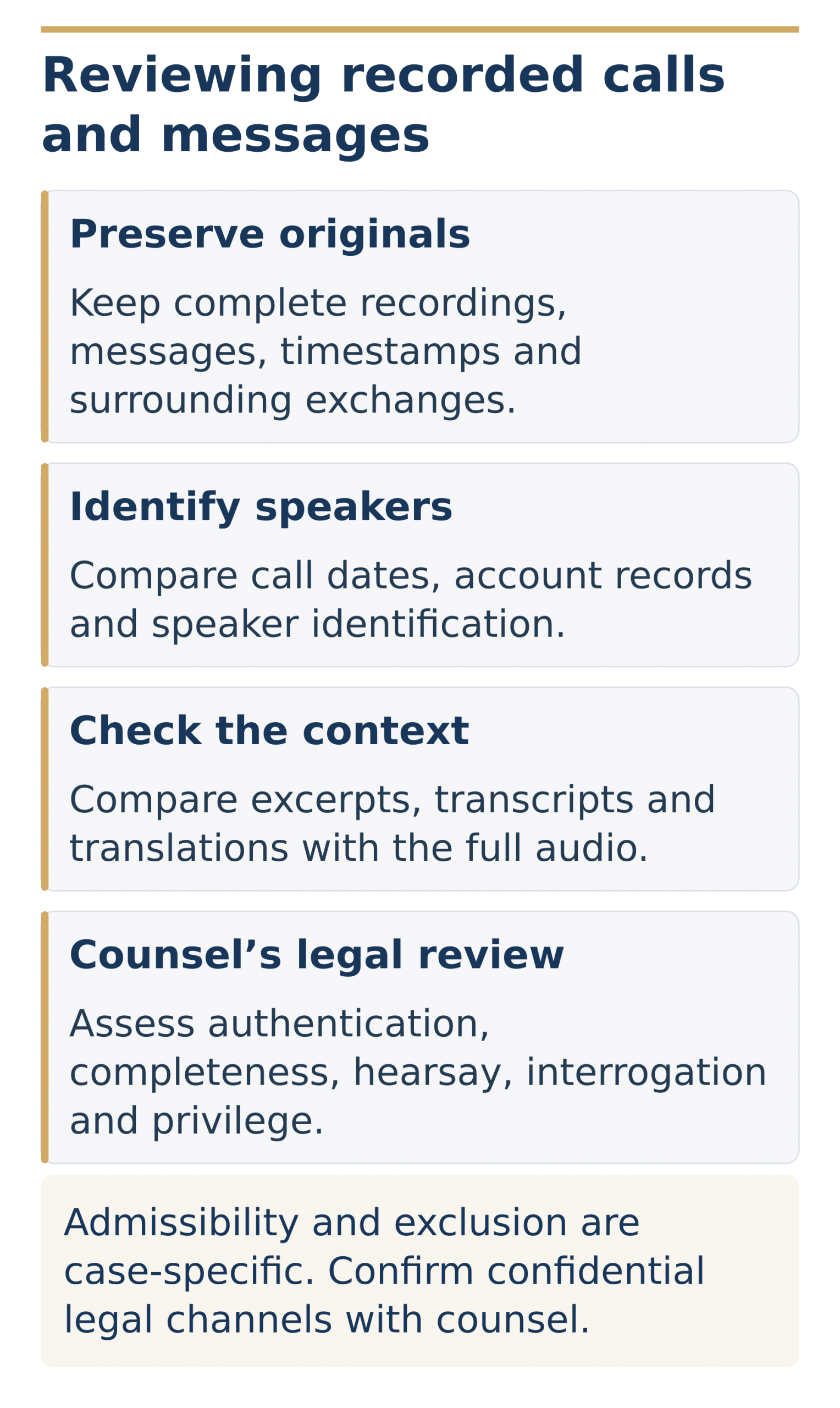
How does the defense test a recording before the jury hears it?
The State’s clip runs 40 seconds. The full call runs 15 minutes. Under TRE 901(a), the State still has to offer evidence that the recording is what it says it is.
| Problem on the recording | What the defense uses |
|---|---|
| Call placed on another inmate’s PIN | TRE 901(b)(5) voice ID and 901(b)(6) number rules |
| 40 seconds of a 15-minute call | TRE 106 and 107 to add the rest |
| Transcript says “gun”; audio is muffled | TRE 901(a) and the audio itself |
| An officer translated the call | A qualified translator’s review |
Rule 106 lets the defense add parts that in fairness belong with the State’s clip. Rule 107 lets it add other parts needed to explain what the State offered. The minute before “get rid of that phone” might be a talk about a cracked screen.
Do voicemails, texts and tablet messages count too?
Mostly, yes. Say a cousin saved a voicemail and later sent police a screenshot of a text thread.
Her screenshot shows four messages, 10:41 to 10:44 p.m. The full thread has 31 that night, and the missing 27 include a ride request to a different address.
So the defense wants the full thread or an export. A voicemail means the original file, its timestamp and the sending number. A jail tablet message means the facility’s account, date and time records. If the State says your son wrote it, TRE 901(b)(4) lets it rely on distinctive content and circumstances, and the defense can test each one.
What can a family do about jail calls?
Maybe your son calls at 8:15 p.m. and starts talking about the night of the shooting. Maybe your sister wants to text a witness “just to check on her.”
- Calls about family news, health and commissary money
- Original texts, voicemails and app messages, unedited
- A dated list of calls that worry you
- Witness names, passed only to the lawyer
Don’t delete or forward the only copy of a message, and don’t relay messages to witnesses. The family arrest guide and the family resources page have more.
Frequently asked questions
Can the defense get copies of the jail calls?
After a timely request, art. 39.14(a) covers the defendant’s recorded statements, and Heath treats calls the sheriff holds as the State’s.
Can a jail call help the defense?
Sometimes. The full 15 minutes may show a short clip is misleading, or a call may support an alibi.
Is a call to his lawyer’s office private?
Not always. A regular inmate line may be recorded, so use the facility’s approved attorney channel, and ask the lawyer how that jail handles attorney numbers.
Do the rules of evidence apply before a grand jury?
Only privilege does. TRE 101(e)(2) says the other rules don’t apply in grand jury proceedings.
Talk with Heath Hyde
If a loved one is in jail on a murder charge, talk with a lawyer before the next call. Call Heath Hyde, P.C. at 903.439.0000 or request a free consultation.
Legal sources
- Tex. R. Evid. 101, 106, 107, 503, 801, 802, 901
- Tex. Code Crim. Proc. art. 38.22
- Tex. Code Crim. Proc. art. 39.14
- Arizona v. Mauro, 481 U.S. 520 (1987)
- Massiah v. United States, 377 U.S. 201 (1964)
- Moten, PD-0932-25 (pending)
- State v. Heath, 696 S.W.3d 677 (Tex. Crim. App. 2024)
This article provides general educational information, not legal advice. Every case depends on its facts, evidence, court, deadlines and governing law. Past results do not guarantee a similar outcome.