What Are Brady Disclosures and Why Do They Matter?
The first description that doesn’t match. The witness with a deal. If the State has it and it helps, it has to come over.
Mr. Heath Enix ‘Heath’ Hyde
Eligible to Practice in Texas
Attorney at Law
Bar Card Number: 00796807
TX License Date: 11/01/1996
Primary Practice Location: Dallas, Texas
Return to the Texas Murder Trial Defense Knowledge Hub
Short answer
Anything in the State’s file that helps the accused, from a mismatched description to a witness’s deal. Federal law requires it when it’s material. Texas requires it either way.
| What the State may say | What the law may require |
|---|---|
| “It wouldn’t change the verdict.” | Texas (h) has no materiality test. |
| “The prosecutor never saw it.” | The duty reaches what police know. |
| “The defense never asked.” | No request is needed. |
What to do now: If you’ve heard something that might help, write it down today with the date and the person who said it, and give the note to your lawyer.
What counts as Brady material?
A neighbor first told police the shooter was “a tall man in a red jacket.” Your son is 5’6″. That first description is exculpatory, and the State has to disclose it.
Impeachment counts too. Say the State’s key witness has a pending drug charge, and someone told him it would “go away” if he testified. So does punishment evidence, such as a co-defendant’s admission to a detective that he fired the fatal shot. A prior inconsistent statement qualifies as well. A witness’s recorded interview may put the shooting at a different time and corner than her trial testimony.
Brady itself was a punishment case. The withheld statement was a companion’s admission that he did the actual killing. It mattered to whether Brady faced the death penalty, and that was enough to require relief on punishment.
Which cases set the federal rule?
Four U.S. Supreme Court decisions do most of the work.
| Case | What the Court held |
|---|---|
| Brady v. Maryland (1963) | Suppressing favorable, material evidence violates due process, whatever the prosecutor’s good or bad faith. |
| Giglio v. United States (1972) | A promise not to prosecute a key witness bears on credibility, and the jury was entitled to know. |
| United States v. Bagley (1985) | Impeachment evidence falls within the Brady rule. |
| Kyles v. Whitley (1995) | The prosecutor must learn of favorable evidence known to police and others acting for the government. |
Does it matter if the prosecutor didn’t know?
Not under Kyles. Say a detective keeps a witness’s second statement in a desk drawer, and the prosecutor never sees it. Under Kyles, the prosecutor has to learn what police and others acting for the government know about the case.
The defense doesn’t have to ask first, either. Kyles, relying on Bagley, said favorable evidence is material regardless of a request.
Not every agency counts automatically. That depends on each agency’s role in the case. Your lawyer maps the team:
- Each agency that worked the case
- The records each agency holds
- A written request for the favorable material in each file
When is a Brady violation proven?
Say the defense learns after trial that a witness first picked someone else from a six-photo lineup. A missing item like that isn’t automatically a violation. Courts look at three parts.
| Element | What the defense must show |
|---|---|
| Favorable | Exculpatory or impeaching evidence |
| Suppressed | Not disclosed, on purpose or by accident |
| Prejudice | A reasonable probability of a different result |
“Reasonable probability” doesn’t mean “more likely than not.” Under Kyles, it’s enough that the missing evidence undermines confidence in the outcome. The items are weighed together, so three small ones can add up.
How does Texas law go further than Brady?
The Michael Morton Act, passed in 2013, pushed Texas disclosure duties past the constitutional floor.
| Texas rule | What it adds |
|---|---|
| Art. 39.14(h) | Disclosure of exculpatory, impeachment, or mitigating information that tends to negate guilt or reduce punishment |
| Watkins v. State (2021) | The (h) duty is “much broader” than Brady, with no materiality limit. |
| Art. 39.14(h-1) | For a jailhouse witness: criminal history, any deal, other cases testified in |
| Art. 39.14(k) | Prompt disclosure of new favorable information before, during, or after trial |
State v. Heath (2024) adds that “the State” includes law enforcement agencies, not just the prosecutor’s office. The rest of the statute is covered in the discovery section of our knowledge hub.
One detective’s March 3 note: $40 in gas money paid to the State’s witness. Brady asks whether that undermines confidence in the verdict. Art. 39.14(h) asks only whether the note is impeachment information.
What does the defense do with a disclosure?
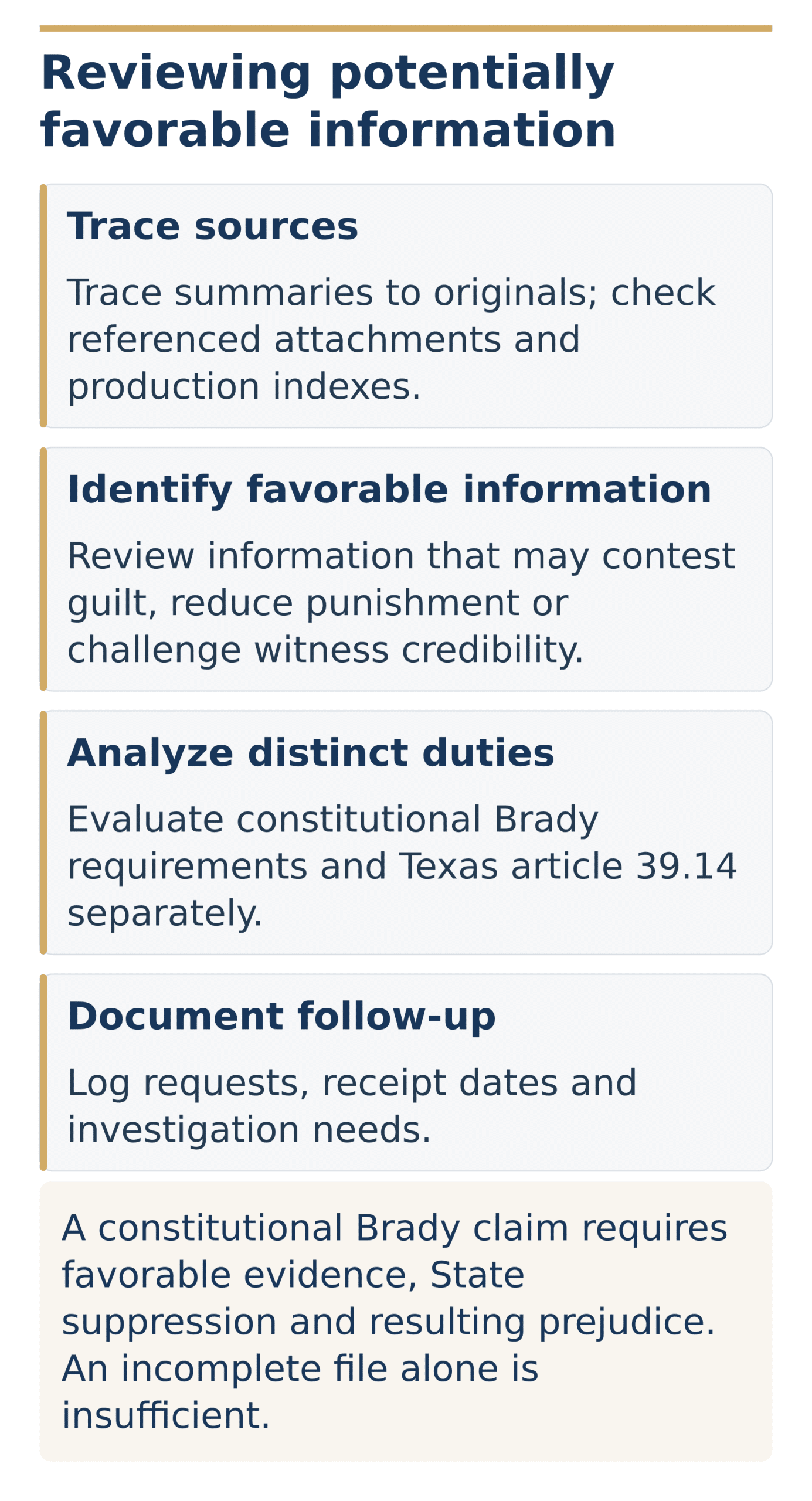
A single page can change the plan. It’s 9 p.m., and a new supplement just came in. It says a cooperating witness was promised leniency. That’s a bias question for cross-examination, especially when the State relies on an accomplice witness.
| What turns up | What your lawyer does |
|---|---|
| A first statement that contradicts the witness’s trial account | Pulls the original recording and compares it word by word |
| A tip naming someone else | Starts work on alternative suspects without speculation |
| A disclosure a week before trial | Asks the court for time to investigate |
| Favorable evidence after the verdict | Raises it promptly; art. 39.14(k) keeps the duty alive |
What can a family do if they hear something?
A cousin at a barbecue hears the State’s witness say she isn’t sure who fired. A detective calls you about a man named nowhere in the papers.
Write it down for the defense lawyer:
- The words you heard, as close as you can get
- The person who said it, and where
- The date and time
- Anyone else who heard it
Bring the note to your lawyer instead of confronting the witness.
Frequently asked questions
Is all favorable evidence “Brady material”?
The constitutional rule asks for prejudice too: a reasonable probability of a different result. Texas art. 39.14(h) has no such test, so more favorable information has to come over in a Texas case.
Does a Brady violation mean the case gets dismissed?
Not automatically. The remedy depends on when the evidence surfaced and how much it mattered.
Can the prosecutor hold back evidence until trial?
Art. 39.14(h) has no request requirement, and Heath read “as soon as practicable” in subsection (a) as soon as reasonably possible. Late disclosure can be raised with the court.
What if the evidence only helps at punishment?
It still counts. Brady covered evidence material to punishment, and art. 39.14(h) covers information that would tend to reduce punishment.
Talk with Heath Hyde
If you think the State is holding back something that could help, write down what you know and bring it to a lawyer. Call Heath Hyde, P.C. at 903.439.0000 or request a free consultation.
Legal sources
- Brady v. Maryland, 373 U.S. 83 (1963)
- Giglio v. United States, 405 U.S. 150 (1972)
- United States v. Bagley, 473 U.S. 667 (1985)
- Kyles v. Whitley, 514 U.S. 419 (1995)
- Tex. Code Crim. Proc. art. 39.14
- Watkins v. State, 619 S.W.3d 265 (Tex. Crim. App. 2021)
- State v. Heath, 696 S.W.3d 677 (Tex. Crim. App. 2024)
This article provides general educational information, not legal advice. Every case depends on its facts, evidence, court, deadlines and governing law. Past results do not guarantee a similar outcome.