
Can a Recorded Statement Be Suppressed?
A recording isn’t automatically evidence. If the State skipped a step, the jury may never hear it.
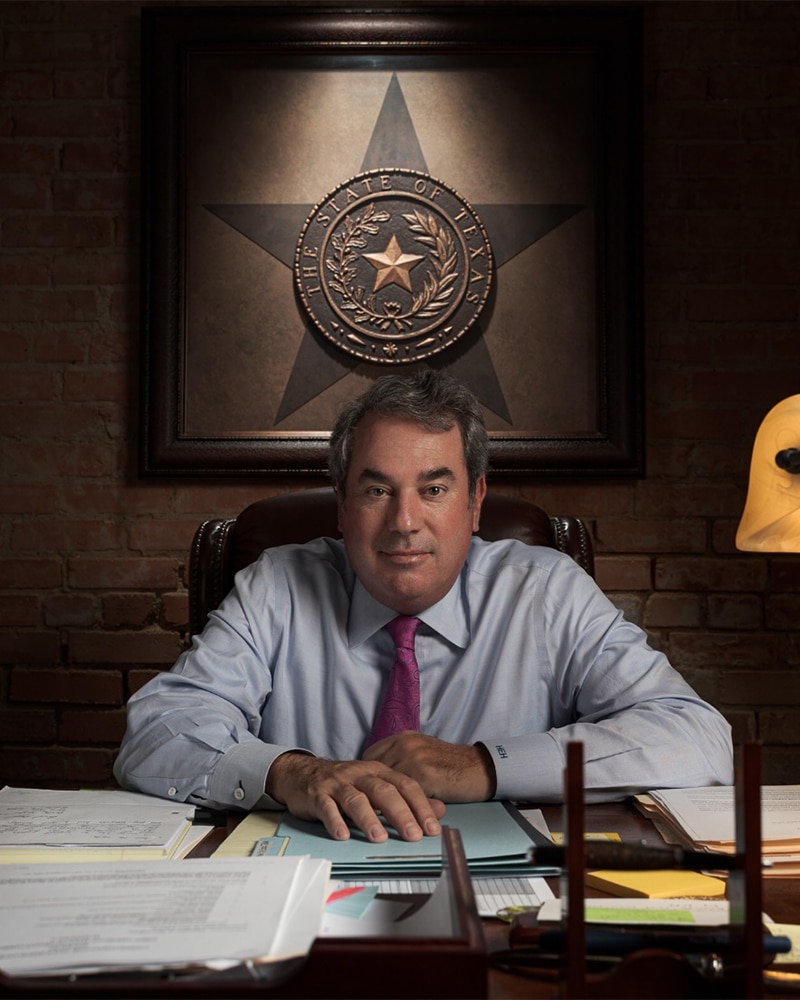
Mr. Heath Enix ‘Heath’ Hyde
Eligible to Practice in Texas
Attorney at Law
Bar Card Number: 00796807
TX License Date: 11/01/1996
Primary Practice Location: Dallas, Texas
Return to the Texas Murder Trial Defense Knowledge Hub
Short answer
When a required step is missing. A video can show what was said. It can’t fix warnings read in the hallway before the camera came on. So your lawyer goes through the recording step by step. Winning keeps the statement out; the case can still go on.
| What the State may say | What the defense checks |
|---|---|
| “He waived his rights.” | Is the waiver on the recording, before the statement? |
| “We read him Miranda.” | Did he hear the Texas right to end the interview? |
| “The camera quit at minute 47.” | A good-faith equipment failure, or a gap? |
| “He talked freely.” | Voluntariness, decided first outside the jury |
What to do now: Write down, while it’s fresh, what time the interview started, who was in the room, and when it ended. Give that page to your lawyer.
What does Texas require on the recording itself?
The video opens on a gray room at 1:12 a.m. A detective says the date, then starts asking questions. Article 38.22, §3(a) of the Code of Criminal Procedure says what has to come before those questions in an oral statement from custodial interrogation.
| Requirement | What it says |
|---|---|
| §3(a)(1) | An electronic recording of the statement |
| §3(a)(2) | Warnings, then a knowing, intelligent, and voluntary waiver, on the recording, before the statement |
| §3(a)(3) | A working recorder, an operator who knows it, and no edits |
| §3(a)(4) | Voices identified, limited by §3(e) to material voices |
There’s a deadline too. Under §3(a)(5), defense counsel must get a true, complete, and accurate copy no later than the 20th day before the proceeding. Section 3(e) tells courts to construe §3(a) strictly.
A common gap, minute by minute:
- 12:58 a.m.: warnings read in the hallway
- 1:12 a.m.: camera starts
- No waiver anywhere on the video
That’s a §3(a)(2) problem.
The Texas warnings in art. 38.22, §2(a) cover:
- the right to remain silent, with any statement usable at trial
- the right to a lawyer before and during questioning, appointed if needed
- the right to end the interview at any time, which Miranda doesn’t list
Listen for that last one on the recording.
Miranda v. Arizona and art. 38.22, §§2–3, require warnings before custodial interrogation. A written statement has its own rule under §2: the warnings and waiver must appear on its face.
What extra rule applies in a murder case?
In murder and capital murder cases, the camera has to be on for the whole interrogation at a place of detention. Under CCP art. 2B.0202(a), the agency must make a complete, contemporaneous electronic recording unless good cause makes it infeasible.
Under art. 2B.0202(b), recording starts when the person enters the interview area or receives warnings, whichever is earlier. It runs until the interrogation ends. Under art. 2B.0201(1), it must be audiovisual, or audio only if audiovisual isn’t available. It must also be authentic, accurate, and unaltered.
Art. 2B.0202(c) lists five kinds of good cause:
- A documented refusal to be recorded
- A spontaneous statement
- A good-faith equipment failure
- An urgent public-safety concern
- An officer’s reasonable belief the case didn’t involve a listed offense
One file can raise several of these. Video that starts after the warnings goes to completeness under (b). A camera “dead at minute 47” goes to (c)(3). A remark blurted out at booking raises whether it was really spontaneous.
Get it wrong and the statement may be out. In a covered case, art. 38.22, §9 bars it unless the State proves good cause.
Who decides whether the statement was voluntary?
The judge decides first, with the jury out of the room.
Voluntariness is a separate question from warnings. Under CCP art. 38.21, the State may use a statement if the accused made it freely and voluntarily, without compulsion or persuasion.
When the defense raises it, art. 38.22, §6, has the judge decide outside the jury’s presence. If the judge admits the statement, the judge enters an order with specific findings.
The jury still gets a say. Under §6, jurors must set the statement aside unless they find, beyond a reasonable doubt, that it was voluntary. Under §7, when the evidence raises the issue, the judge must instruct the jury on the law about the statement.
Does it count as interrogation if nobody asked a question?
It can. Statements often become the State’s main proof of intent, so the line matters.
| Case | What the Court held |
|---|---|
| Rhode Island v. Innis (1980) | Interrogation includes words or actions police should know are reasonably likely to draw an incriminating response. |
| Berghuis v. Thompkins (2010) | The person must invoke the right to remain silent unambiguously. |
| Missouri v. Seibert (2004) | The Court affirmed suppression of warned statements police got by questioning first and warning midstream. |
Say two detectives in the front seat talk about a missing gun near an elementary school, loud enough for the man in back to hear. Under Innis, that talk can count as interrogation if they should know it’s likely to draw an incriminating response.
What happens after the judge rules?
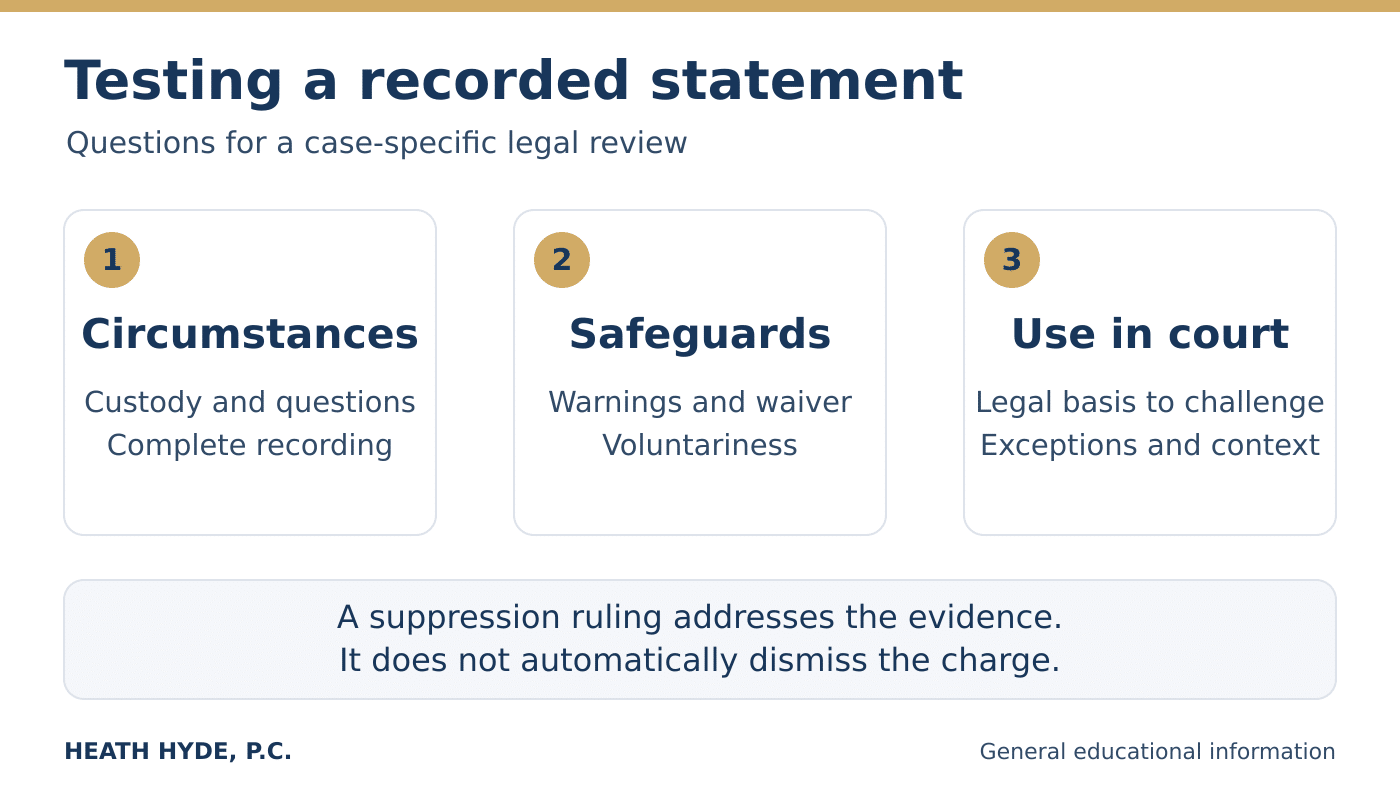
The ruling decides how the statement can be used. It doesn’t decide the case.
| Ruling or fact | What follows |
|---|---|
| Statement suppressed | The State can’t use it to prove guilt; its other evidence stays in. |
| Suppressed, but found voluntary | Art. 38.22, §5 doesn’t bar a voluntary statement bearing on credibility as a witness. |
| Statement admitted | The defense can still attack context and completeness, and TRE 107 brings in other parts on the same subject. |
| Statement led police to a weapon | Section 3(c): §3(a) doesn’t apply to statements of facts later found true that tend to show guilt. |
That last row looks like this: he tells a detective where to look, and an hour later officers pull a pistol from a storm drain on Fourth Street.
What can a family do after a recorded interview?
You may have heard from your loved one right after the interview. Maybe your son called from the station at 3 a.m., said he’d been in a small room for six hours, and repeated a detective’s line: “This is your chance to tell your side.”
Write these down for the defense lawyer:
- The time he went in and the time he came out
- His ride to the station, or his own car
- Officers’ words to him, as he repeated them
- Medication, injuries, or lost sleep that day
That list goes to your lawyer. Not the police.
Frequently asked questions
If I wasn’t read my rights, will the case be dismissed?
No. A warning problem can keep a statement out, but the State can go forward on its other evidence.
Does the State have to give my lawyer the recording?
Yes. For an oral custodial statement to come in, defense counsel must get a complete copy at least 20 days before the proceeding. Article 39.14 also covers recorded statements of the defendant.
Can a written statement be suppressed too?
Yes. A typed statement signed at the end of the interview needs the art. 38.22, §2 warnings and waiver on its face.
What about something I said to a cellmate or a friend?
Not usually under these rules. A conversation with a cellmate usually isn’t custodial interrogation by police, though other challenges may still be available.
Talk with Heath Hyde
Bring the timeline of the interview: when it started, who was there, and when it ended. Call Heath Hyde, P.C. at 903.439.0000 or request a free consultation.
Legal sources
- Tex. Code Crim. Proc. arts. 38.21, 38.22
- Tex. Code Crim. Proc. arts. 2B.0201, 2B.0202
- Tex. Code Crim. Proc. art. 39.14
- Miranda v. Arizona, 384 U.S. 436 (1966)
- Missouri v. Seibert, 542 U.S. 600 (2004)
This article provides general educational information, not legal advice. Every case depends on its facts, evidence, court, deadlines and governing law. Past results do not guarantee a similar outcome.