


WIRE FRAUD · FEDERAL INVESTIGATION
What Happens After a Federal Wire Fraud Target Letter?
A target letter isn’t an indictment. It does mean a federal prosecutor sees you as a likely defendant, and what you do in the next few days matters.
Eligible to Practice in Texas
Attorney at Law
Bar Card Number: 00796807
TX License Date: 11/01/1996
214 Connally St Ste A
Sulphur Spgs, TX 75482-2612
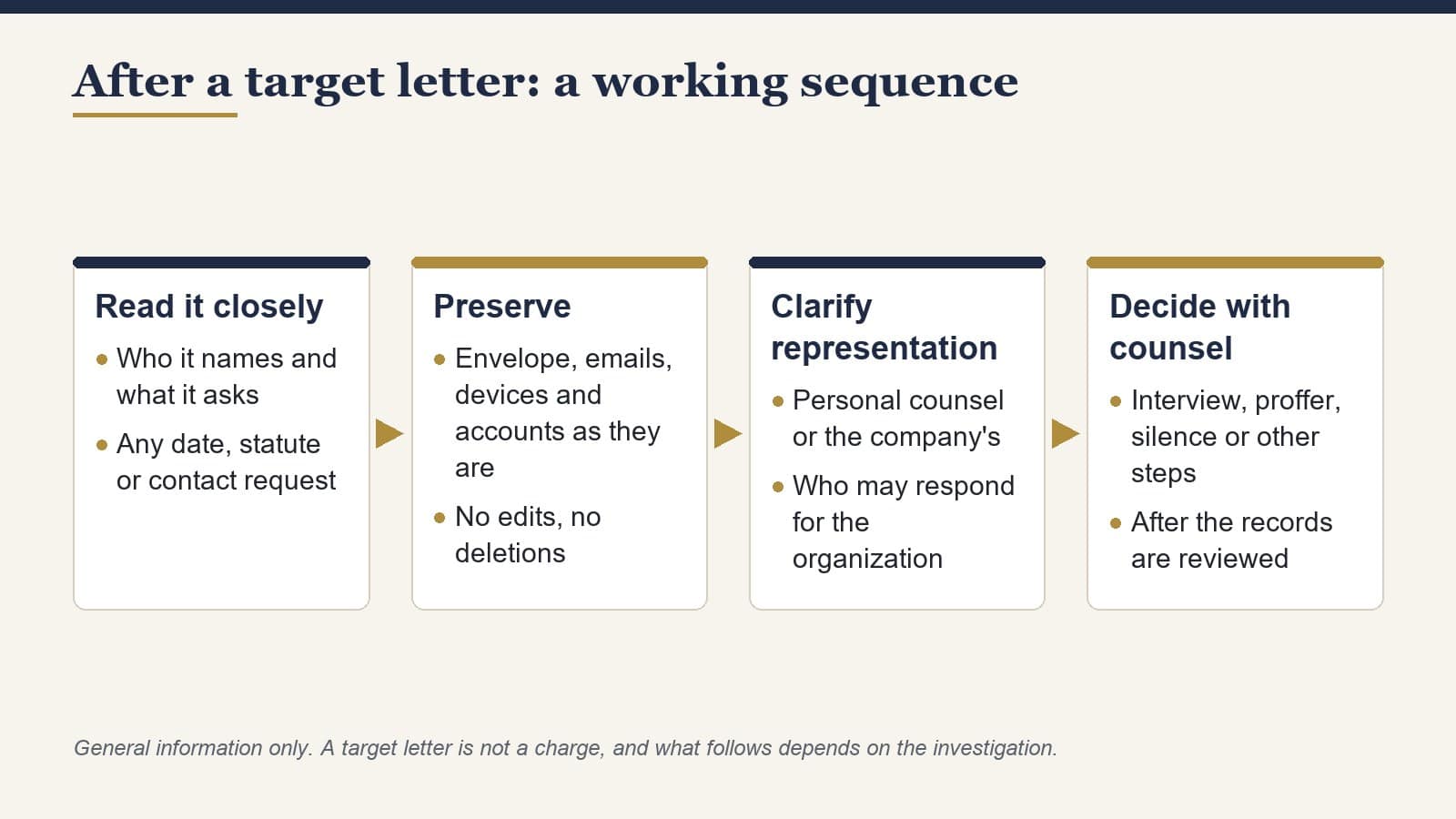
A target letter says a federal prosecutor considers you a target of a grand jury investigation. It isn’t a charge. Keep the letter and the envelope, write down the date it arrived, and talk to a lawyer before you contact the prosecutor, an agent or your employer about it.
What “target” means
Justice Manual § 9-11.151 defines a target as a person the prosecutor or grand jury has “substantial evidence linking him or her to the commission of a crime” and who is “a putative defendant.” A subject is anyone whose conduct falls within the scope of the investigation. An officer or employee of a target company isn’t automatically a target.
Section 9-11.153, “Notification of Targets,” encourages notice in appropriate cases, a reasonable time before indictment, so the target can testify. Notice isn’t appropriate in routine clear cases or where it might jeopardize the investigation. Section 1-1.200 says the Manual creates no rights enforceable in court. No letter doesn’t mean no investigation.
Reading the letter
Five things to copy down from the letter:
- The prosecutor’s name and office (signature block).
- Any statute named, such as 18 U.S.C. § 1343, and any listed transactions.
- Every date, including any deadline to respond, appear or call.
- Anything stapled behind it, such as a subpoena or an invitation to testify.
- The envelope’s postmark.
Preserve records and change nothing
John Yates captained a fishing boat in the Gulf of Mexico. In August 2007 a Florida wildlife officer found 72 undersized red grouper and told him to keep them until port. Yates had the crew throw them overboard. In Yates v. United States (2015), the Supreme Court held fish aren’t a “tangible object” under § 1519. Records and documents are a different matter.
Section 1519 makes it a crime to destroy, alter or falsify “any record, document, or tangible object” with intent to impede a federal investigation. Leave emails, spreadsheets, invoices, wire confirmations and phones as they are. Mark a missing record as missing. Never recreate or backdate one.
Who represents you?
Ask any lawyer who contacts you: “Do you represent me, or the company?” A company lawyer’s duty runs to the company. Who paid the fee doesn’t answer the question.
Hypothetical: a bookkeeper’s letter
- Tuesday, March 3: a bookkeeper at a Sulphur Springs trucking company signs for a target letter.
- The letter cites 18 U.S.C. § 1343 and lists eleven vendor payments from 2025.
- She already knows the owner has met with FBI agents.
| Step the bookkeeper might take | Risk |
|---|---|
| Call the owner to compare recollections | Can look like coordinating testimony. The owner may repeat the call to agents |
| Email the prosecutor an explanation that night | A statement that can be used against her |
| Delete texts about the vendor payments | Possible § 1519 exposure |
| Send the letter, the payment records and a list of contacts to her own lawyer | Low. Counsel can ask the prosecutor about scope before any statement |
Only the last one keeps her options open. I’d want that folder on my desk by Wednesday, with her phones, email accounts and the names of everyone who had the bookkeeping password.
Talking to agents or the grand jury
The facts of Brogan v. United States (1998):
- October 1993: Labor Department and IRS agents visit James Brogan, a union officer, at home.
- They ask whether he took cash from a real estate company. He says no.
- Told that records show otherwise, he sticks to his answer.
The Supreme Court upheld his § 1001 conviction and rejected an “exculpatory no” exception.
- Your lawyer can call the prosecutor about scope and timing while you say nothing.
- JM § 9-11.151’s advice of rights says a witness may refuse to answer if a truthful answer “would tend to incriminate.”
- A proffer is a sit-down under a written agreement. Its terms limit how the government can use what you say.
- Under JM § 9-11.152, a target’s reasonable request to testify ordinarily gets favorable consideration with an explicit waiver of the privilege against self-incrimination.
Common questions
Does a target letter mean I’ll be indicted?
Not always. Under JM § 9-11.155, the U.S. Attorney may tell a former target that target status has ended but isn’t required to.
Can I talk about the letter with others?
Federal Rule of Criminal Procedure 6(e) imposes no secrecy obligation on witnesses. Anything you tell a coworker can be repeated to agents.
Can I just ignore the letter?
The letter alone doesn’t order you to do anything. Under Rule 17(g), a court can hold a witness in contempt for disobeying a subpoena “without adequate excuse.”
Sources
- DOJ Justice Manual § 9-11.151 (Advice of “Rights” of Grand Jury Witnesses)
- DOJ Justice Manual § 9-11.152 (Requests by Subjects and Targets to Testify Before the Grand Jury)
- DOJ Justice Manual § 9-11.153 (Notification of Targets)
- DOJ Justice Manual § 9-11.155 (Notification to Targets when Target Status Ends)
- DOJ Justice Manual § 1-1.200
- Federal Rule of Criminal Procedure 6(e)
- Federal Rule of Criminal Procedure 17(g)
- 18 U.S.C. § 1001
- 18 U.S.C. § 1343
- 18 U.S.C. § 1519
- Yates v. United States, 574 U.S. 528 (2015)
- Brogan v. United States, 522 U.S. 398 (1998)
This article provides general information, not legal advice. The law and its application depend on the facts and the law in effect on the relevant date. Consult a lawyer about a specific matter.