


Wire Fraud · Federal Charges
Is a Broken Business Promise Wire Fraud?
A failed deal does not answer whether a promise was fraudulent when made. The key evidence concerns what the speaker knew, what money or property the scheme sought, and how the transaction unfolded.
Eligible to Practice in Texas
Attorney at Law
Bar Card Number: 00796807
TX License Date: 11/01/1996
214 Connally St Ste A
Sulphur Spgs, TX 75482-2612
A broken promise is not automatically wire fraud. The government must prove the elements of 18 U.S.C. § 1343, including a scheme to obtain money or property by false or fraudulent means, intent to defraud, and an interstate or foreign wire used for executing that scheme. The central intent question is what the accused knew and intended when the relevant representation was made—not simply whether the business later succeeded.
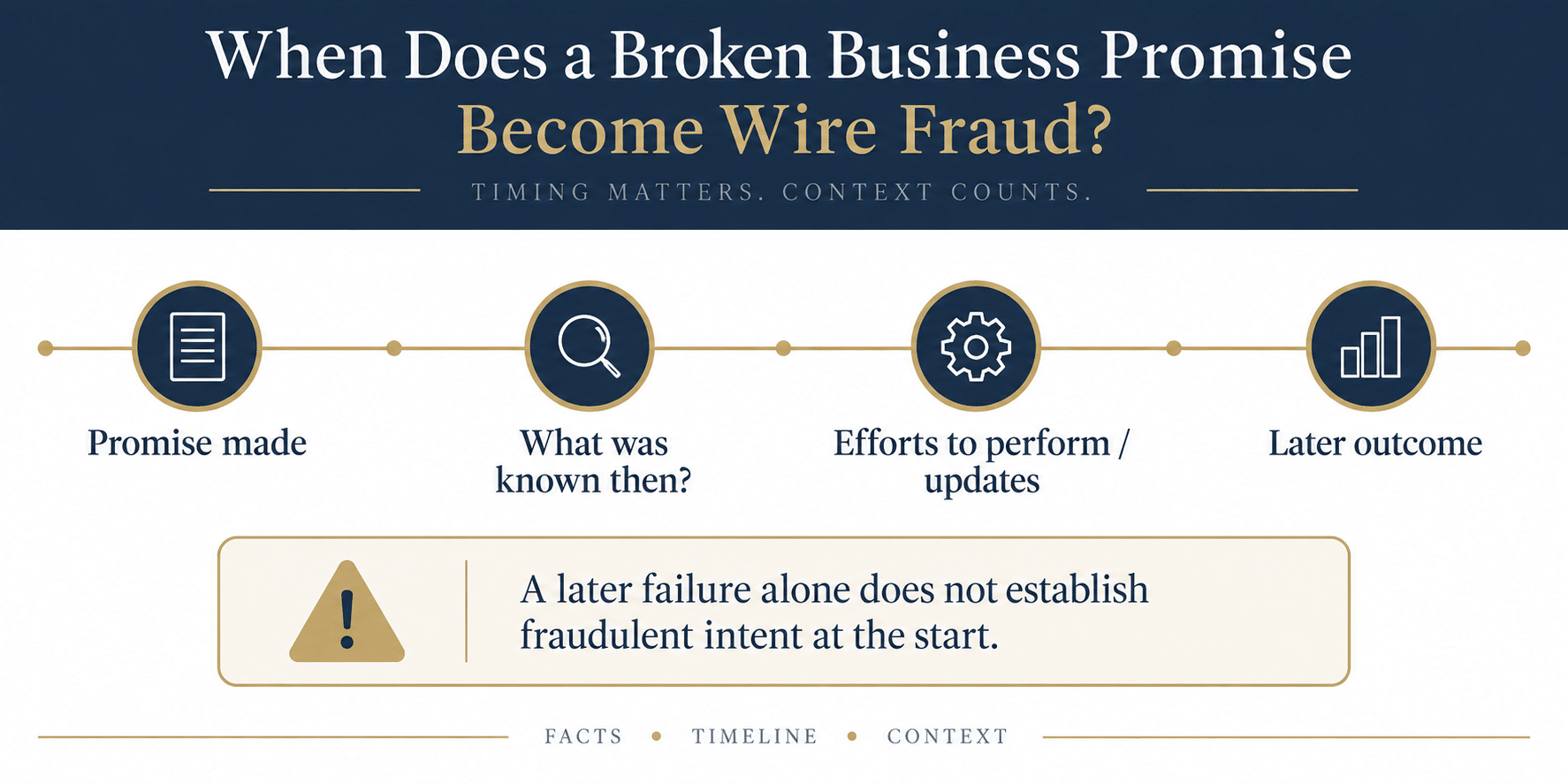
Start with the promise and the facts known then
Put the promise beside the contract, projections, risk disclosures and any conditions attached to it. What exactly was represented? Did the speaker knowingly misstate a fact? Does the charged legal theory cover an alleged concealment of a material fact? If the statement was a promise, did the speaker intend to perform it?
Why was the deadline missed? A supplier’s failure, higher costs or a cash shortage may explain it. Find the records for that explanation before drawing conclusions about an earlier promise.
Look for dated evidence of the work the company was doing. Plans, budgets, engineering or development records, procurement, staffing and deliverables may show efforts to perform. Compare those records with any allegation that a false certification or fictitious product was used to obtain payment.
Keep the notices sent to customers, including corrections and refund offers. Match each notice to the person who wrote or approved it. If an employee warned about a problem internally, find out who received the warning and when; do not attribute it to every manager simply because they worked for the same company.
Separate performance from the property theory
In Kousisis v. United States, the Supreme Court held that fraudulent inducement to obtain property does not require net economic loss. So receiving the promised goods does not necessarily end the case. Material deception, intent to defraud and a scheme to obtain money or property still must be proved; a contract breach alone is insufficient.
Ciminelli v. United States addresses a different problem. There, the Court rejected treating a person’s ability to make an informed economic decision as the property protected by the fraud statute. Counsel therefore needs to pin down the money or other property the alleged scheme sought. A complaint that a buyer lacked useful information, or would have chosen differently, cannot by itself supply that property.
Build a dated knowledge chronology
Start with the dated proposal. Put the company’s working records beside it: what had been designed, ordered or staffed at that point? Repeat the comparison for each later request for payment. Include updates sent inside the business as well as those sent to customers. A later correction or repayment belongs at its own date in the sequence.
The refund and the failed project are evidence to consider. Neither tells the whole story of the original promise. Counsel still needs the words used, the property being sought and the evidence of that particular speaker’s intent at the time. Later events may help explain those facts; they should not replace them.
Sources
This article provides general information, not legal advice. A specific case requires review of its charging instrument, offense dates, and underlying records. Representation begins only after the firm agrees to take the matter.