

MONEY LAUNDERING · FEDERAL CHARGES
What Property Can the Government Freeze or Forfeit?
A frozen account, a forfeiture count and a civil case against property are different things. Here’s how to tell which one you’re facing and what property it can reach.
Eligible to Practice in Texas
Attorney at Law
Bar Card Number: 00796807
TX License Date: 11/01/1996
214 Connally St Ste A
Sulphur Spgs, TX 75482-2612
Hypothetical, a hardware store in Tyler:
| When | What happened |
|---|---|
| Monday, March 3, 10 a.m. | The owner’s debit card bounces on a $2,180 lumber order |
| 10:20 a.m. | The bank says a federal restraining order covers the operating account |
| 4 p.m. | Her lawyer has the order and the indictment |
In a laundering case the government can go after property “involved in” the offense, which reaches further than proceeds. A freeze still isn’t a forfeiture, and it isn’t proof she did anything wrong.
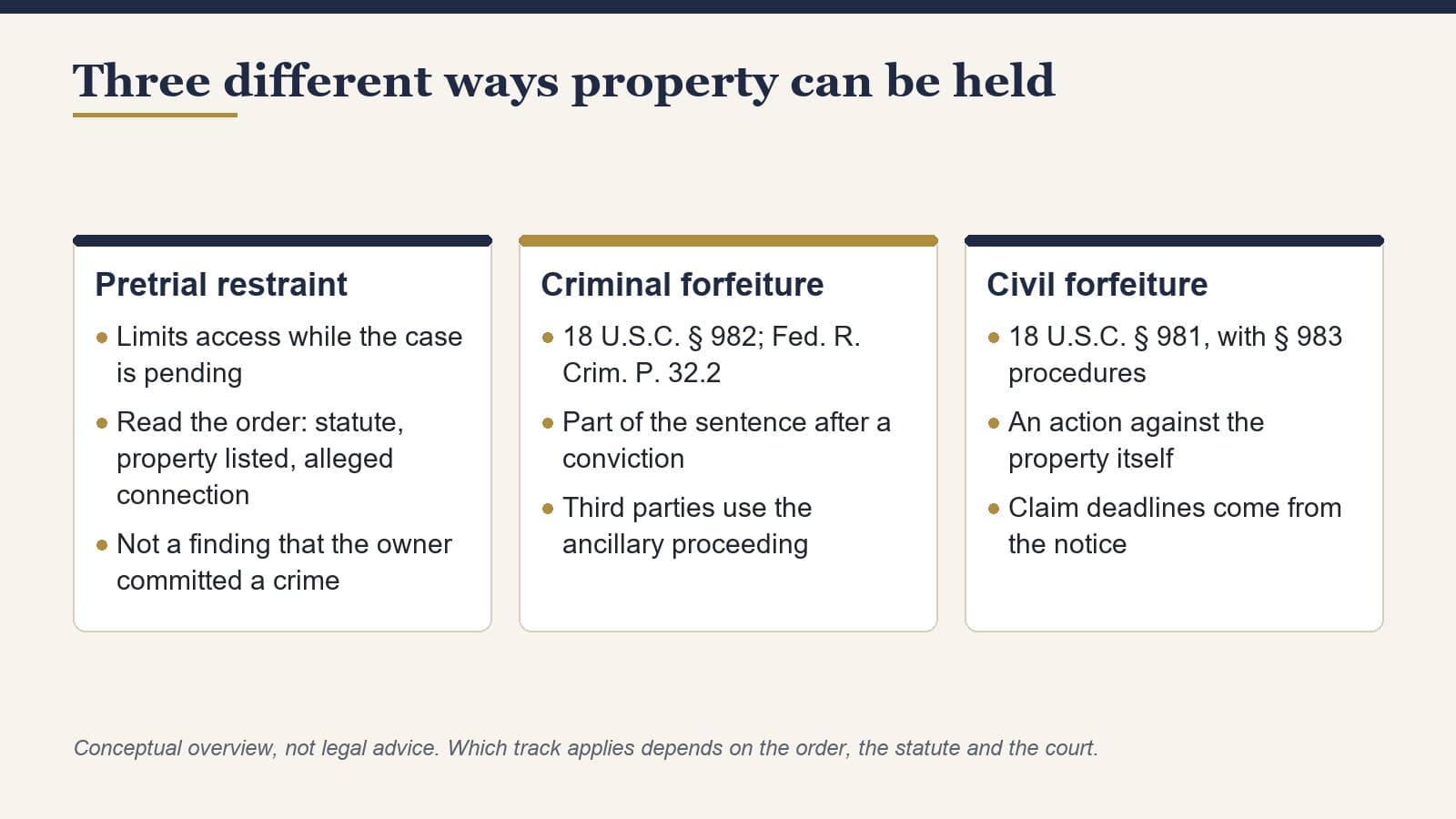
Which paper did you get?
Her order’s first page cites 21 U.S.C. § 853(e). Yours will cite its own statute near the top. That citation tells you which of these you’re holding:
- Seizure warrant from a magistrate judge: 18 U.S.C. § 981(b). It reaches property subject to civil forfeiture and can issue before any charge.
- Restraining order before indictment, § 853(e)(1)(B): notice and a hearing come first, except for a brief temporary order, and it lapses after 90 days unless extended or an indictment is filed.
- Restraining order after indictment: § 853(e)(1)(A), applied by 18 U.S.C. § 982(b)(1). It reaches the same property and lasts while the case is pending. The hardware store’s order is this kind.
- Civil complaint naming the property as defendant: 18 U.S.C. §§ 981 and 983. It’s a separate civil case aimed at laundering property or proceeds of specified unlawful activity.
- Forfeiture notice at the end of the indictment: § 982 and Fed. R. Crim. P. 32.2(a). Its reach depends on the count of conviction. There’s no forfeiture judgment without it, and the order comes at sentencing.
- Motion for substitute property: § 853(p) and Rule 32.2(e). After conviction, it reaches other property of the defendant up to the value, but only if a § 853(p)(1) condition is met.
“Involved in” versus “proceeds”
The count of conviction picks the statutory words, and the words set the reach.
| Charge | Statute | Its words |
|---|---|---|
| § 1956 or § 1957 | 18 U.S.C. § 982(a)(1) | property “involved in such offense, or any property traceable to such property” |
| Bank fraud, or wire fraud affecting a financial institution | § 982(a)(2) | property “constituting, or derived from, proceeds the person obtained directly or indirectly” |
| Civil case, laundering | § 981(a)(1)(A) | property “involved in a transaction or attempted transaction” violating § 1956 or § 1957 |
| Civil case, other specified unlawful activity | § 981(a)(1)(C) | property that “constitutes or is derived from proceeds traceable to” the offense |
Clean deposits in a mixed account may be argued to be “involved in” a laundering transaction, depending on the facts and the circuit’s cases. A proceeds theory doesn’t reach them.
Substitute assets before trial
Section 853(p) lets a court forfeit other property of the defendant at sentencing. It applies when the original property can’t be located, was transferred, was moved beyond the court’s reach, lost value or was commingled beyond division.
A pretrial freeze is a separate matter. Section 853(e) refers to property described in § 853(a). In United States v. Floyd, 992 F.2d 498 (5th Cir. 1993), the Fifth Circuit held the statute doesn’t authorize restraining untainted substitute assets before conviction. Other circuits have read related statutes differently.
Hypothetical: one operating account
The order freezes the whole $310,000 balance, though the indictment ties only $40,000 of it to a fraud.
I’d pull these records first:
- Two years of bank statements, showing the balance before any of the disputed $40,000 landed.
- Customer invoices and remittance stubs that tie ordinary deposits to real customers.
- The payroll register and the loan agreement. Wages are due Friday and a note payment on the 15th.
- The forfeiture notice, which shows the government’s theory for each deposit.
Third parties
A spouse, a lender or a business partner has a separate procedure and a separate clock.
- In a criminal case, a third party can’t intervene in the trial (§ 853(k)). After a preliminary order, the third party petitions in the ancillary proceeding under Rule 32.2(c) and § 853(n). The deadline is 30 days from final publication or receipt of notice, whichever is earlier (§ 853(n)(2)).
- At that hearing, the petitioner must prove a superior interest or a bona fide purchase for value by a preponderance of the evidence (§ 853(n)(6)).
- In a civil case, an owner files a claim under § 983(a)(2). The deadline is the date in the notice letter, at least 35 days after mailing. If no letter arrived, it’s 30 days after final publication.
- In a civil case, an owner can raise the innocent-owner defense under § 983(d) and must prove it by a preponderance of the evidence.
Lawyer fees: Luis and Kaley
Sila Luis was charged in 2012 with health care crimes, and the government said she had obtained close to $45 million. It sought to hold the roughly $2 million she still had. Both sides agreed the order would keep her from using untainted funds to hire a lawyer. In Luis v. United States, 578 U.S. 5 (2016), a four-justice plurality held that freezing legitimate, untainted assets needed to hire counsel of choice violates the Sixth Amendment. Justice Thomas concurred in the judgment on other grounds. Tainted property stays frozen.
Kerri Kaley sold medical devices for a Johnson & Johnson subsidiary. She and her husband Brian were indicted for moving stolen devices across state lines and laundering the proceeds. The government restrained a $500,000 certificate of deposit they meant to use for legal fees. In Kaley v. United States, 571 U.S. 320 (2014), the Court held they couldn’t use the restraint hearing to relitigate the grand jury’s probable cause finding. Traceability is a different question, and the bank records carry it.
Steps after a seizure are covered in the companion article on responding to a laundering seizure. Don’t move or retitle property under an order.
Common questions
Does an innocent owner lose property too?
In civil forfeiture, § 983(d) gives an innocent-owner defense, proved by a preponderance of the evidence. In criminal forfeiture, third parties raise their interest in the § 853(n) ancillary proceeding.
Sources
- 18 U.S.C. § 981
- 18 U.S.C. § 982
- 18 U.S.C. § 983
- 21 U.S.C. § 853
- Federal Rule of Criminal Procedure 32.2
- Luis v. United States, 578 U.S. 5 (2016)
- Kaley v. United States, 571 U.S. 320 (2014)
- United States v. Floyd, 992 F.2d 498 (5th Cir. 1993)
This article provides general information, not legal advice. The law and its application depend on the facts and the law in effect on the relevant date. Consult a lawyer about a specific matter.