


Money Laundering · Federal Charges
How Do Mixed Lawful and Unlawful Funds Affect Tracing?
A mixed bank balance does not answer which funds a charged withdrawal used. The government and defense may read the same records differently. Counsel needs to examine the complete transaction history and the tracing law that applies to the charge.
Eligible to Practice in Texas
Attorney at Law
Bar Card Number: 00796807
TX License Date: 11/01/1996
214 Connally St Ste A
Sulphur Spgs, TX 75482-2612
You can’t work out a mixed-funds case by pointing to the bank balance. Start with the payment in the charge. Which proceeds does the government say went into it? Follow that explanation through the account history and check it against the law that governs the charge. Depositing lawful earnings beside alleged proceeds doesn’t make the proceeds lawful. It doesn’t turn everything in the account into criminal property, either.
Davis: which money went into the $25,000 check?
The charged transaction in Davis was a $25,000 check drawn on a Forum Financial bank account. Before the fraud victim’s $100,000 reached that account, the balance had been $18,585.55. Davis relied on that earlier balance to explain the check. By the time the check cleared on March 14, 1994, the balance remaining was $13,579.62. The dispute concerned how much of the check came from the victim’s money, and the court had other withdrawals to consider as well.
| Position or evidence | How it affected the tracing dispute |
|---|---|
| Davis’s proposed allocation | Davis wanted to subtract the opening balance from the charged check and attribute only the difference to the victim’s money. That amount would be below the § 1957 threshold. His subtraction left the other withdrawals out. |
| The rest of the account history | The court had “banking records showing various withdrawals, made after receipt of the $100,000, that totaled more than $100,000.” The charged $25,000 check was one of those withdrawals. |
| The court’s analysis | The Fifth Circuit did not accept that allocation. It used its earlier approach to commingled accounts and considered the aggregate withdrawals. Together, they exceeded the available lawful funds by far more than $10,000. On that record, the evidence supported a finding that the particular $25,000 check contained more than $10,000 in tainted money. |
Davis’s proposed allocation: $25,000 − $18,585.55 = $6,414.45.
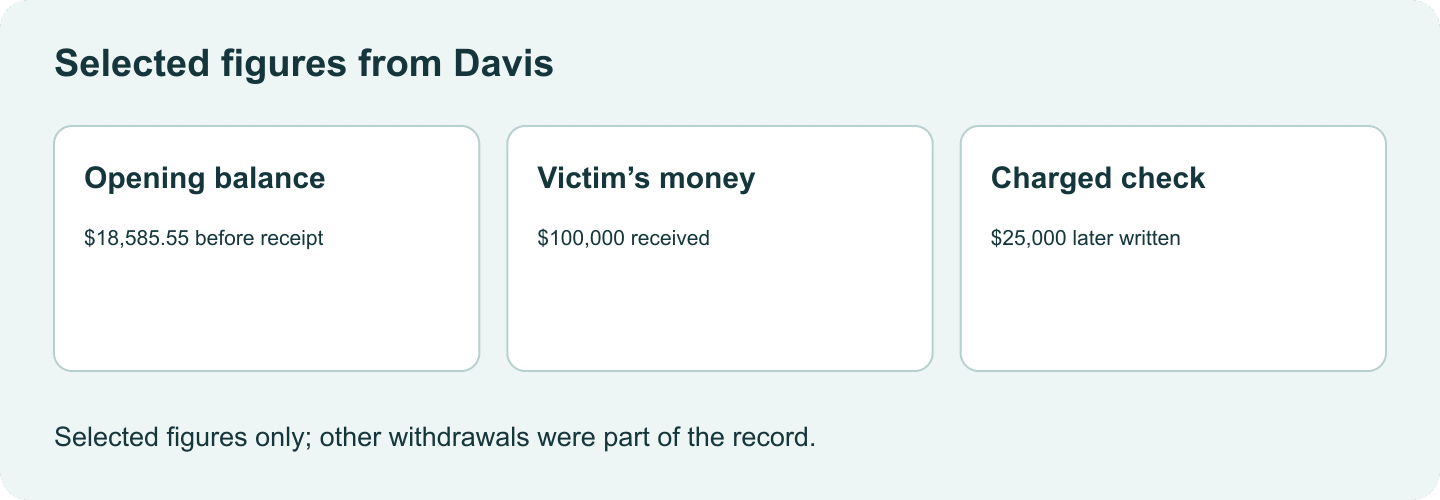
Before relying on Davis in another case, compare the transactions and read the precedent that governs the charge. Every payment from a mixed account is not automatically a crime. The presence of lawful funds and alleged proceeds in another account doesn’t, on its own, justify carrying over the Davis result.
Read the charge before choosing a tracing method
Section 1957 requires more than $10,000 in criminally derived property from specified unlawful activity to be involved in the transaction. There must also be a knowing monetary transaction through, by, or to a covered financial institution, with the required connection to interstate or foreign commerce. Those are requirements of 18 U.S.C. § 1957, not a threshold to apply indiscriminately to other charges.
For 18 U.S.C. § 1956(a)(1), look at the clause that sets out the required intent or knowledge. It deals with domestic financial transactions. International transfers and undercover operations have other provisions. The definition of proceeds in § 1956(c)(9) includes gross receipts.

Put the records and the calculation together
Rebuild the account history before accepting an allocation. For the Davis account, that means including the other withdrawals, as well as the victim’s deposit and the charged check. Then test the allocation under the applicable tracing method. Getting the subtraction right doesn’t show that the allocation has a legal basis.
- Get enough statements to show the opening balance and follow the later entries. Keep track of reversals, fees, and settlement dates.
- Follow a transfer into the receiving account. It is still the same money; do not count it as a second receipt.
- If a statement is missing, identify the calculation that you cannot yet check.
- Put the opening balance, deposits, reversals, and withdrawals beside the source records. Someone else should be able to reproduce the arithmetic.
- Name the tracing method you used.
- If a disputed deposit changes the amount allocated to proceeds, calculate it both ways.
Set your reconstruction beside the government’s figures. If you get a different answer, work out where the difference comes from:
- Was an entry omitted?
- Is the source of money disputed?
- Was a different tracing rule used?
The defense still needs a legal basis for its allocation, even if the arithmetic is correct. It also cannot keep reserving the same lawful funds for every payment it wants to explain.
Sources
- 18 U.S.C. § 1956.
- 18 U.S.C. § 1957.
- United States v. Davis, No. 98-51173 (5th Cir. Aug. 29, 2000) (commingled-account analysis under § 1957).
This article provides general information, not legal advice. A specific case requires review of its charging instrument, offense dates, account records, and controlling law. Representation begins only after the firm agrees to take the matter.