


Online Investment Fraud · Federal Charges
How Are Online Investment Fraud Allegations Defended?
A falling portfolio can prompt an investigation, but the loss does not tell us what investors were promised. The records behind those promises matter: the messages, the holdings and the information available to the person speaking.
Eligible to Practice in Texas
Attorney at Law
Bar Card Number: 00796807
TX License Date: 11/01/1996
214 Connally St Ste A
Sulphur Spgs, TX 75482-2612
What did the investor see before sending money? That is often the most useful place to begin an online investment-fraud review. Save the pitch as it appeared then, including the disclosures. Compare it with the trading and custody records for that date. A later version of the website may give a very different impression of the offer.
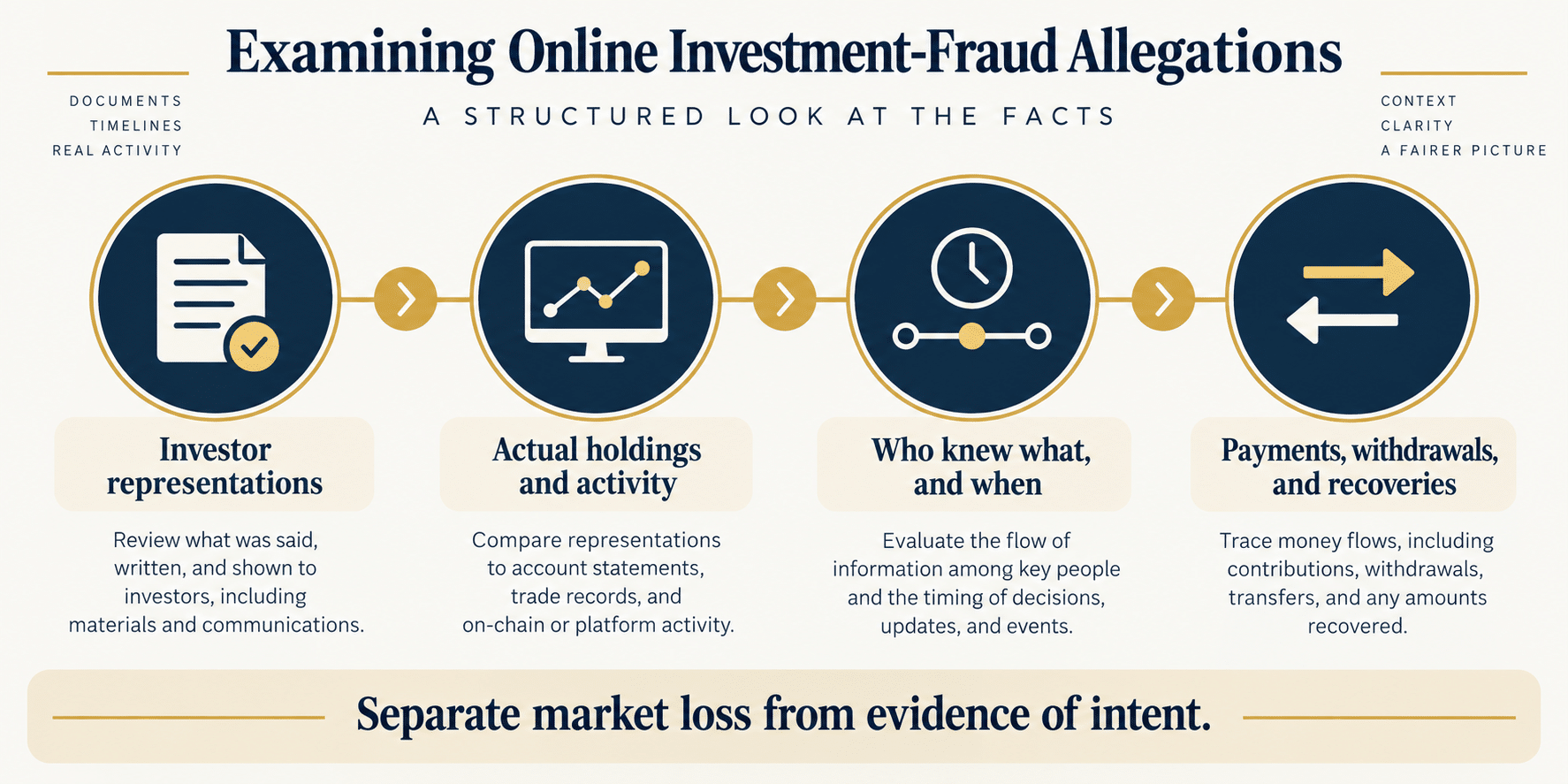
Match each representation to its source
Save the pitch the investor saw at the time. A copy of today’s website may be quite different. There may also have been a private message, an account statement or a notice about withdrawals. For each important claim, identify who wrote or approved it and when. Read any balance together with its label: was it presented as an estimate, an unaudited figure or assets the business actually held?
Keep the original file as well as the screenshot. The displayed number does not explain which data feed or calculation produced it. The export, access log or version history may explain more. Check those against the bank, brokerage and blockchain records. If the number was changed, find out who changed it and why before treating the correction as an admission or an innocent mistake.
Trace assets and investor payments
Build a transaction history from the investor’s first deposit. Record the terms given to that investor, the use of the money and each withdrawal or refund. Trace any returns to their source. Calling a payment a profit does not show that trading produced it. At the same time, a declining portfolio or token price says little by itself about fraud. Evidence of real trading also leaves open whether other statements in the offer were false.
Count each investor’s deposit once, even if it moves between accounts. Record refunds, recoveries and market changes separately. Restitution and sentencing loss require different legal calculations.
A transfer may also appear in a laundering count or an additional wire-fraud count. Neither charge follows merely because money was moved or converted into another asset. The government still has to prove the elements of the offense charged.
Connect evidence to each person’s knowledge and role
Identify the people responsible for custody, dashboard calculations, investor messages and redemptions. They may not be the same people. Look at each person’s access and approvals, then at the warnings that person actually received. What did the person review or change? What was passed on to investors? A colleague’s knowledge should not be assigned to somebody else merely because they held similar positions.
Suppose a projection turns out to be wrong. Counsel still needs to know whether the person who gave it honestly believed it then. Now consider a statement that specific assets were held, made by a speaker who knew those assets were not held. The difference lies in what was said and known at the time. Read the original words with the disclosures and internal records to test that distinction.
Check the evidence against the charge
For a charge under § 1343, prosecutors must prove a scheme to obtain money or property by fraud and the intent to defraud. They must also prove the use of an interstate or foreign wire to execute that scheme. Match each allegation to the original investor records to identify what supports it and what is disputed.
Keep original files before changing a dashboard or correcting an entry. Document how each exported file was obtained. As the chronology develops, put later discoveries on their own dates rather than treating them as information known from the start. Include evidence that helps the defense as well as evidence that supports the charge. A repayment, real trading or a market downturn may matter without deciding the case.
Sources
This article provides general information, not legal advice. A specific matter requires review of its charging instrument, offense dates, and underlying records. Representation begins only after the firm agrees to take the matter.