


Bank Fraud · Charges
Can a Bank Employee and Borrower Face Different Charges?
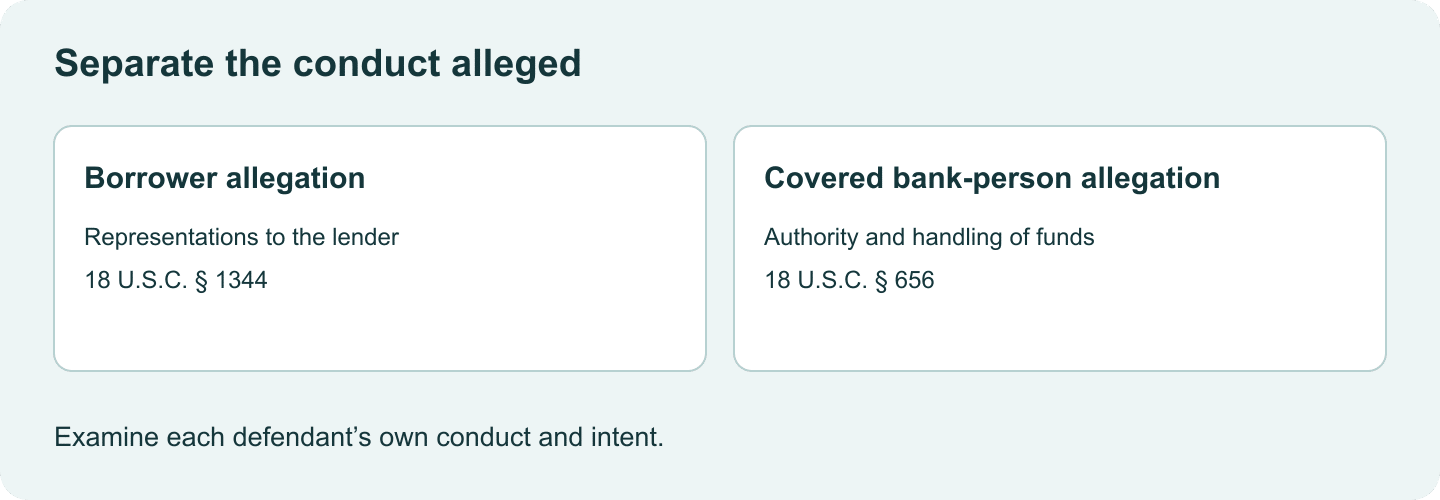
Borrower and bank-employee allegations can involve the same transaction, but the statutes ask different questions about each person’s conduct and intent.
Eligible to Practice in Texas
Attorney at Law
Bar Card Number: 00796807
TX License Date: 11/01/1996
214 Connally St Ste A
Sulphur Spgs, TX 75482-2612
Yes. The borrower and the bank employee can be investigated over one loan and face different charges. A borrower may be charged with bank fraud under 18 U.S.C. § 1344. A covered employee accused of stealing, embezzling, or willfully misapplying bank funds may face § 656. For either person, prosecutors still have to prove the charged elements and that person’s own conduct.
The approval record and the later loss
Review the record of the original approval to examine what was represented, authorized and known. The loan’s later loss does not, by itself, establish that the approval was fraudulent or a willful misapplication.
Read the borrower’s application alongside the bank’s approval records
| Question to test | Records to compare | Limit that remains |
|---|---|---|
| What does the signed application establish about the borrower’s role and knowledge? | Begin with the borrower’s application and certifications. Read them alongside the credit file, messages to the lender, and disclosed exceptions. As you compare the accounts, keep the borrower’s communications separate from the bank’s internal entries and approval decisions. | The borrower’s signature alone does not establish everything the borrower knew or prove every element of the charged offense. Compare the borrower’s account with the lender’s records. Do not assume that the person who communicated with the lender also made the bank’s internal entries or approval decisions. |
| What does the approval establish about the employee’s role and knowledge? | Use the separate authority, control, and decision-record checks below. | Processing a loan or signing an exception is not automatically an offense under § 656. Review what the employee had authority to do, what the controls allowed, and what the employee knew about the use or diversion of the funds. |
Separate The Checks Behind The Approval
- Before interpreting the approval, obtain the job description and signing authority to check the employee’s authority.
- Committee minutes and dual-control settings may help explain what the employee could authorize and what the controls allowed.
- Review the account logs and pay records. Compare the messages with the written history of approved exceptions to examine the reason given for the decision.
Those records can help counsel assess the employee’s authority and the reason given for the decision. Counsel must also examine what the records show about the employee’s knowledge of the use or diversion of the funds. Documenting the approval alone does not answer that question.

Apply The Statute Actually Charged
Start with the part of § 1344 named in the charge. Its first clause concerns a scheme to defraud a financial institution. The second concerns obtaining property belonging to the institution, or in its custody or control, by false or fraudulent means.
For § 656, counsel must check the person’s connection to a covered institution. Identify the institution’s funds, or property entrusted to that institution’s care, that the allegation concerns. The conduct addressed includes embezzlement, abstraction, theft, and willful misapplication. The people covered include specified officers, directors, agents, and employees.
Do Not Treat An Alleged Agreement As An Assumed Fact
A claim that the borrower and employee agreed to a crime needs its own analysis. Read the charge against the complete record. Ask what supports the alleged agreement and what contradicts it in:
- The messages.
- The timing.
- Any shared benefits.
- The steps attributed to each person.
Routine contact or a breach of bank policy does not, by itself, establish conspiracy or criminal intent.
Understand who a company lawyer represents
Before an interview with company counsel, an employee should find out whether the lawyer represents the company, the employee, or both. Do not assume that a conversation with a lawyer at work is personal legal advice. Upjohn Co. v. United States concerned privilege for certain employee communications that helped counsel advise the company. It did not make every employee the company lawyer’s individual client. An employee facing questions about disputed approvals should consider whether separate counsel is needed before making a statement.
Preserve The Record And The Response Deadline
- Keep the original records.
- Give counsel any government deadline or asset order before responding.
- Do not alter records.
- Do not arrange a common account of events with another witness.
- Do not move money to evade an order.
Each person’s conduct needs to be assessed under the charges and procedures that apply in that court.
For the broader investigation and trial framework, see the Federal Bank Fraud and Related Texas Financial Crimes knowledge hub.
Primary legal sources
- 18 U.S.C. § 1344 (bank fraud).
- 18 U.S.C. § 656 (theft, embezzlement or misapplication by a bank officer or employee).
- 18 U.S.C. § 371 (conspiracy to commit an offense against or defraud the United States).
- Upjohn Co. v. United States, 449 U.S. 383 (1981).
To discuss representation, contact Heath Hyde or call 903-439-0000. Representation begins only after the firm agrees to take the matter.