


When Does a Robbery, Kidnapping or Burglary Make a Murder Capital Murder in Texas?
A death during a robbery isn’t automatically capital murder. The State has to prove an intentional killing and a predicate offense that was under way when the killing happened.
Mr. Heath Enix ‘Heath’ Hyde
Eligible to Practice in Texas
Attorney at Law
Bar Card Number: 00796807
TX License Date: 11/01/1996
Primary Practice Location: Dallas, Texas
Return to the Texas Murder Trial Defense Knowledge Hub
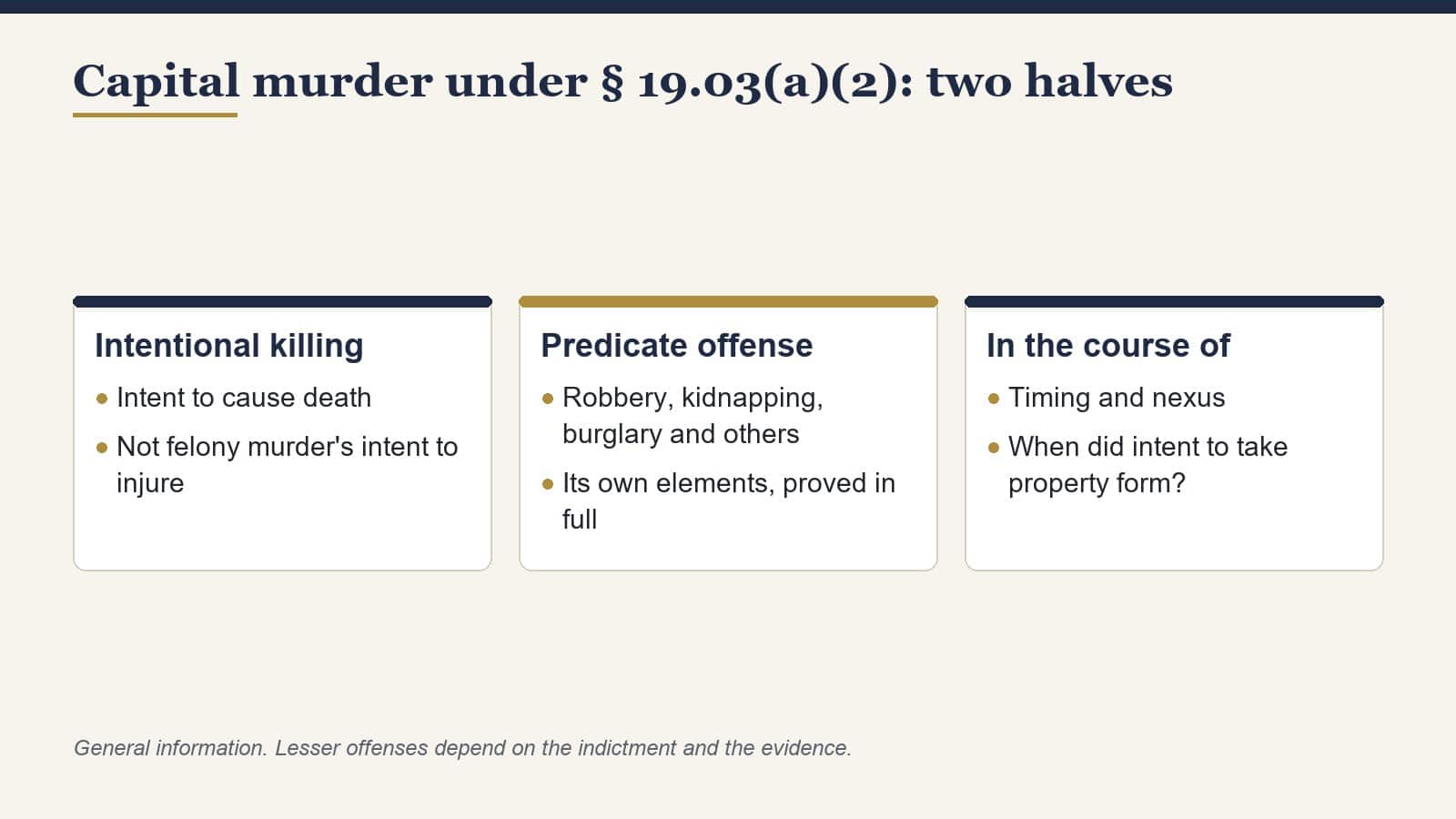
A murder becomes capital murder under Penal Code §19.03(a)(2) when the person intentionally commits it in the course of committing or attempting to commit one of the listed felonies, which include kidnapping, burglary and robbery. The State has to prove both the intentional killing and the underlying offense.
The indictment is one paragraph long. It says the accused caused a man’s death “in the course of committing and attempting to commit robbery.” The evidence behind those words is a wallet found in a car two days later.
That paragraph tracks Penal Code §19.03(a)(2). It makes murder capital when “the person intentionally commits the murder in the course of committing or attempting to commit” one of a short list of offenses: kidnapping, burglary, robbery, aggravated sexual assault, arson, obstruction or retaliation, or certain terroristic threats. The State has to prove both halves. One is an intentional killing. The other is a predicate offense that was actually happening.
Two halves, two sets of proof
| Element | What the State has to show | Source |
|---|---|---|
| The killing | Murder under §19.02(b)(1), committed “intentionally” | §19.03(a), (a)(2) |
| The predicate | Every element of the robbery, kidnapping or burglary | Penal Code chs. 20, 29, 30 |
| The link | The killing happened while the predicate was being committed or attempted | §19.03(a)(2) |
Each half can fail on its own. If the killing wasn’t intentional, the case may be felony murder under §19.02(b)(3). That statute needs no intent to kill, but it’s still a first-degree felony, not a capital one. If the predicate fails, what’s left may be murder, and not capital murder.
Robbery: when did the intent to take property form?
Robbery under §29.02 is an injury or a threat of injury, committed “in the course of committing theft” and with intent to get or keep the property. Section 29.01(1) defines that phrase as conduct “in an attempt to commit, during the commission, or in immediate flight after” the theft.
Timing is where many robbery-capital cases are fought. The Court of Criminal Appeals has said “the killer’s intent to rob must be formed before or at the time of the murder.” It has also said a robbery “committed as an afterthought and unrelated to a murder” isn’t enough for capital murder (Conner v. State, 2001).
Say it goes like this:
| Time | What happened |
|---|---|
| 11:52 p.m. | Two men argue in a driveway about a debt; a neighbor’s camera records shouting |
| 11:58 p.m. | Shots; the camera records the sound, not the shooter |
| 12:06 a.m. | A phone pings near the victim’s address |
| Two days later | The victim’s wallet is found in the accused’s car |
The State will say the debt shows a motive to take money. The defense will say the argument was about something else, and that if the wallet was taken at all, it was taken after the death and as an afterthought. A jury can infer intent from the circumstances, so the work is in the details: what the argument was about, when the wallet left the victim’s pocket and who touched the car. A cash withdrawal or phone search before the meeting can cut the other way.
The “immediate flight” language matters too. If the State says the taking happened as the accused ran, I’d want to know how far he got, how much time passed and whether anything broke the chain between the shooting and the taking. A wallet picked up in the driveway is a different fact from one found in a glove box across the county two days later.
Kidnapping and burglary have their own traps
Kidnapping isn’t just moving someone. Section 20.03 requires that the person “intentionally or knowingly abducts another person.” Section 20.01(2) defines “abduct” as restraint “with intent to prevent his liberation” by hiding the person or by using or threatening deadly force.
Burglary turns on entry and consent. Section 30.02(a) covers entry “without the effective consent of the owner.” It reaches a person who enters “with intent to commit a felony, theft, or an assault,” and one who enters and then “commits or attempts to commit” one of those offenses.
Here’s where I’d look first.
| Predicate | Statute | What the defense asks |
|---|---|---|
| Kidnapping | §§20.01(2), 20.03 | Was there restraint and an intent to prevent release, or only a short drive or a fight in one place? |
| Burglary, consent | §30.02(a) | Did the owner or a resident invite him in? Did he have a key or live there? |
| Burglary, purpose | §30.02(a)(1), (a)(3) | What does the State say he meant to do when he crossed the threshold, and what proves it? |
| Robbery | §§29.01(1), 29.02 | Was there an intent to take property before or during the killing? |
Burglary has a twist. Because §30.02(a) lists “an assault” as one of the qualifying purposes, the State may argue the entry itself was made to hurt the person inside. Then the dispute moves to what the accused intended at the door. Text messages from earlier that day, a returned key or a history of visits can matter as much as the forensic evidence.
When intent to kill is the weak point
Section 19.03(c) says that if the jury doesn’t find capital murder beyond a reasonable doubt, the defendant “may be convicted of murder or of any other lesser included offense.” The Court of Criminal Appeals has treated felony murder as a lesser included offense of capital murder (Fuentes v. State, 1999; Threadgill v. State, 2004). The difference between the two is the intent to kill.
The instruction isn’t automatic. Under art. 37.09 and the Texas two-step test, there has to be some evidence that would let a rational jury find the accused guilty only of the lesser offense. The federal Constitution backs this up in death cases. In Beck v. Alabama (1980), the Supreme Court struck down a death sentence because the jury hadn’t been allowed to consider a lesser noncapital offense the evidence would have supported.
The verdict changes the possible sentence.
| Verdict | Punishment range |
|---|---|
| Capital murder, State seeking death | Death or life without parole, §12.31(a) |
| Capital murder, State not seeking death | Life without parole for an adult, §12.31(a)(2) |
| Murder, including felony murder | 5 to 99 years or life, §§19.02(c), 12.32 |
| Aggravated robbery | 5 to 99 years or life, §§29.03(b), 12.32 |
More on the lesser-offense request is in our article on lesser included offenses in a Texas murder case. When more than one person took part, the law of parties adds its own questions.
Common questions
Is every killing during a home break-in capital murder?
The State has to prove the killing was intentional and that every element of burglary, including entry without the owner’s effective consent, is there. A death during a break-in that wasn’t intended may be charged as felony murder instead.
If property was taken after the death, can it still be capital murder?
It can be, if the State proves the intent to take the property existed before or at the time of the killing. If the taking was an afterthought, unrelated to the killing, the evidence won’t support capital murder on a robbery theory.
Sources
- Tex. Penal Code §§12.31, 12.32, 19.02, 19.03
- Tex. Penal Code §§20.01, 20.03, 29.01, 29.02, 29.03, 30.02
- Tex. Code Crim. Proc. art. 37.09
- Conner v. State, 67 S.W.3d 192 (Tex. Crim. App. 2001)
- Fuentes v. State, 991 S.W.2d 267 (Tex. Crim. App. 1999)
- Threadgill v. State, 146 S.W.3d 654 (Tex. Crim. App. 2004)
- Beck v. Alabama, 447 U.S. 625 (1980)
This article provides general information, not legal advice. The law and its application depend on the facts and the law in effect on the relevant date. Consult a lawyer about a specific matter.