
How Are Statements and Confessions Challenged in a Texas Capital Murder Case?
In a capital case, the State can use the same interview twice: once to prove guilt and again to argue for a death sentence. The challenge has to be built for both.
Mr. Heath Enix ‘Heath’ Hyde
Eligible to Practice in Texas
Attorney at Law
Bar Card Number: 00796807
TX License Date: 11/01/1996
Primary Practice Location: Dallas, Texas
Return to the Texas Murder Trial Defense Knowledge Hub
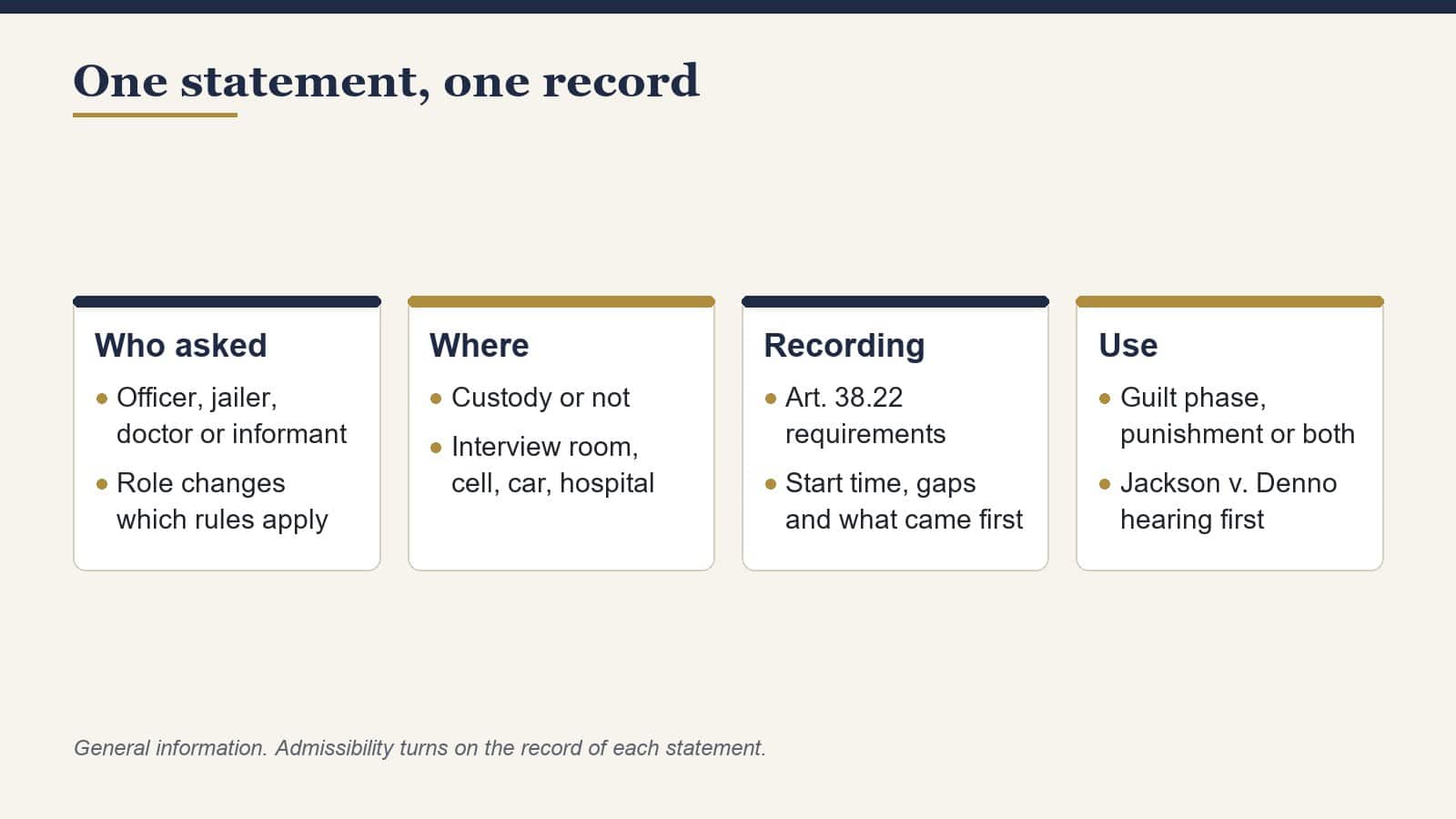
A statement or confession in a Texas capital murder case is challenged first on voluntariness. Article 38.21 lets the State use it only if it was freely and voluntarily made, and the judge decides that at a hearing before the jury hears it. The defense also tests the warnings and recording required by art. 38.22, the suspect’s own condition during questioning, and how the State wants to use the statement at punishment.
A 19-year-old is arrested on a Friday night and questioned at the sheriff’s office until almost 4 a.m. Three months later, the defense gets a disc with a four-hour video, a two-page summary and a booking log. By then the indictment says capital murder.
Article 38.21 of the Code of Criminal Procedure lets the State use a statement only if it “was freely and voluntarily made without compulsion or persuasion.” The warning and recording rules in art. 38.22 sit on top of that, and our article on whether a recorded statement can be suppressed covers them in detail.
The hearing before the jury hears anything
At 1 a.m. on June 14, 1960, Nathan Jackson robbed a Brooklyn hotel clerk and traded shots with a police officer outside. The officer died. Jackson was shot in the liver and lung and had lost about 500 cc of blood.
At 3:55 a.m. he got demerol and scopolamine. Minutes later an assistant district attorney took his confession at the hospital, and surgery ran from 5 to 8 a.m. Jackson said the drugs affected his will. The State said they had no effect. New York let the trial jury decide that dispute and guilt together.
In Jackson v. Denno (1964), the Supreme Court held that procedure violated due process and overruled Stein v. New York. Art. 38.22, §6 now has the judge decide voluntariness first, outside the jury’s presence.
Art. 2B.0202, formerly art. 2.32, requires “a complete and contemporaneous electronic recording” of custodial interrogation at a place of detention in murder and capital murder cases.
Say the booking log puts the client in the building at 9:55 p.m. The interview-room door log shows the door opening at 10:31. The video file starts at 11:20. That leaves 85 minutes with no recording.
Art. 38.22 §3(a)(5) requires that the defense get a true, complete and accurate copy of every recording no later than the 20th day before the proceeding.
The motion then raises five separate questions:
| Issue | Statute or case | What the defense asks |
|---|---|---|
| Was the statement voluntary? | Art. 38.21; art. 38.22, §6 | A hearing and written findings of fact |
| Were the warnings given and waived on the recording? | Art. 38.22, §§2–3 | Exclusion if a step is missing |
| Was the interrogation recorded as Texas requires for capital murder? | Art. 2B.0202(a); art. 38.22, §9 | Exclusion unless the State proves good cause |
| Did officers keep going after a request for a lawyer? | Edwards v. Arizona (1981) | Exclusion of what followed |
| Was the evidence obtained in violation of law? | Art. 38.23(a) | Exclusion, and a jury instruction if the facts are disputed |
If the judge admits the statement, §6 says jurors must not consider it “for any purpose” unless they believe beyond a reasonable doubt it was voluntary. Art. 38.23(a) adds its own instruction when the facts about how evidence was obtained are disputed.
A waiver from a tired or impaired suspect
Federal due process mostly asks whether the police overreached. Texas goes further. Under arts. 38.21 and 38.22, as Oursbourn v. State (2008) reads them, a suspect’s own exhaustion, illness, or medication can matter even when the officers did nothing wrong.
In a hypothetical file, that argument rests on paper. His time card shows a 9:15 p.m. clock-out after a twelve-hour shift at the plant. The jail intake form says “anti-seizure med” and leaves the dose blank, so the pharmacy record fills it in. A fourth-grade special-education report puts his reading level in front of the judge. On the video at 11:24 p.m., he nods once and never says yes.
For a suspect under 18, J.D.B. v. North Carolina (2011) held that a child’s age, when known or obvious to the officer, informs the custody question. A 17-year-old is tried as an adult for capital murder in Texas but can’t be sentenced to death.
Statements used at punishment
Ernest Benjamin Smith was indicted in Dallas County in 1973 for a grocery store robbery in which his accomplice shot the clerk. The judge ordered a competency exam, as he later said he did in all capital cases. Dr. James Grigson interviewed Smith in the county jail for about 90 minutes.
At punishment, Grigson was the State’s only witness. He called Smith a severe sociopath who would keep committing crimes, said no treatment would change that and said Smith showed no remorse. The jury answered the future-dangerousness question yes, and Texas law then required death.
The Supreme Court threw out the death sentence in Estelle v. Smith (1981) and left the conviction alone. Nobody had warned Smith that what he told Grigson could be used against him, which was a Fifth Amendment problem. His lawyers weren’t told the interview would reach punishment, which was a Sixth Amendment problem.
Say at minute 212 of a four-hour video, the client mutters, “I’d do it again.” The guilt-phase jury may barely notice. At punishment, the State can replay it for jurors deciding future danger.
Any statement can come back at punishment this way:
| Phase | How the State may use the statement | Rule |
|---|---|---|
| Guilt | To prove intent to kill, or the robbery, burglary or other fact that makes the case capital | Penal Code §19.03(a) |
| Punishment, first issue | To argue “a probability that the defendant would commit criminal acts of violence” | CCP art. 37.071, §2(b)(1) |
| Punishment, parties issue | To argue the accused “actually caused the death” or “intended to kill” | CCP art. 37.071, §2(b)(2) |
- Who ordered it, and on whose motion?
- What was the lawyer told about its scope?
- Did anyone give a warning?
- Will we call our own mental-health expert at punishment?
What the accused said to other people
George Bruton and a co-defendant named Evans were tried together in Missouri for armed postal robbery. A postal inspector who had questioned Evans at the St. Louis city jail testified that Evans confessed and named Bruton. The judge told jurors to disregard it as to Bruton. Evans didn’t testify, and he was later acquitted at a retrial.
In Bruton v. United States (1968), the Supreme Court overruled Delli Paoli v. United States and held the instruction couldn’t cure the violation of Bruton’s right to cross-examine. Under Massiah v. United States (1964), deliberately eliciting statements from an indicted defendant without counsel violates the Sixth Amendment.
Art. 38.075 bars a conviction on a cellmate’s testimony unless other evidence tends to connect the defendant to the offense. Art. 38.14 requires the same for accomplices; see our article on accomplice witnesses.
For a jailhouse witness, I’d want the housing log, the dates the two men shared a pod and any deal the witness got. Art. 38.075(c) allows impeachment with a prior offense the witness got a benefit for.
Common questions
If the statement is suppressed, can the State still seek death?
It can. Suppression keeps the statement out of the State’s proof, but the case and the death option go forward on the rest of the evidence.
Police never read him his rights. Does the case get thrown out?
Not for that reason alone. Art. 38.22 §3(a)(2) can keep an unwarned recorded statement out, but the case goes forward on any other evidence.
He signed a written statement. Can it still be challenged?
Art. 38.22 §2 requires the statement to show the warnings and a knowing, intelligent and voluntary waiver on its face, and voluntariness under art. 38.21 is still open.
Sources
- Tex. Code Crim. Proc. arts. 2B.0201, 2B.0202
- Tex. Code Crim. Proc. arts. 37.071, 38.075, 38.14, 38.21, 38.22, 38.23
- Tex. Penal Code §§8.07, 12.31, 19.03
- Jackson v. Denno, 378 U.S. 368 (1964)
- Massiah v. United States, 377 U.S. 201 (1964)
- Bruton v. United States, 391 U.S. 123 (1968)
- Estelle v. Smith, 451 U.S. 454 (1981)
- Edwards v. Arizona, 451 U.S. 477 (1981)
- J.D.B. v. North Carolina, 564 U.S. 261 (2011)
- Oursbourn v. State, 259 S.W.3d 159 (Tex. Crim. App. 2008)
This article provides general information, not legal advice. The law and its application depend on the facts and the law in effect on the relevant date. Consult a lawyer about a specific matter.