
How Is Forensic Evidence Challenged in a Texas Capital Murder Case?
When the State seeks death, Texas adds forensic rules that don’t apply in other murder cases, starting with DNA testing before trial and running through appeal.
Mr. Heath Enix ‘Heath’ Hyde
Eligible to Practice in Texas
Attorney at Law
Bar Card Number: 00796807
TX License Date: 11/01/1996
Primary Practice Location: Dallas, Texas
Return to the Texas Murder Trial Defense Knowledge Hub
Forensic evidence in a Texas capital murder case is challenged on several fronts: whether the lab was accredited when it did the analysis, whether the expert’s method is reliable enough to reach the jury under Rule 702 and Kelly v. State, and whether evidence the State left untested should be tested. When the State seeks death, art. 38.43(i) requires DNA testing of the biological evidence it holds before trial.
Say the victim was found in her own kitchen. Six weeks after the capital indictment, the State’s lab packet comes in: a two-page DNA report, a property log with 22 items, and eight swabs marked “not analyzed.” One of those swabs came off the back doorframe.
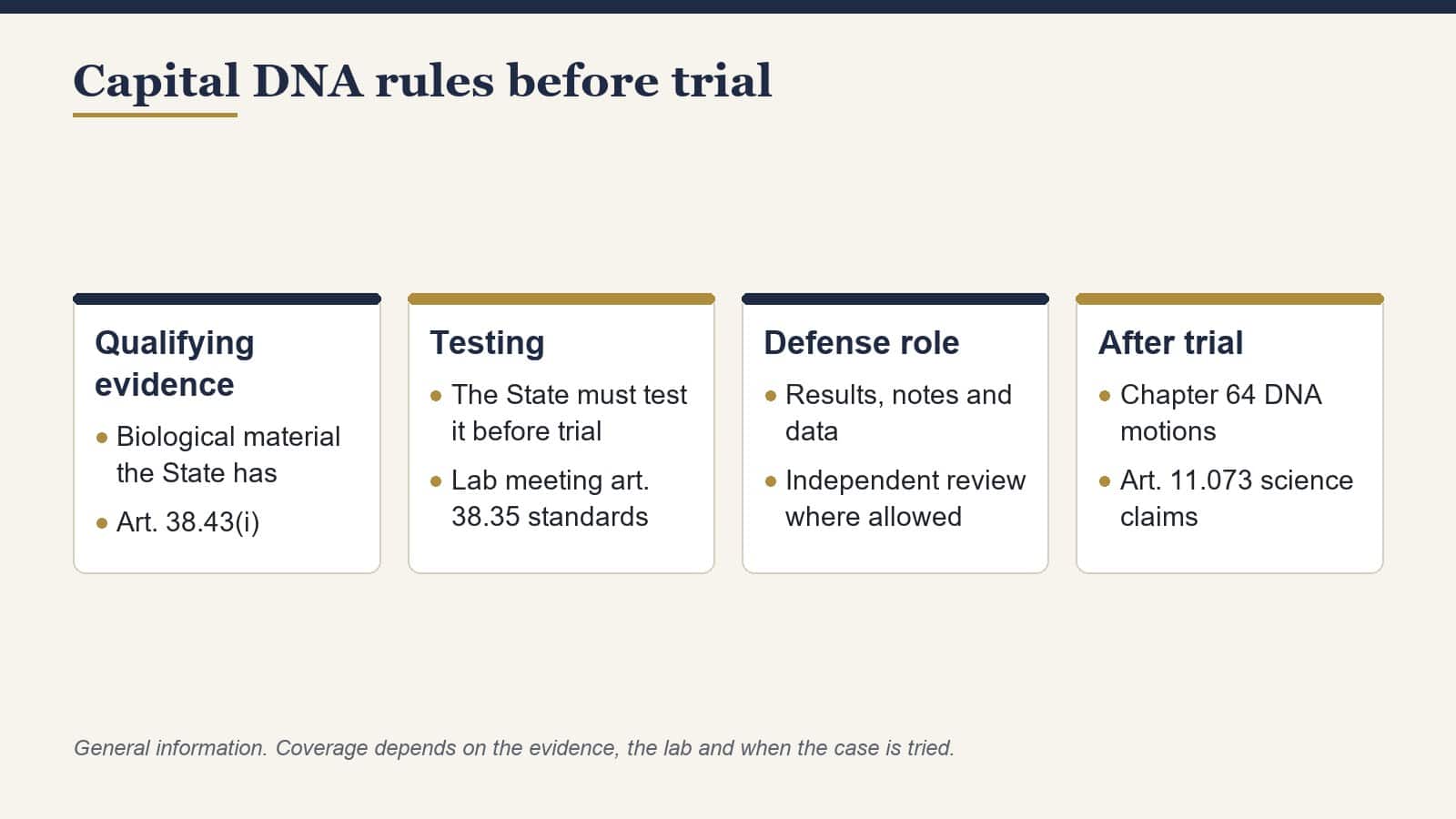
In most murder cases, the lab’s choices would end there. When the State seeks death, art. 38.43(i) of the Code of Criminal Procedure says the State “shall require” an accredited or DPS lab to DNA test “any biological evidence” it holds before trial. The lab pays.
Eight swabs nobody tested
Three of the eight would get my attention first:
- The doorframe swab. The State calls it not probative because it’s the victim’s own home. An unknown profile there would support an another-person theory.
- The fingernail scrapings. They were tested once, and a newer method may be worth a retest.
- The cigarette butt from the driveway. It’s on the property log, so the State has it.
Subsection (i) adds that testing runs “in accordance with the laboratory’s capabilities.” The rest of art. 38.43, plus one appointment statute, gives the defense its tools.
| Provision | What it gives the defense |
|---|---|
| Art. 38.43(j) | A meet-and-confer unless the State “has affirmatively waived the death penalty in writing,” a hearing if the sides can’t agree, and “a rebuttable presumption” that items the defendant asks to test qualify |
| Art. 38.43(k) | Bench notes and results when a test uses up a sample |
| Art. 38.43(m) | Testing at another accredited lab, at the defense’s cost |
| Art. 26.052(f) | An ex parte request by appointed counsel for advance payment of investigative expenses |
| Art. 38.43(l) | One mandamus application to the Court of Criminal Appeals, the “exclusive remedy,” due by the art. 11.071 habeas deadline |
Was the lab accredited, and does the rule reach this test?
Article 38.35(d) bars a forensic analysis, and testimony about it, if the lab wasn’t accredited by the Texas Forensic Science Commission “at the time of the analysis.” Subsection (e) has a narrow exception for a lab that was eligible and gets accredited before testimony.
Whether the rule applies depends on the test:
| Question | Rule |
|---|---|
| Does the rule cover DNA, toxicology and firearms? | Yes. A “forensic analysis” includes a “medical, chemical, toxicologic, ballistic, or other expert examination,” art. 38.35(a)(4). |
| Does it cover fingerprints and phone extractions? | No. Latent print examination and digital evidence are excluded, art. 38.35(a)(4)(A), (C). |
| Does it cover the autopsy? | Not the part done by a pathologist who is a licensed physician, art. 38.35(f). |
| What about a cell-site location map? | Probably digital evidence, so outside art. 38.35. The fight moves to Rule 702: can the method support the map? |
Our articles on cross-examining a forensic expert and on what toxicology evidence can establish take those Rule 702 fights question by question.
Rule 702 at guilt
The jury is out of the room. The State’s DNA analyst is on the stand with a slide of the doorframe-swab mixture, and the judge is deciding whether the jury ever sees it.
Rule 702 asks whether the expert’s knowledge “will help the trier of fact.” Kelly v. State (1992) puts the burden on the side offering the expert to prove three things, by clear and convincing evidence:
- The underlying scientific theory is valid.
- The technique applying it is valid.
- The technique was properly applied on this occasion.
Questions I’d put to a DNA analyst about that doorframe swab:
- How many contributors does the lab say are in the mixture?
- Which software version ran the interpretation, and when was it validated?
- Do the bench notes match the lab’s own protocol, step by step?
Rule 702 at punishment
Thomas Barefoot was convicted of killing a police officer in Bell County, Texas, in 1978. At punishment the State called two psychiatrists, John Holbrook and James Grigson. Neither had examined him. Both answered a long hypothetical question built from his prior nonviolent convictions, his reputation and an escape in New Mexico.
Grigson put the chance that Barefoot would commit future violence at “one hundred percent and absolute.” The American Psychiatric Association told the Court such predictions were unreliable, and the dissent cited its estimate that about two of three are wrong. In 1983 the Court was “not persuaded that such testimony is almost entirely unreliable.”
Art. 37.071, §2(b)(1) still asks whether the defendant “would commit criminal acts of violence that would constitute a continuing threat to society.”
Billie Wayne Coble was sentenced to death in 1990 and got a new punishment trial in 2008. State psychiatrist Richard Coons predicted future violence. The trial court had held a hearing and found him qualified, but he admitted he’d never published his method. Defense expert Mark Cunningham put Coble in the group least likely to commit future violence. In Coble v. State (2010), the Court of Criminal Appeals held the testimony wasn’t shown reliable under Rule 702. It rejected his Eighth Amendment claim because Barefoot still binds it. Coble’s death sentence was still affirmed.
The Constitution sets the Barefoot floor. Texas evidence law sets the higher Coble bar, and the defense can ask for a hearing outside the jury’s presence. The State can test the defense’s own neuropsychological work under the same rule.
Preservation and review after trial
Say the jury convicts and answers the punishment questions for death. The swabs don’t go away.
| After a capital conviction | Rule |
|---|---|
| Keeping biological evidence | Art. 38.43(c)(2)(A): “until the inmate is executed, dies, or is released on parole” |
| Before anything is destroyed | Art. 38.43(d): mailed notice; a written objection received before the 91st day stops it |
| Post-conviction DNA testing | Art. 64.03(a): identity was at issue, and with exculpatory results he “would not have been convicted” |
| New science | Art. 11.073(b): new, admissible scientific evidence that would, by a preponderance, have prevented the conviction |
| One more chapter 64 motion | Art. 38.43(l), after the 11.071 application is filed |
Both statutes are written around the conviction. A claim that new science would have changed only the death sentence fits them less easily.
The basic charge is explained in what makes a murder charge capital murder in Texas, and the Texas Murder Trial Defense Knowledge Hub has the DNA, firearm and toxicology articles.
Common questions
Who pays for the DNA testing the State must do before a death trial?
The lab that tests under art. 38.43(i) pays. If the defense uses another accredited lab under subsection (m), the defense pays.
Can the defense see the lab’s notes, or only the report?
Art. 39.14(a) requires the State, on a timely request, to produce designated material documents held by it or anyone under contract with it. In a death case, art. 38.43(k) separately makes the lab hand over bench notes when a test uses up a sample.
Will we know ahead of time which experts the State plans to call?
The State must name them if the defense asks at least 30 days before jury selection. Art. 39.14(b) then requires each side to name its experts, generally by the 20th day before jury selection.
Sources
- Tex. Code Crim. Proc. arts. 11.073, 37.071, 38.35, 38.43
- Tex. Code Crim. Proc. ch. 64
- Tex. Code Crim. Proc. arts. 26.052, 39.14
- Tex. R. Evid. 702
- Kelly v. State, 824 S.W.2d 568 (Tex. Crim. App. 1992)
- Barefoot v. Estelle, 463 U.S. 880 (1983)
- Coble v. State, 330 S.W.3d 253 (Tex. Crim. App. 2010)
This article provides general information, not legal advice. The law and its application depend on the facts and the law in effect on the relevant date. Consult a lawyer about a specific matter.