
How Will the Lawyer Communicate With the Client and Family?
Mom, Dad, and the lawyer all answer to one person here: the client.
Mr. Heath Enix ‘Heath’ Hyde
Eligible to Practice in Texas
Attorney at Law
Bar Card Number: 00796807
TX License Date: 11/01/1996
Primary Practice Location: Dallas, Texas
Return to the Texas Murder Trial Defense Knowledge Hub
Short answer
Mom hears court dates if your son says so. Dad, who paid, hears only what your son allows. The State’s files don’t leave the defense.
| Who | What they can usually expect |
|---|---|
| The accused | Regular updates and private legal visits or calls |
| A relative the client approves | Court dates and next steps, within his limits |
| A relative who pays the fee | Nothing extra, unless the client agrees |
| Everyone else | Nothing without the client’s consent |
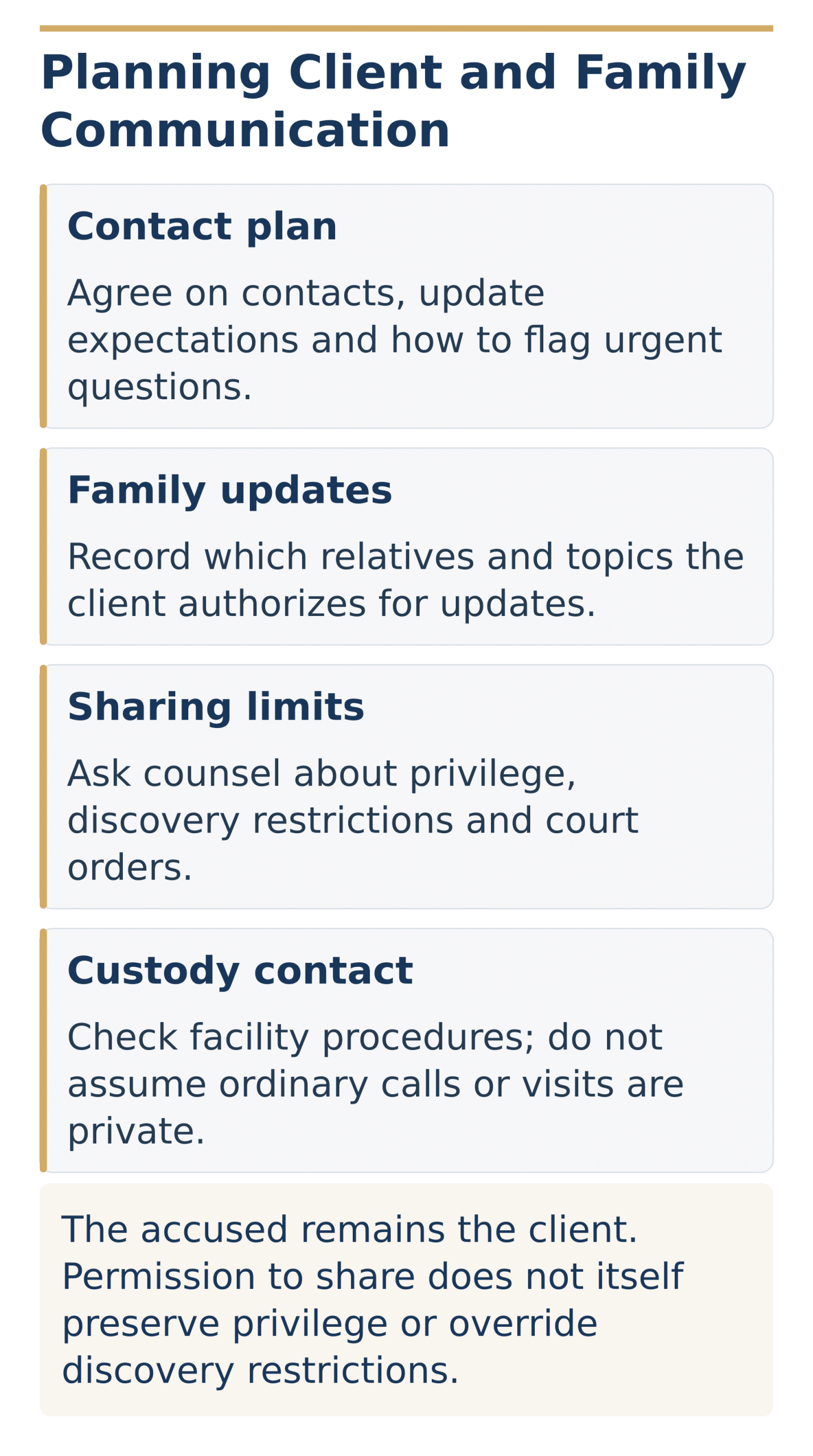
What to do now: Ask the client to tell the lawyer, ideally in writing, which relatives get updates and on what topics.
What should the communication plan cover?
Ask about language and hearing needs, too, such as an interpreter. Ask how quickly a plea offer will be explained to the client.
The floor comes from three places:
- Rule 1.03: keeping the client informed, and explaining enough for informed decisions
- Comment 1 to Rule 1.03: a plea offer’s substance, told to him promptly, unless earlier talks made clear he’d reject it
- Performance Guideline 1.3(B): regular contact, and replies to calls and letters
Under Rule 1.02(a)(3), the client decides the plea, a jury waiver, and whether to testify, after consulting the lawyer. The family can’t make those calls.
Who decides what the family hears?
A father pays the retainer and expects a report every Friday. The client does the deciding, even when relatives pay.
| Date | What happens | Rule |
|---|---|---|
| May 4 | Son tells the lawyer: Mom gets court dates, not plea talks | 1.05(b)(1) |
| May 18 | Dad, who paid, asks about an offer; the lawyer follows the son’s line | 1.08(e) |
| Later | Son changes his mind and tells the lawyer himself | 1.05(b)(1) |
Rule 1.08(e) lets a lawyer take a relative’s money only with the client’s consent, and the payer can’t steer the lawyer’s judgment.
Can family sit in on meetings without losing privilege?
Ask the lawyer before Mom joins the first jail visit.
| Situation | Rule | The privilege question |
|---|---|---|
| A legal visit, just him and the lawyer | TRE 503(b)(1) | Covered: confidential, for legal help |
| Mom sits in while he describes that night | TRE 503(a)(5) | Is she a third person who ends confidentiality? |
| His sister translates for him | TRE 503(a)(5) | Is she needed to transmit it? Ask first. |
| He forwards the strategy email to a cousin | TRE 511(a)(1) | Did sharing a significant part waive it? |
Can the family see the State’s evidence?
The State hands over 900 pages of reports and 12 videos. None of it goes home. An update can still say where the case stands.
Article 39.14(e) bars sharing discovery with third parties without a court order, unless it’s already public. Under art. 39.14(f), your son may view it but not keep copies, and addresses, phone numbers, and identifying numbers get redacted first. The one copy exception is a witness’s own statement, which may go to that witness. If your son wants to watch a video, he views it with the defense, not on a tablet passed around at home.
How does communication work when the client is in jail?
Sunday, 7 p.m.: the county jail calls. Treat that call, video visits, and jail messages as public, and keep the facts of the case off them.
Attorney visits, private legal calls, and legal mail are handled differently at each facility. Ask the lawyer how this jail does it before sending a letter about the case.
Watch for cellmates, too. Under CCP art. 39.14(h-1), the State must disclose credibility information if it plans to use a jail informant’s testimony.
Say that on his third night in a new cell block, a cellmate keeps asking your son what happened. Months later, that cellmate appears on the State’s witness list. The lawyer asks for the credibility information art. 39.14(h-1) requires, and your son tells the lawyer every word he said.
| Instead of saying this | Try this |
|---|---|
| “What really happened with the gun?” | “Write your questions down for the lawyer.” |
| “Did you tell the police anything?” | “The lawyer will go over it in a legal visit.” |
| “I talked to the witness for you.” | Give the names to the lawyer instead. |
The family resources page covers jail visits, calls, and commissary. The family arrest guide covers first steps.
What can a family do to keep communication clear?
Three siblings are each calling the office twice a week with the same bond question. Nobody knows which of them the client wants updated.
- Pick one sibling to call the office.
- Get your brother’s own list of who hears what.
- Put every court date on one shared calendar.
- Send questions in one weekly batch.
Frequently asked questions
Can the lawyer refuse to talk to us?
On topics the client hasn’t approved, the lawyer has to. Ask the client to tell the lawyer which updates you may receive.
How fast should the lawyer return calls?
No rule sets a fixed time. Agree on a realistic expectation at the start and a way to follow up.
Can we be on the call when the lawyer explains a plea offer?
Only if the client wants that and the lawyer agrees it’s wise, given the privilege concerns.
Who do we call if there’s a court date we didn’t know about?
The lawyer’s office, right away. Give the cause number if you have it.
Talk with Heath Hyde
Bring the booking information and court dates you have. Call Heath Hyde, P.C. at 903.439.0000 or request a free consultation.
Legal sources
- Tex. Disciplinary R. Prof’l Conduct 1.02, 1.03, 1.05, 1.08
- Tex. R. Evid. 503, 511
- Tex. Code Crim. Proc. art. 39.14
This article provides general educational information, not legal advice. Every case depends on its facts, evidence, court, deadlines and governing law. Past results do not guarantee a similar outcome.