


What Is Post Conviction Habeas Corpus?
Habeas corpus lets a convicted person bring in facts the jury never heard. Texas has three routes, and the first filing is usually the one that counts.
Mr. Heath Enix ‘Heath’ Hyde
Eligible to Practice in Texas
Attorney at Law
Bar Card Number: 00796807
TX License Date: 11/01/1996
Primary Practice Location: Dallas, Texas
Return to the Texas Murder Trial Defense Knowledge Hub
Short answer
A habeas application can show facts the trial record never held, such as what the trial lawyer failed to investigate. It can’t simply reargue an appeal that was lost. So a habeas lawyer gathers every claim and every document before anything is filed.
| What a family may think | What habeas actually requires |
|---|---|
| “It’s a second appeal.” | A separate case with a legal ground for relief |
| “We can add claims later.” | A later application is hard to get heard. |
| “There’s no deadline.” | Art. 11.07 has none, but the federal year runs. |
| “The judge will hold a hearing.” | Often the court decides on affidavits. |
What to do now: Write down every possible claim you know of, with names, dates, and documents. Give that list to counsel before anything is filed.
Which habeas route fits this conviction?
Which article applies turns on the sentence and on what the person is asking for. A 45-year murder sentence with the appeal already lost goes under art. 11.07.
| Route | When it applies |
|---|---|
| Art. 11.07 | Final felony judgment, penalty other than death |
| Art. 11.071 | Judgment imposing a death sentence |
| Art. 11.072 | Person is or was on community supervision |
| Chapter 64 | Motion for DNA testing, not habeas |
| 28 U.S.C. §2254 | Federal court, once state remedies are used up |
What kinds of claims can habeas raise?
Page 3 of the case file lists two alibi witnesses, with phone numbers. Trial counsel never called either one. Art. 11.23 says the writ reaches confinement where no lawful right exists, or where power is used in a way the law doesn’t allow.
| Claim | What it needs |
|---|---|
| Ineffective assistance, the most common | Deficient performance and prejudice (Strickland v. Washington, 1984), usually shown by affidavit, as in Ex parte Nailor (2004) |
| New science, art. 11.073 | Science unavailable at trial, and more likely than not no conviction |
| Withheld favorable evidence | Records the defense didn’t have at trial |
In 2025 a cousin’s public-records request turns up a 2019 police report. Page 2: a neighbor saw a different car leave at 10:50 p.m. That page may support a withheld-evidence claim. The two alibi witnesses nobody called may support an ineffective-assistance claim, if they’d have helped.
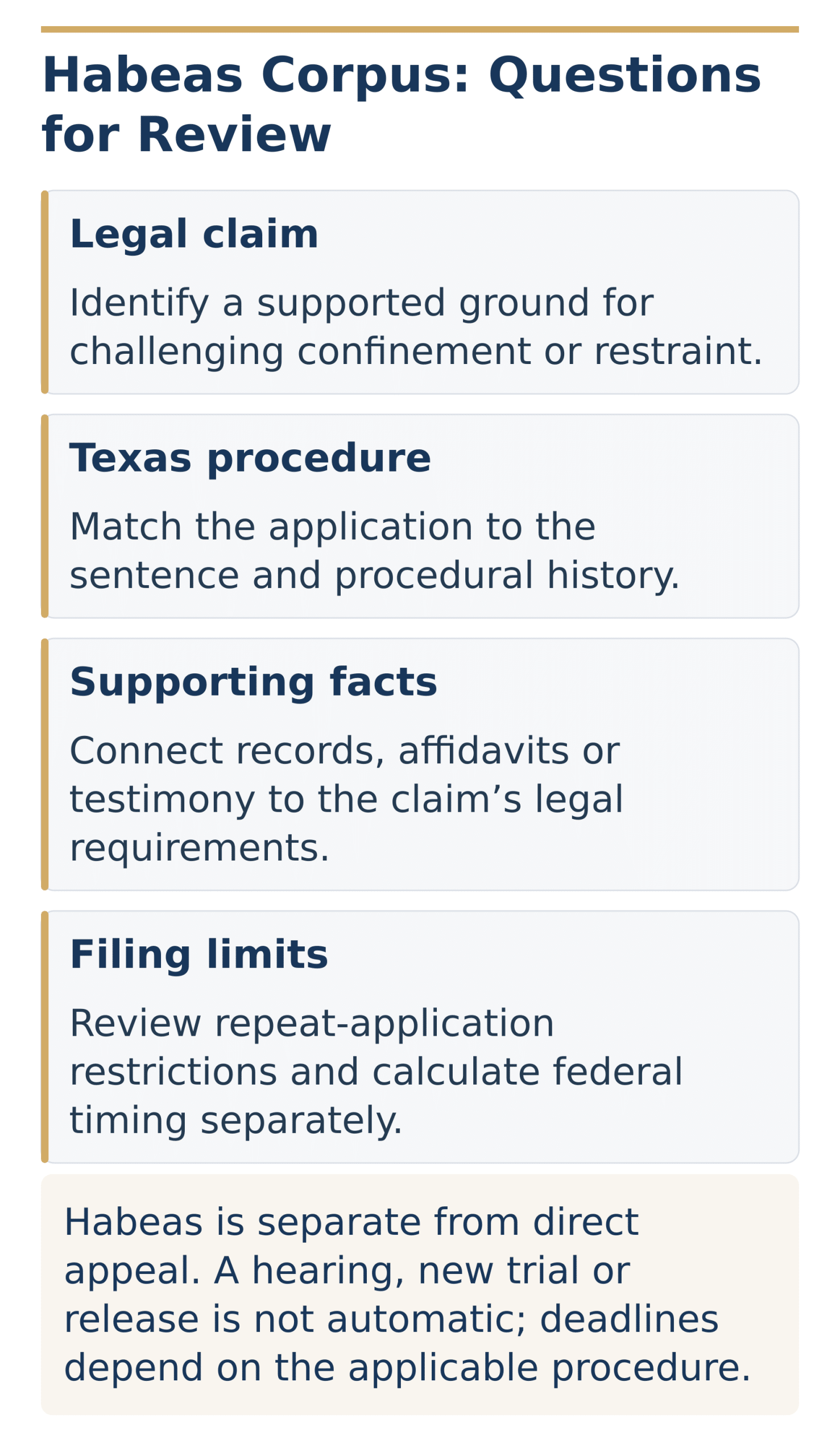
A habeas case isn’t a second appeal. Losing an appeal doesn’t by itself create a habeas claim. The applicant still has to show a legal ground for relief.
How does an art. 11.07 case move through the courts?
Say the clerk of the convicting court sends the application to the State on March 3. The State’s answer is due by the 30th day after it receives the application (§3(b)).
Then the convicting court has 20 days after the answer period ends. In that window, it decides whether there are unresolved facts material to the confinement (§3(c)). If it finds none, or doesn’t act, the clerk sends the case to the Court of Criminal Appeals without a hearing.
If facts are disputed, the trial court can take affidavits or depositions, send interrogatories, order forensic testing or hold a hearing (§3(d)). The final word still belongs to the Court of Criminal Appeals (§5).
Why does the first application matter so much?
Say a first 11.07 application was denied in 2022, and a new claim turns up now. After a first application is finally decided, a later one is hard to get heard. Article 11.07, §4 allows it in two situations:
- The claim’s factual or legal basis wasn’t available when the first application was filed (§4(a)(1)).
- But for a constitutional violation, no rational juror could have found guilt beyond a reasonable doubt (§4(a)(2)).
The official 11.07 form requires every ground on the form. It warns that grounds raised later may be barred. If the interests of justice require it, the court can appoint counsel for an indigent applicant (art. 1.051(d)(3)).
What deadlines apply?
Say the conviction became final 10 months ago, and nothing has been filed. The deadlines differ by route, so counsel checks each one.
| Proceeding | Deadline |
|---|---|
| Art. 11.07 | None in the statute, but delay can affect a claim |
| Art. 11.071 | Later of 180 days after counsel’s appointment or 45 days after the State’s original brief (§4(a)) |
| Art. 11.071 extension | One 90-day extension for good cause (§4(b)) |
| Federal (28 U.S.C. §2244(d)) | One year, usually from finality |
The federal clock may already be running while a family is still gathering records. A properly filed Texas application pauses it only while that application is pending. Don’t assume you’ll get a fresh year afterward.
Say a key witness signs a recantation on June 12. Counsel asks whether that new fact starts a later federal date under §2244(d)(1)(D), and how much of the original year is left.
What can a family do before a habeas filing?
Maybe your mother kept every letter from trial counsel in a shoebox. Maybe an uncle still has the business card of the investigator who never called back.
Bring counsel the judgment and the date the conviction became final, the appellate opinion, names and numbers of witnesses the jury never heard, and any earlier habeas filing with its ruling. Do that before anyone fills out a form.
Frequently asked questions
Is habeas the same as an appeal?
A habeas case can add facts from outside the trial record. The appeal couldn’t.
Will there be a hearing?
Only if the convicting court finds disputed facts that need one. Affidavits often do the job instead.
Can the family file for the person in prison?
Talk to counsel first. The application has strict form rules, and a weak first filing can block later claims.
Does habeas work for a probation case?
Yes, but usually under a different article. A person on community supervision generally uses art. 11.072 instead of art. 11.07.
Talk with Heath Hyde
If a family member was convicted and you’ve found facts the jury never heard, don’t wait. Call Heath Hyde, P.C. at 903.439.0000 or request a free consultation. You can also review how an alibi can be preserved and tested and the Texas Murder Trial Defense Knowledge Hub.
Legal sources
- Tex. Code Crim. Proc. arts. 11.07, 11.071, 11.072, 11.073, 11.23
- Tex. Code Crim. Proc. art. 1.051
- Tex. Code Crim. Proc. ch. 64
- Art. 11.07 application form and instructions
- 28 U.S.C. §§2244, 2254
- Strickland v. Washington, 466 U.S. 668 (1984)
- Ex parte Nailor (Tex. Crim. App. 2004)
This article provides general educational information, not legal advice. Every case depends on its facts, evidence, court, deadlines and governing law. Past results do not guarantee a similar outcome.