


What Is Different About a Death Penalty Trial?
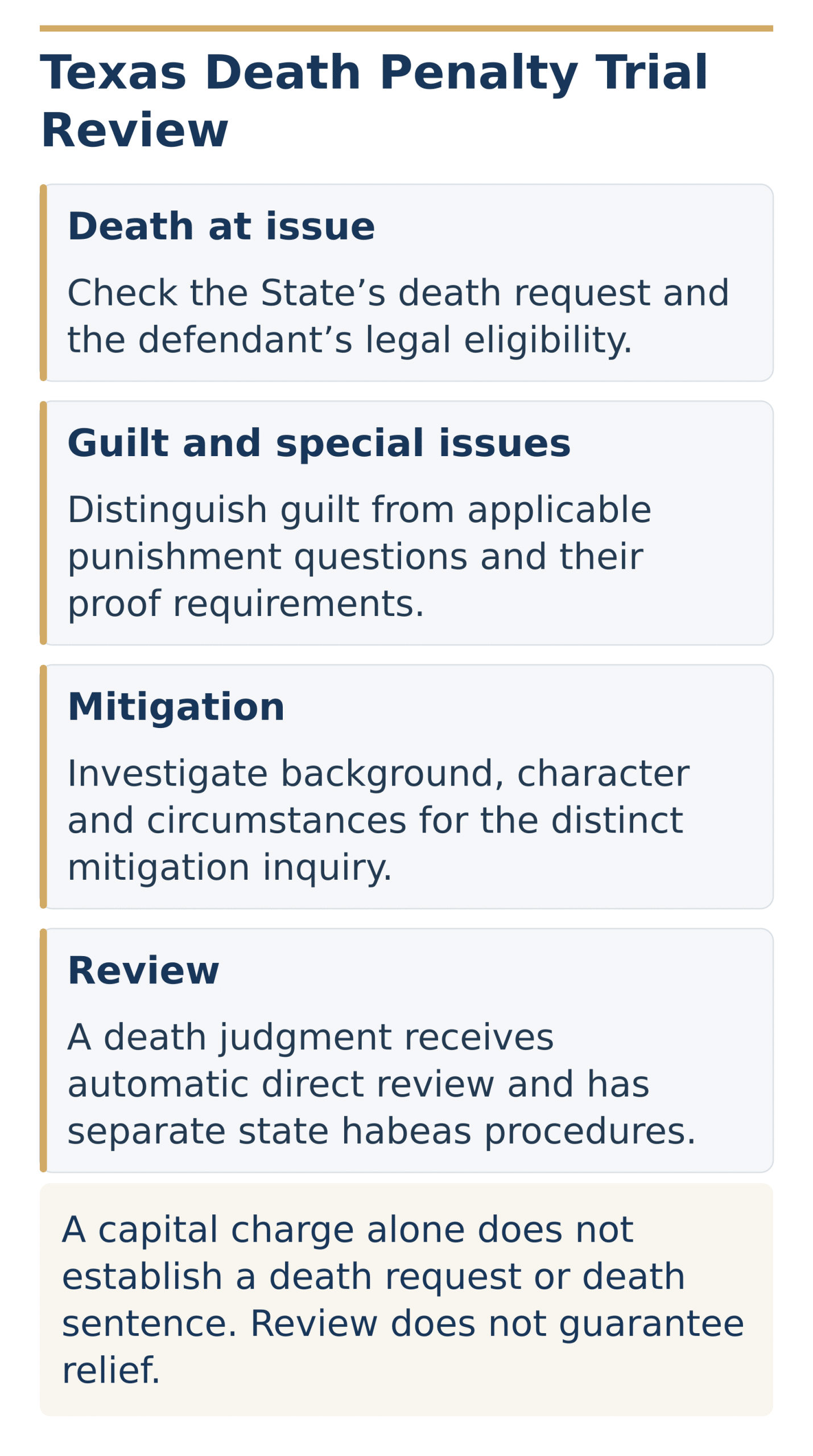
A capital murder charge alone doesn’t put death on the table. When the State seeks it, the appointment, jury selection, sentencing and review rules all change.
Mr. Heath Enix ‘Heath’ Hyde
Eligible to Practice in Texas
Attorney at Law
Bar Card Number: 00796807
TX License Date: 11/01/1996
Primary Practice Location: Dallas, Texas
Return to the Texas Murder Trial Defense Knowledge Hub
Short answer
A death penalty trial is a capital murder trial where the State has decided to seek death. A capital charge alone can’t produce a death sentence, and several rules take death off the table. So your lawyer first finds out whether the State is seeking death, then prepares for individual jury questioning and a separate sentencing hearing.
| What families may hear | What may actually be true |
|---|---|
| “Capital murder means a death sentence.” | Only if the State seeks death |
| “He was 17, but it’s still a death case.” | No death sentence for an offense before 18 |
| “The jury just votes on death.” | It answers up to three special issues |
| “If the jury splits, he gets death.” | An unanswered issue means life without parole |
What to do now: Ask the lawyer whether the State has given written notice that it won’t seek death. That notice changes how the defense team is appointed.
When is death actually possible?
A 17-year-old is charged with capital murder after a robbery shooting. Death isn’t a possible sentence for him.
Capital murder under Penal Code §19.03 is only the starting point. Several rules each take death off the table on their own.
| Rule | Effect |
|---|---|
| The State doesn’t seek death, §12.31(a). | Life without parole for an adult, or life if under 18 at the offense |
| The offense came before age 18, §8.07(c). | No death sentence |
| The case rests only on §19.03(a)(9), art. 37.071, §1(b). | The State can’t seek death. |
| The person has intellectual disability. | Atkins v. Virginia (2002): the Eighth Amendment bars the execution. |
Learn more about what makes a murder charge capital murder in Texas.
The offense date matters too. S.B. 60 took effect Sept. 1, 2005. If every element of the offense happened on or after that date, the current §12.31 and art. 37.071 apply. If any element happened earlier, S.B. 60, §17 says the older law governs. The rules below describe adults whose offenses fall after that date.
How is jury selection different?
One prospective juror sits alone in the box. The rest of the panel has gone home for the day, and both lawyers take turns asking about her views on the death penalty.
That’s individual voir dire. Under art. 35.17, §2, the judge first questions the whole panel on core principles. Then either side can demand to question each juror individually, apart from the panel. Without death sought, that’s up to the court.
Each side gets 15 peremptory strikes under art. 35.15(a), instead of 10. Under art. 35.16(b)(1), the State may challenge a juror with conscientious scruples about imposing death. Under art. 35.16(c)(2), the defense may challenge a juror biased against law it relies on, including mitigation. Under Penal Code §12.31(b), prospective jurors are told that life without parole or death is mandatory on a capital conviction.
What does the jury decide at sentencing?
The jury convicts at 4 p.m. on a Friday. The next phase is a separate hearing under art. 37.071, §2, with up to three questions.
The first asks about future dangerousness. The State must prove beyond a reasonable doubt a probability that the defendant would commit criminal acts of violence that would be a continuing threat to society. The second, the anti-parties issue, comes up if the guilt charge allowed conviction as a party. Then the State must prove he caused the death, intended a killing, or anticipated that a life would be taken.
| Issue | Burden and vote |
|---|---|
| Future dangerousness, §2(b)(1) | State proves it beyond a reasonable doubt; “yes” unanimous, “no” needs 10 |
| Anti-parties issue, §2(b)(2) | Same burden and voting rule |
| Mitigation, §2(e)(1) | Asked only after “yes” answers above; “no” unanimous, “yes” needs 10 |
On the mitigation question, jurors don’t have to agree on which evidence supports a “yes.” They weigh his background, character and personal moral culpability along with the offense. Jones v. State (Tex. Crim. App. 2003) noted earlier holdings that the issue isn’t unconstitutional for leaving out a burden of proof.
The answers then fix the sentence under §2(g).
| Jury’s answers | Sentence under §2(g) |
|---|---|
| “Yes” on each §2(b) issue and “no” on mitigation | Death |
| “No” on any §2(b) issue | Life without parole |
| “Yes” on mitigation | Life without parole |
| No answer on an issue | Life without parole |
The law of parties matters here because of the second issue.
Say two people rob a store, and the partner shoots the clerk. The defendant drove the car and stayed in the lot with the engine running. The jury must decide whether he intended a killing or anticipated that a life would be taken, so the defense focuses on what he knew and expected.
How do preparation and review differ?
A capital indictment comes down, and the judge appoints the defense team. Under art. 26.052(e), that means two attorneys, at least one qualified under the statute, unless the State gives written notice that it won’t seek death.
The mitigation team works toward the third question. At sentencing, either side can offer any evidence the court deems relevant, including background, character or offense circumstances that mitigate against death (art. 37.071, §2(a)(1)). The State can’t use race or ethnicity to predict future crime (§2(a)(2)).
| After a death sentence | Rule |
|---|---|
| Direct appeal | Automatic review in the Court of Criminal Appeals, art. 37.071, §2(h) |
| Habeas | A separate process with its own counsel, art. 11.071 |
| Habeas deadline | The later of 180 days after counsel is appointed or 45 days after the State’s original appeal brief, §4(a) |
The math, with illustrative dates: habeas counsel is appointed March 1, so day 180 is Aug. 28. The State files its original appeal brief July 20, so day 45 is Sept. 3. The later date, Sept. 3, controls.
What can a family do when the State may seek death?
Maybe your mother still has his baby book and a letter from his fourth-grade teacher. Maybe an uncle remembers the year the family lived in a car.
- A list of every school, doctor, caseworker and job
- Photos, letters and records already at home
- Names of relatives who saw his childhood firsthand
- Silence about the case on jail calls and online
The mitigation team will ask for all of it, so start the list now.
Frequently asked questions
Does the State have to announce early whether it seeks death?
Not always. The statute ties two-lawyer appointment to written notice that the State won’t seek death, and timing depends on the prosecutor and court.
Can a person under 18 be sentenced to death in Texas?
Penal Code §8.07(c) bars it. For those offenses, §12.31 sets a life sentence instead.
What happens if the jury can’t agree at sentencing?
Life without parole. Under art. 37.071, §2(g), the court imposes it when the jury can’t answer an issue.
Is mitigation evidence limited to the crime itself?
Jurors weigh his background, character and personal moral culpability along with the offense.
Talk with Heath Hyde
If the State may seek death against someone you love, the defense team and mitigation work need to start right away. Call Heath Hyde, P.C. at 903.439.0000 or request a free consultation. You’ll find more in the Texas Murder Trial Defense Knowledge Hub.
Legal sources
- Tex. Code Crim. Proc. art. 37.071
- Tex. Code Crim. Proc. arts. 35.15–35.17
- Tex. Code Crim. Proc. art. 26.052
- Tex. Code Crim. Proc. art. 11.071
- Tex. Penal Code §§8.07, 12.31, 19.03
- S.B. 60, 79th Leg., R.S. (2005)
- Atkins v. Virginia, 536 U.S. 304 (2002)
- Jones v. State, No. 74,060 (Tex. Crim. App. 2003)
This article provides general educational information, not legal advice. Every case depends on its facts, evidence, court, deadlines and governing law. Past results do not guarantee a similar outcome.