


What Issues Can Be Raised on Direct Appeal?
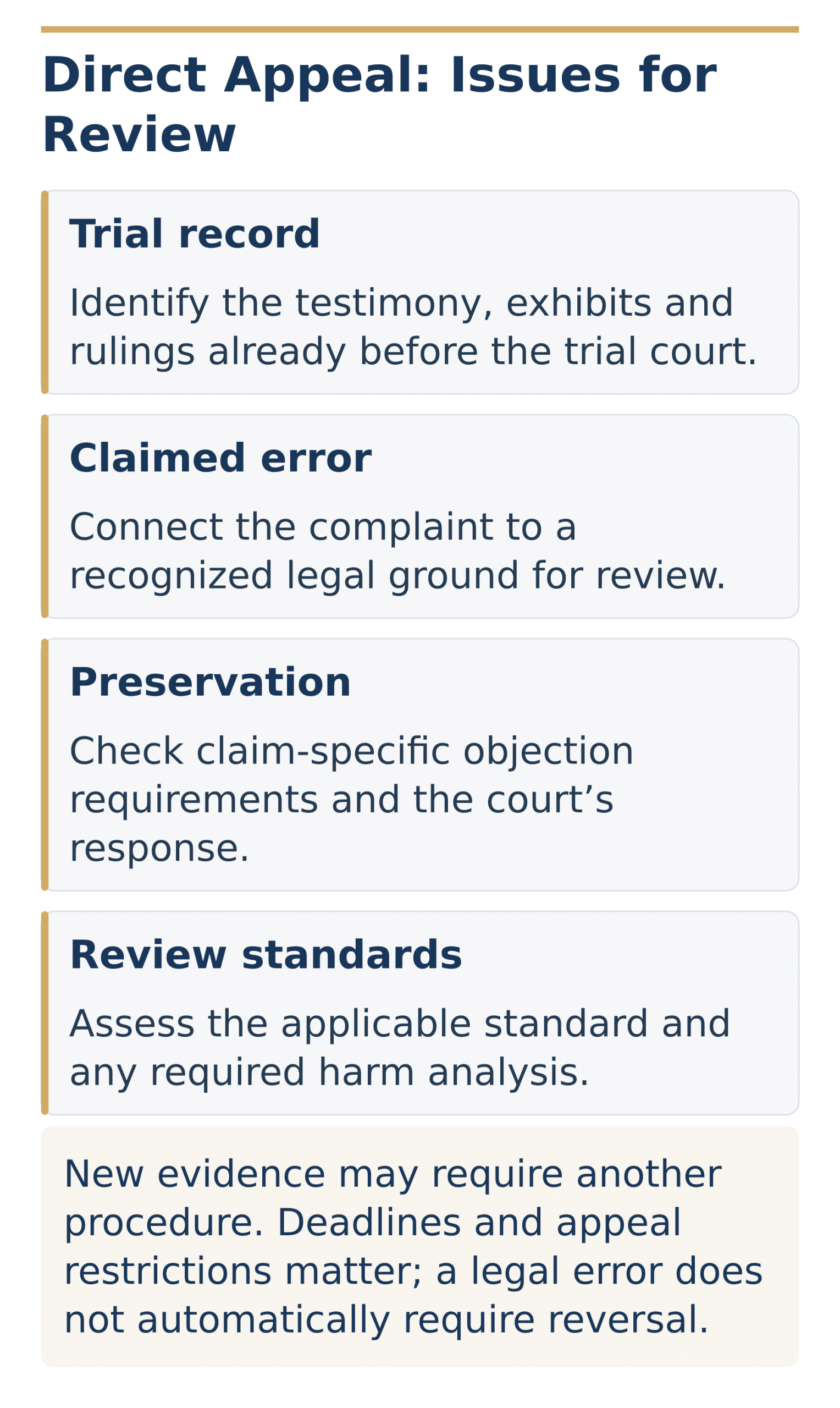
The court of appeals reads the trial record and nothing else. What’s written in that record, and what the trial lawyer objected to, decides which issues it will hear.
Mr. Heath Enix ‘Heath’ Hyde
Eligible to Practice in Texas
Attorney at Law
Bar Card Number: 00796807
TX License Date: 11/01/1996
Primary Practice Location: Dallas, Texas
Return to the Texas Murder Trial Defense Knowledge Hub
Short answer
A direct appeal can show that the judge got the law wrong at trial, as long as the record proves it. It can’t retry the facts or hear a new witness. So your appellate lawyer starts with the transcript and the objections in it, not with the verdict.
| What a family may hope | What the court of appeals can do |
|---|---|
| “The jury believed the wrong witness.” | Ask only whether any rational juror could convict. |
| “We found a new witness.” | Nothing, unless the record already holds her. |
| “The judge let in bad evidence.” | Review it, if the lawyer objected and got a ruling. |
| “The mistake was obvious.” | Reverse only if the error caused harm. |
What to do now: Write the sentencing date on a calendar and count 30 days. That’s the usual deadline for the notice of appeal.
What kinds of mistakes can an appeal raise?
Say the only proof of intent was a vague text your son sent two days after the shooting. That may support a challenge to the evidence on intent. The court won’t weigh who told the truth. It asks a narrower legal question.
Under Jackson v. Virginia (1979), the court views the evidence in the light most favorable to the verdict. Then it asks whether any rational juror could find each element beyond a reasonable doubt. That test runs straight back to what the State must prove to convict someone of murder in Texas.
A suppression ruling is another common issue. Art. 38.23 bars evidence obtained in violation of the law. If the judge wrongly denied a motion to suppress, the appeal can raise it.
A refused instruction can matter, too. If the defense asked for a lesser-included offense and the judge said no, that refusal can be raised. See which lesser included offenses a jury may consider.
Some errors touch only the sentence. In a non-capital case, a new trial for punishment-stage error alone sends the case back for a new punishment hearing (art. 44.29(b)).
Two examples. On page 88 of the pretrial transcript, the defense moves to suppress a phone search, and the judge denies it. That ruling can be reviewed. Now say the jury sent a note at 3:40 p.m. on day four, and the judge answered it without telling the defense. That may be a procedural error, but only if the record shows the note and the answer.
Did the trial lawyer object at the right moment?
A detective on the stand repeats what a neighbor told him. Defense counsel stands: “Objection, hearsay.” The judge: “Overruled.” Under TRAP 33.1, a timely, specific objection plus a ruling usually preserves the complaint.
| What happened at trial | Effect on appeal |
|---|---|
| Objection, reason, and ruling | Usually preserved |
| Judge refused to rule; lawyer objected | Preserved (Rule 33.1(a)(2)(B)) |
| Hearsay objection; confrontation argued later | Complaint may not match |
| No objection to charge error | Egregious harm required (Jimenez, 2000) |
| Charge objection made | “Some harm” required (Jimenez) |
Ask the appellate lawyer to mark each objection in the transcript by page number. The gaps show up fast.
What if the proof isn’t in the transcript?
Say the family finds a witness after trial and staples her affidavit to the appellate brief. The court won’t read it. It reviews the clerk’s record and, when needed, the reporter’s record (TRAP 34.1). In Whitehead v. State (2004), the court held that a party can’t get around that rule with an affidavit filed for the first time on appeal.
Three record problems come up often. A bench conference went unrecorded, so there may be nothing to review. Facts came out after trial, and a motion for new trial can bring them in by affidavit or at a hearing (TRAP 21.7). An exhibit went missing, and counsel can ask to supplement the clerk’s record.
Say the transcript on page 412 reads only “(Bench conference held off the record).” Your brother remembers his lawyer arguing hard at that bench. Without a record of what was said, the appellate court may have nothing to review.
Does a wrong ruling mean a new trial?
Not always. Say the judge wrongly let in a hearsay statement over objection. The conviction can still stand, because TRAP 44.2 sets two harm tests.
| Rule | What the court does |
|---|---|
| TRAP 44.2(a), constitutional error | Reverses unless the error was harmless beyond a reasonable doubt |
| TRAP 44.2(b), other error | Disregards it if substantial rights weren’t affected |
| Art. 44.29(a), guilt-stage reversal | Treats the case as if a new trial was granted |
For constitutional error, the bar for keeping the conviction is high. The court must find beyond a reasonable doubt that the error didn’t contribute to the conviction or punishment. A wrong ruling alone isn’t enough to win.
Why does ineffective assistance usually wait for habeas?
Say trial counsel never called the one witness who could place your son across town at 9:15 p.m. Why not? The transcript usually doesn’t say. These claims turn on what the lawyer did and why.
| Case | What the Court held |
|---|---|
| Strickland v. Washington (1984) | The claim needs deficient performance and resulting prejudice. |
| Freeman v. State (2003) | The direct-appeal record was “simply undeveloped” on counsel’s choices. |
| Ex parte Nailor (2004) | The applicant developed the claims through trial counsel’s affidavit in habeas. |
What deadlines can end an appeal early?
Say the family first calls an appellate lawyer five weeks after sentencing. The notice of appeal was due 30 days after sentencing. A timely motion for new trial stretches that to 90 days (TRAP 26.2(a)).
A plea bargain narrows things further. After an agreed plea, the defendant can appeal only written pretrial motions ruled on before trial, issues the court permits, or appeals a statute authorizes (TRAP 25.2(a)(2)). The trial court must also certify the right of appeal with each judgment of guilt.
What can a family do while the appeal is being prepared?
Maybe you sat behind the defense table every day and took notes on a legal pad. Maybe you still have the texts your cousin sent you from the hallway during jury selection.
Gather these for the appellate lawyer:
- The sentencing date and any motion-for-new-trial date
- Your notes on objections, bench talks, and jury notes, with dates
- Names of witnesses who came forward after the verdict
- Copies of the judgment and the certification of the right of appeal
Give everything to the lawyer, and let the lawyer decide what belongs in a motion, the brief, or a later habeas filing.
Frequently asked questions
Can the appeals court hear from new witnesses?
It reviews the trial record. New evidence usually goes through a motion for new trial or habeas instead.
Can we argue the jury believed the wrong witness?
Not by itself. The sufficiency test views the evidence in favor of the verdict and asks whether any rational juror could convict.
What if my son’s lawyer didn’t object?
Often, the complaint is lost. Unobjected jury-charge error is still reviewed, but under the harder egregious-harm test.
Should ineffective assistance be raised on appeal?
Sometimes. The trial record may not show the lawyer’s reasons, so your appellate lawyer will weigh whether habeas is the better place.
Talk with Heath Hyde
If you’re weighing an appeal, the deadline may already be running. Call Heath Hyde, P.C. at 903.439.0000 or request a free consultation. You can also explore the Texas Murder Trial Defense Knowledge Hub.
Legal sources
- Tex. R. App. P. 21.7, 25.2, 26.2, 33.1, 34.1, 44.2
- Tex. Code Crim. Proc. art. 38.23
- Tex. Code Crim. Proc. art. 44.29
- Jackson v. Virginia, 443 U.S. 307 (1979)
- Strickland v. Washington, 466 U.S. 668 (1984)
- Jimenez v. State (Tex. Crim. App. 2000)
- Whitehead v. State (Tex. Crim. App. 2004)
- Freeman v. State (Tex. Crim. App. 2003)
- Ex parte Nailor (Tex. Crim. App. 2004)
This article provides general educational information, not legal advice. Every case depends on its facts, evidence, court, deadlines and governing law. Past results do not guarantee a similar outcome.