What Is Article 39.14 Discovery in a Texas Murder Case?
Article 39.14 is the Texas statute that opens the State’s file to the defense. Here’s what it reaches, who it binds, and what happens when the State is late.
Mr. Heath Enix ‘Heath’ Hyde
Eligible to Practice in Texas
Attorney at Law
Bar Card Number: 00796807
TX License Date: 11/01/1996
Primary Practice Location: Dallas, Texas
Return to the Texas Murder Trial Defense Knowledge Hub
Short answer
Article 39.14 can open most of the State’s file to your lawyer, and favorable information has to come over without a request. It can’t put copies of that file in the family’s hands. So your lawyer sends a timely request, logs every item that arrives, and chases what’s missing.
| What you may hear | What the law says |
|---|---|
| “We’ll send discovery when you ask.” | Subsection (a) material comes after a timely request, as soon as practicable. |
| “That isn’t material.” | Watkins: “material” means relevant, not verdict-changing. |
| “The sheriff has it, not us.” | Heath: “the State” includes law enforcement agencies. |
| “Nobody asked for that.” | Subsection (h) favorable information comes with no request. |
What to do now: Ask your lawyer the date the written discovery request went out and the date the State’s expert list is due.
What’s in the file the State has to hand over?
The lead detective’s binder can run three inches, tabbed, with a sleeve of discs at the back. Subsection (a) reaches most of it, as soon as practicable after a timely request. That file is also where your lawyer learns what the State will try to prove.
The covered categories, with murder-case examples:
- Offense reports, including every supplement
- Statements, written or recorded, from the defendant or any witness, officers included
- Documents, papers, and photographs, such as autopsy photos, warrants, and lab reports
- Objects and other tangible things, such as clothing or a recovered pistol
Some things stay out. The work product of prosecutors and their investigators, including their notes and reports, isn’t covered. Some written messages between the State and its own agents or employees can stay out too.
Blacked-out pages don’t get a pass. If the State withholds or redacts part of an item, it has to say so, and on request the court must hold a hearing under art. 39.14(c).
Does “the State” include the sheriff and the lab?
Say a 911 recording sits on a sheriff’s server, and nobody at the DA’s office ever asks for it. The Court of Criminal Appeals has answered whether that counts.
| Case | What the Court held |
|---|---|
| State v. Heath (2024) | “The State” includes law enforcement agencies, and prosecutors must use reasonable diligence to find discoverable items. |
| Watkins v. State (2021) | “Material” in subsection (a) means “relevant,” not evidence that would change the verdict. |
Under Heath, the sheriff’s recording counts. But the court has granted review in Moten (PD-0932-25) on whether to overrule Heath. Its facts involve recorded jail calls found during jury selection. Your lawyer should check for a newer decision.
Contractors count too. Subsection (a) reaches material held by a person under contract with the State, such as a private lab that finished a DNA report but hasn’t sent it to the prosecutor yet.
What about evidence that helps the defense?
Suppose a witness told a detective she saw a second car leave the lot at 11:20 p.m. Nobody has to ask for that line.
Subsection (h) requires the State to disclose exculpatory, impeachment, or mitigating information that tends to negate guilt or reduce punishment. No request is needed. Under Watkins, that duty is broader than Brady v. Maryland because it isn’t limited to “material” evidence. And under subsection (k), the State must promptly disclose new favorable information whenever it surfaces, before, during, or after trial.
Jailhouse witnesses come with extra rules. Say the State will call a cellmate who claims the defendant made a statement against interest while both were held in the same facility. Art. 39.14(h-1) requires disclosure of that witness’s criminal history, any deal, and other cases where the witness testified.
Who can see the discovery?
Families usually hit this wall first. A mother asks for a copy of the police report, and the lawyer has to say no. Subsections (e) and (f) explain why.
| Person | What the statute allows |
|---|---|
| Defense lawyer, investigators, experts | Review and copy; no third party without a court order or prior public release |
| The defendant | View through the defense team; no copies |
| A witness or prospective witness | View; keep only a copy of their own statement |
| Anyone viewing under (f) | Only after the defense redacts addresses, phone numbers, birth dates, and identifying numbers |
Family members aren’t named in (f), so work through counsel. The family resources page covers other ways to help.
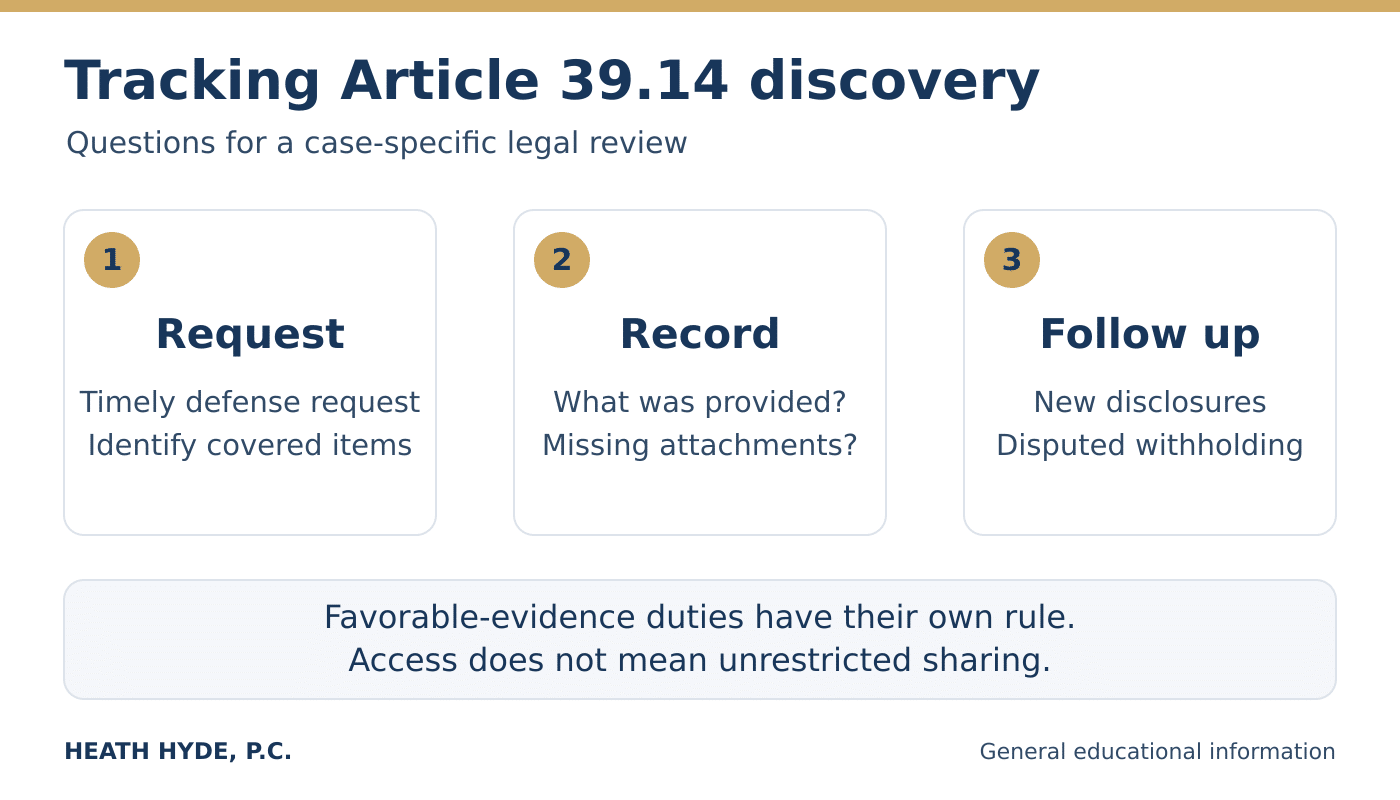
How does the defense keep track of what it received?
A murder file can arrive as eleven discs and 3,400 pages. Under art. 39.14(i), the State must record or otherwise document every item it provides. Under (j), each side acknowledges the disclosed-items list in writing or in open court before a guilty or no-contest plea is accepted, or before trial.
Experts run on their own clock. Either side can demand the other’s expert names and addresses under (b). Ask by the 30th day before jury selection, and the answer is due by the 20th.
| Log line | What’s wrong |
|---|---|
| Supplement, p. 14 | Mentions a “second recorded interview”; only one came |
| Disc 6 | Store video won’t play on any office computer |
| Lab report | Cites bench notes nobody sent |
Each line gets a written request: does it exist, who has it, and when will it come?
What happens when the State turns something over late?
Second morning of trial, and a lab report shows up. That alone won’t end the case. What happens next depends on the record.
| Authority | What it says |
|---|---|
| State v. Heath (2024) | A trial court may exclude late evidence without first finding bad faith. |
| Watkins v. State (2021) | The exhibits should have been disclosed, so the case went back for a harm review. |
| Art. 29.03 | A continuance needs a written motion fully setting out sufficient cause. |
None of those authorities makes dismissal automatic.
Does the date of the offense matter?
Take a cold case: a 2011 death charged today. The offense date controls which version of art. 39.14 applies, not the arrest date. The Michael Morton Act version covers offenses committed on or after January 1, 2014. If any element happened before that date, the older version applies under section 3 of S.B. 1611.
What can a family do while discovery comes in?
Your lawyer may ask about something in the file without showing you the page. Maybe a report says your nephew left the party at 11, and you know he was on your couch by 10:30.
Write that down. Add who was with him that night and how to reach them, any texts, photos or receipts with times on them, cameras near the places he went, and every police or press contact with its date. Your lawyer can line those up against the file.
Frequently asked questions
Do we have to ask for discovery?
Yes, for most of it. Subsection (a) material comes after a timely request, while favorable information under (h) must come without one.
Can my family get a copy of the police report?
Not from the defense. Under art. 39.14(e), the defense team can’t pass discovery to a third party without a court order.
Does art. 39.14 open the grand jury’s records?
Grand jury proceedings stay secret under art. 20A.202. To get them, a defendant has to show a particularized need under art. 20A.205.
Does the defense have to disclose anything?
Yes, expert names on a timely request under art. 39.14(b). Other defense duties depend on the case.
Talk with Heath Hyde
If someone you love is charged with murder, the discovery file is where the defense starts. Call Heath Hyde, P.C. at 903.439.0000 or request a free consultation. The discovery section of the Texas murder defense knowledge hub has more background.
Legal sources
- Tex. Code Crim. Proc. art. 39.14
- Tex. Code Crim. Proc. arts. 20A.202, 20A.205
- Tex. Code Crim. Proc. art. 29.03
- S.B. 1611, 83rd Leg., R.S. (2013), §§ 3–4
- Watkins v. State, 619 S.W.3d 265 (Tex. Crim. App. 2021)
- State v. Heath, 696 S.W.3d 677 (Tex. Crim. App. 2024)
- Moten, PD-0932-25 (pending)
- Brady v. Maryland, 373 U.S. 83 (1963)
This article provides general educational information, not legal advice. Every case depends on its facts, evidence, court, deadlines and governing law. Past results do not guarantee a similar outcome.