

Should a Person Speak to Police During a Murder Investigation?
A detective’s call can sound casual. Here’s what the law protects in that room, where it stops, and why the first call should go to a lawyer.
Mr. Heath Enix ‘Heath’ Hyde
Eligible to Practice in Texas
Attorney at Law
Bar Card Number: 00796807
TX License Date: 11/01/1996
Primary Practice Location: Dallas, Texas
Return to the Texas Murder Trial Defense Knowledge Hub
Short answer
Usually not, until you’ve talked with a defense lawyer. An interview can give officers your words on tape. It can’t take back anything you said once it’s in the file. So your lawyer finds out what the officers want and answers for you when that helps.
| What an officer may say | What it may actually mean |
|---|---|
| “Come down and clear a few things up.” | A request. You can decline it. |
| “You’re not under arrest.” | True for now. Custody can start later. |
| “Just tell us your side.” | Your words, recorded and usable later. |
What to do now: Take the officer’s card, say a lawyer will call back, and phone a defense lawyer the same day.
Do you have to go to the station if a detective asks?
No. The card in your door says Detective R. Alvarez, Homicide, with a cell number on the back. Nothing on it orders you to show up.
In Oregon v. Mathiason (1977), a man came to the station on his own. Officers told him he wasn’t under arrest. He left when the interview ended. The Court held he wasn’t in custody.
That cuts both ways. Miranda v. Arizona (1966) requires warnings before custodial interrogation. A visit like Mathiason’s isn’t custodial, so the questions can start with no warnings at all.
The detective also doesn’t have to tell you that you’re the suspect. Under Stansbury v. California (1994), an officer’s undisclosed view that you’re a suspect doesn’t decide custody.
When does a friendly talk turn into custody?
It depends on the room, not the label.
| In the room | Leans toward |
|---|---|
| You drove yourself and can walk out | Not custody |
| Phone and keys taken, door shut | Custody |
| Hours of accusations, no break | Custody |
No single fact settles it. A judge looks at the whole evening, including what officers told you and how long it went on.
Texas adds a warning of its own. Under CCP art. 38.22, §2(a), the warnings needed for a statement to come in include the right to end the interview at any time.
Is staying quiet enough to protect you?
Sitting silent for two hours feels like the safe move. The Supreme Court has said it may not be.
| Case | What the Court held |
|---|---|
| Berghuis v. Thompkins (2010) | Silence through hours of custodial questioning didn’t invoke the right. The invocation must be unambiguous. |
| Salinas v. Texas (2013) | The State used silence from a voluntary, unwarned interview at trial. The lead opinion said he had to claim the privilege expressly. |
| Edwards v. Arizona (1981) | After a custodial request for a lawyer, questioning stops until one is available, unless the suspect restarts it. |
Three sentences do the work:
- “I’m going to remain silent.”
- “I want a lawyer.”
- “Am I free to leave?”
Will the interview be recorded?
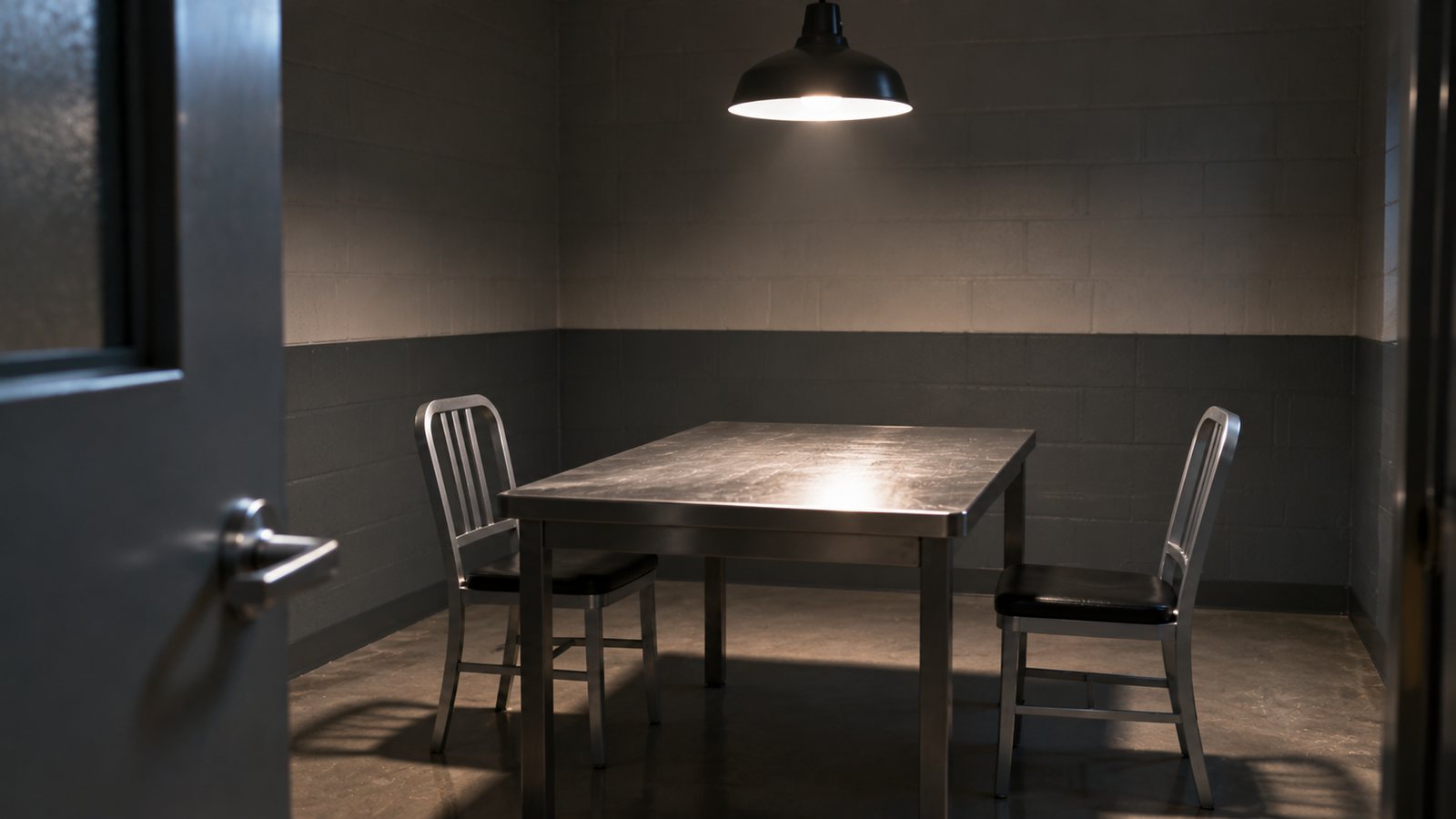
In a murder case, the camera in a station interview room should be running before anyone sits down.
The rule is CCP art. 2B.0202(a). If you’re suspected of or charged with murder or capital murder and questioned in custody at a place of detention, the agency has to record all of it, electronically, as it happens. The one out is good cause that made recording infeasible.
Under art. 2B.0202(b), the recording starts when you enter the interview area or get the warnings, whichever comes first. It runs until the interrogation ends.
Skipping it has a price. Under art. 38.22, §9, the statement isn’t admissible unless the State proves good cause made recording infeasible. Under §3(b), the agency must keep the recording until the case is final or prosecution is barred.
Where the questions happen decides whether the recording rule applies.
| Where | Recording rule? |
|---|---|
| Interview Room 2 at the sheriff’s office, after arrest | Yes |
| Your living room, “not under arrest” | No; a home isn’t a place of detention (art. 2B.0201(3)) |
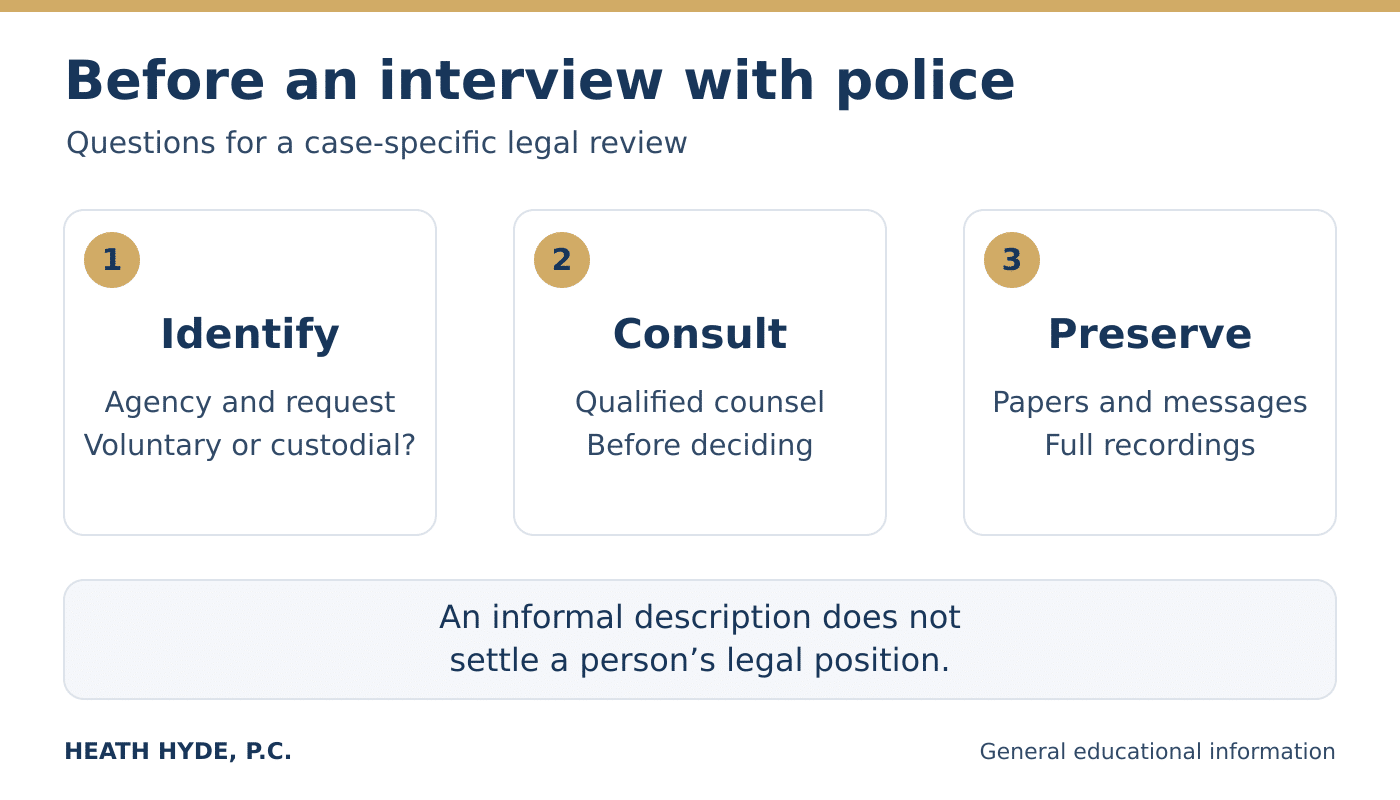
What should you do when an officer calls or knocks?
Detectives like to call late on a Friday and ask for your side “before the weekend.” Get a name and a number. Then call a lawyer. If someone in your family is already under arrest, the family arrest guide and the post on the first 48 hours of a murder charge cover next steps.
| If this happens | Your move |
|---|---|
| A grand jury subpoena arrives | Get it to a lawyer right away |
| Officers ask to look through your phone | No consent without advice |
Consent matters for phones. CCP art. 18.0215(d) lists consent as one of the exceptions to the warrant rule. Jail calls, texts, and posts can be saved and used as evidence.
What can a family do when detectives start calling?
Police often reach the family before they reach the person they’re looking at. Maybe a detective leaves a card in your door on Sunday, or phones your mother at work to ask where your son was Friday night.
Keep a short record for the defense lawyer:
- Date, time, officer, and agency for each contact
- The officer’s questions, in their own words
- Other relatives police called or visited
- Any card, subpoena, or warrant left behind
Frequently asked questions
Do police have to read me my rights before any question?
Only once you’re in custody and being questioned. The patrol officer at the scene who asks your name and what you saw doesn’t have to give Miranda warnings.
Will asking for a lawyer look like guilt?
Not in court. CCP art. 38.38 keeps out evidence that you contacted or hired a lawyer when the question is whether you committed the offense. The judge and the prosecutor can’t comment on it, either.
Can I claim my rights ahead of time, by letter or phone?
Don’t count on it. In Bobby v. Dixon (2011), the Court said it has never held that Miranda rights can be invoked ahead of time, outside custodial interrogation. Say the words in the room.
Talk with Heath Hyde
If investigators want to talk with you or someone in your family about a death, call before anyone sits down for an interview. Reach Heath Hyde, P.C. at 903.439.0000 or request a free consultation. More background is in the Texas Murder Trial Defense Knowledge Hub.
Legal sources
- Miranda v. Arizona, 384 U.S. 436 (1966)
- Oregon v. Mathiason, 429 U.S. 492 (1977)
- Stansbury v. California, 511 U.S. 318 (1994)
- Edwards v. Arizona, 451 U.S. 477 (1981)
- Berghuis v. Thompkins, 560 U.S. 370 (2010)
- Bobby v. Dixon, 565 U.S. 23 (2011)
- Salinas v. Texas, 570 U.S. 178 (2013)
- Tex. Code Crim. Proc. arts. 2B.0201, 2B.0202
- Tex. Code Crim. Proc. arts. 38.22, 38.38
- Tex. Code Crim. Proc. art. 18.0215
This article provides general educational information, not legal advice. Every case depends on its facts, evidence, court, deadlines and governing law. Past results do not guarantee a similar outcome.