


Wire Fraud · Federal Charges
When Can an Email Support a Federal Wire Fraud Charge?
A message can help execute a fraud even when it does not contain the original lie. The key question is how the charged transmission relates to the scheme alleged.
Eligible to Practice in Texas
Attorney at Law
Bar Card Number: 00796807
TX License Date: 11/01/1996
214 Connally St Ste A
Sulphur Spgs, TX 75482-2612
Wire fraud under 18 U.S.C. § 1343 requires an interstate or foreign wire transmission made for the purpose of executing a scheme to defraud or obtain money or property by false or fraudulent pretenses. An email need not itself contain the alleged false statement to matter. The question is whether that particular transmission was part of executing the charged scheme as the defendant conceived it.
This article focuses on that connection. The government must also prove the other applicable elements, including the required intent to defraud and material deception. See Neder v. United States, 527 U.S. 1, 25 (1999), and United States v. Fatani, slip opinion at 6. An email’s existence also does not establish the interstate or foreign transmission requirement in § 1343; examine the transmission records separately.
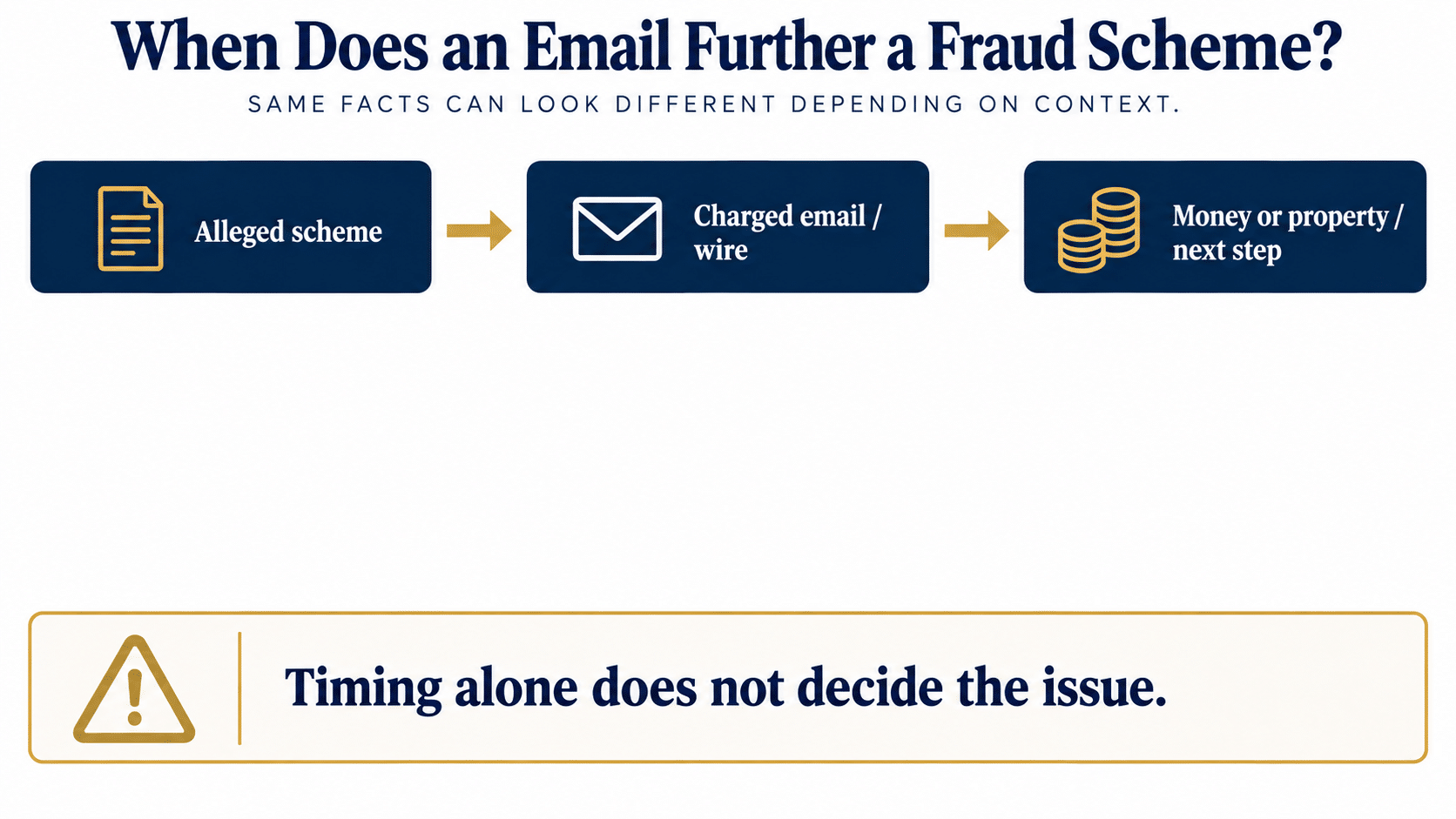
Connect the charged email to the scheme
Read the charged email alongside the allegation about the property being sought. Record its content, recipient and sender, including anyone alleged to have caused the transmission. An invoice requesting funds may serve an obvious payment function, but the timestamp alone does not establish its place in a fraud. The prosecution must connect the message to the alleged scheme and prove the other charged elements. An inaccurate email in a business dispute does not dispense with that proof.
In Schmuck v. United States, the wholesaler had already been paid for cars with rolled-back odometers. The dealers then mailed title applications when reselling those cars. The Supreme Court held that the mailings helped execute his scheme: he depended on the dealers being able to transfer title and continuing to buy from him. His receipt of payment had not ended the fraud.
Schmuck was a mail-fraud case. The Fifth Circuit applied its reasoning to an email in United States v. Barraza, No. 10-50450, slip opinion at 9–11 (Sept. 8, 2011). A judge sought money and sexual favors in exchange for help in a criminal case. The email concerned the sexual favors, but the court examined its role in the combined scheme rather than isolating that request from the money. The court also relied on an honest-services bribery theory. Those facts differ from an ordinary commercial email; the useful point is to examine the whole charged scheme.
The wire need not itself be indispensable. A sufficient connection to an essential part of the scheme can satisfy the execution requirement. In United States v. Fatani, No. 23-20491, slip opinion at 6–10 (Jan. 15, 2025), a wire generated by a check paid a participant’s agreed share of fraudulent PPP-loan proceeds. The scheme had not ended merely because another participant had already received money. Ask what still had to happen when the charged email was sent; the answer depends on the actual plan and evidence.
Nor does the government have to show that the message achieved the result the sender wanted. Schmuck, 489 U.S. at 715, looks at the scheme as conceived at the time, even if a communication later proves counterproductive. That does not remove the need to prove its connection to execution of the scheme.
When a message follows a payment
Suppose a buyer has paid a deposit. An email arrives from the seller: the order is on track, and the balance is due. In a fraud prosecution, that request could help explain how the seller intended to collect the rest of the money. Preserve both the request and any reply. This is a hypothetical example; the actual messages and payment terms would determine its relevance in a case.
Even after the victim has paid the full amount sought, ask whether a later reassurance was planned to keep the victim from discovering the fraud or complaining. In United States v. Sampson, 371 U.S. 75, 80–81 (1962), the Supreme Court allowed mail-fraud allegations based on planned post-payment assurances to proceed. It did not hold that every later message qualifies. A reassurance meant to sustain the scheme differs from a document that merely records a completed transaction.
There may be no balance due, no further solicitation and no unfinished part of the scheme. In that situation, ask what the later email was meant to achieve. A record created after the scheme ended may fail this element if it played no part in executing the fraud. The analysis needs the message and the surrounding events, not just a comparison of dates.
Check the endpoint alleged in the charging document against the evidence. Later solicitations, transfers and the recipient’s response can help establish whether that account fits.
A routine or automated bank notice has to be evaluated against the charged theory. Its content, transmission time, and any funds or information conveyed may show whether it helped execute the scheme. The count and the jury instructions define the question the evidence must answer.
Build a count-by-count timeline
Build a separate timeline for each charged email. Record its date and time, sender, recipient and content. Add the alleged stage of the scheme, the victim’s response, and any later payment or solicitation.
Then compare that sequence with the indictment and the government’s explanation. Did this email make a representation, arrange a transfer or reassure the recipient? Or does it appear only as part of the business record? The question is the message’s role in the charged scheme.
| Evidence | Question it helps answer |
|---|---|
| Original email and complete thread | What was communicated, by whom, to whom, and in what context? |
| Full headers and available provider records | When was it sent, and through which systems? What supports the alleged interstate or foreign transmission? |
| Attachments and linked documents | What representations or instructions accompanied the message? |
| Contracts, invoices and payment records | What remained to be performed or paid? |
| Later communications | Was there another solicitation, transfer or reassurance? How did the recipient respond? |
| Indictment and applicable instructions | What must be proved for this particular count? |
Preserve original messages, attachments and available metadata. Screenshots and forwarded excerpts may leave out context or transmission details. Keep them if they are part of the record, but do not rely on them as substitutes for the originals.
Why reviewing each email matters to your defense
This review may reveal a weakness in a particular count or clarify the alleged scheme’s scope. It may also uncover evidence supporting the prosecution. A problem with one transmission does not automatically dispose of the other counts or the entire case.
Common questions
Can a truthful email support a wire-fraud charge?
Yes. The message need not contain the original lie, but the government must prove the required connection to the scheme and the other elements.
Can an email sent after payment further a fraud scheme?
It can, if it serves a continuing part of the plan, such as a planned reassurance or distribution of proceeds. Payment alone does not answer the question, and a merely historical record may be different.
Does every email in a fraudulent transaction constitute wire fraud?
No. Each charged transmission must be examined in context, including its purpose, the interstate or foreign connection, and the other elements the government must prove.
Sources
- 18 U.S.C. § 1343.
- Schmuck v. United States, 489 U.S. 705 (1989) (mail-fraud execution principle, 710–15).
- United States v. Barraza, No. 10-50450, slip opinion at 9–11 (5th Cir. Sept. 8, 2011).
- United States v. Fatani, No. 23-20491, slip opinion at 6–10 (5th Cir. Jan. 15, 2025).
- United States v. Sampson, 371 U.S. 75, 80–81 (1962) (planned post-payment mailings).
This is general legal information. Advice about a particular case requires the charging document, relevant offense dates and underlying records. Reading this page does not retain the firm; representation requires the firm’s agreement.