
What Happens When Police Call Someone a Witness Rather Than a Suspect?
A detective can call you a witness and still use every word you say. The label isn’t a legal status, and it doesn’t settle Miranda.
Mr. Heath Enix ‘Heath’ Hyde
Eligible to Practice in Texas
Attorney at Law
Bar Card Number: 00796807
TX License Date: 11/01/1996
Primary Practice Location: Dallas, Texas
Return to the Texas Murder Trial Defense Knowledge Hub
Short answer
Less than it sounds like. A witness gets no immunity, and the word doesn’t decide whether Miranda applies. Your lawyer looks at what happened in the room instead.
| What an officer may say | What it may actually mean |
|---|---|
| “You’re not a suspect, we just need a statement.” | The State can still use your words. |
| “You can leave whenever you want.” | One custody fact, weighed with the rest. |
What to do now: Before you agree to a time, give the detective’s name and number to a defense lawyer and let the lawyer make the call back.
Does being called a witness protect you?
No. The text from the detective may read, “You’re not in trouble, we just need a witness statement.” Nothing in Texas law turns that sentence into immunity.
Your words still count. Under CCP art. 38.21, a statement of the accused may be used if it was made freely and voluntarily, without compulsion or persuasion. Article 38.22, §5, doesn’t bar a statement that doesn’t stem from custodial interrogation.
Some witnesses end up charged under the Texas law of parties. Others become the State’s accomplice witness.
Who decides whether you’re in custody?
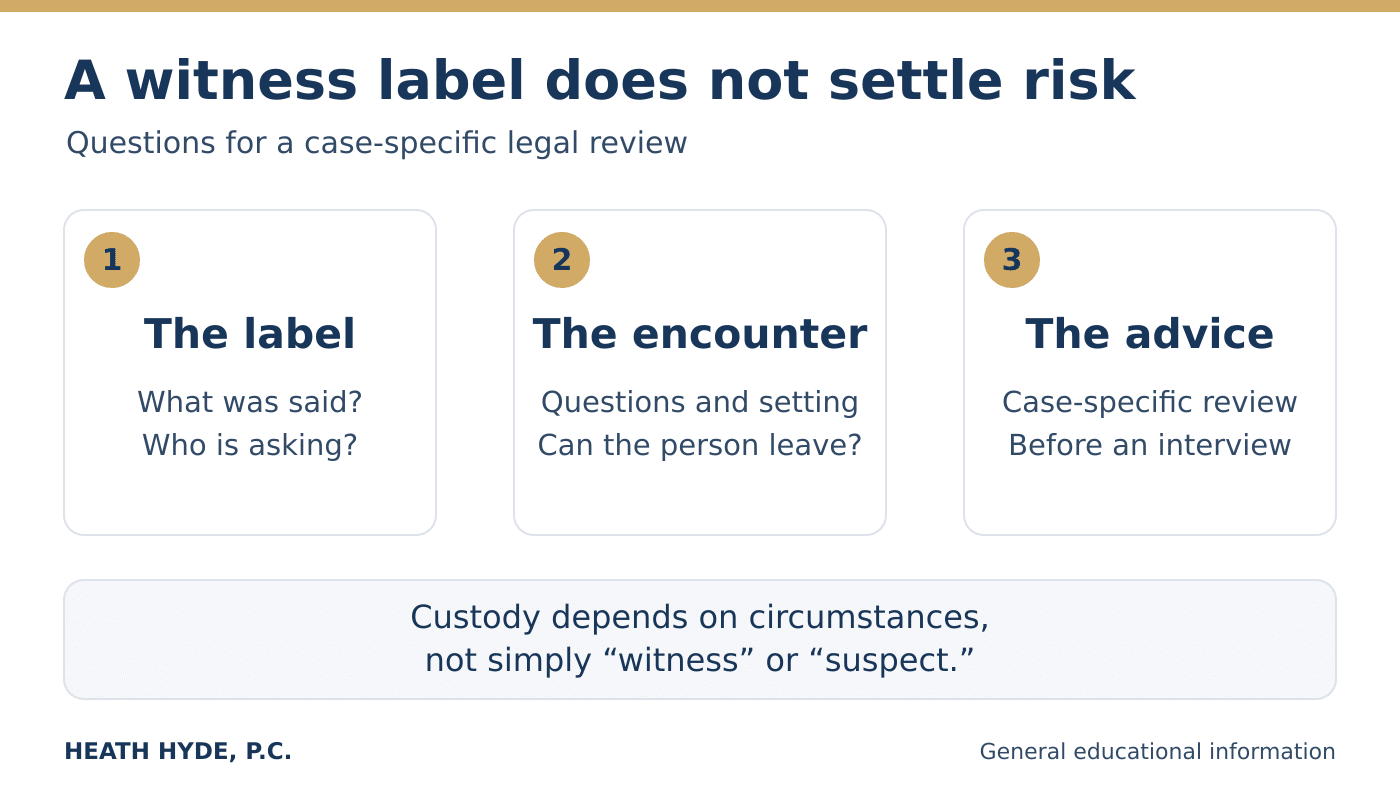
A judge does, later, by looking at what happened in the room. The officer’s word for you isn’t the test.
| Case | What the Court held |
|---|---|
| Miranda v. Arizona (1966) | Officers must give warnings before custodial interrogation. |
| Stansbury v. California (1994) | An officer’s undisclosed belief is irrelevant to custody. |
| Howes v. Fields (2012) | Courts weigh location, length, statements made, restraints, and release at the end. |
One wrinkle: if the officer tells you you’re a suspect, that can count, but only as far as it changes whether a reasonable person would feel free to go.
How does a witness interview turn into a suspect interview?
Quietly. Nobody walks in and announces the change.
Here’s how one evening at the station can go.
| Time | What happens | Why it matters for custody |
|---|---|---|
| 7:10 p.m. | You arrive on your own. | Points toward a voluntary interview |
| 8:30 p.m. | He says your story doesn’t match the video. | Statements made are a Howes factor. |
| 9:15 p.m. | Officers take your phone and keys and close the door. | Restraints can make you feel unable to leave. |
| 11:00 p.m. | You’re arrested or sent home. | Release at the end is another factor. |
Say the questions kept going at 9:40 p.m. with no warnings. If custody began earlier, the statement may need Miranda warnings and the Texas art. 38.22 warnings to come in.
Does the witness label change the recording rule?
It can. In Texas, the camera rule turns partly on how officers saw you when the questioning began.
CCP art. 2B.0202(a) requires a complete recording of custodial interrogation at a place of detention. It covers a person suspected of or charged with murder or capital murder.
Article 2B.0202(c)(5) lists a kind of good cause for skipping it. That’s an officer’s reasonable belief, when questioning began, that the person wasn’t in custody for a listed offense or being questioned about one.
Your lawyer will want to check:
- the label on the report’s first page, such as “W-2, witness”
- whether a camera ever came on
- the time the questions started
Without good cause, art. 38.22, §9 keeps an unrecorded custodial statement in a covered case out.
What should you do before giving a witness statement?
Treat it like any interview in a death investigation. That goes double if you were nearby or know the people involved.
| Moment | Your move |
|---|---|
| The first call | Name, agency, and callback number |
| Before any interview | A lawyer learns what officers want |
| The first minute in the room | Ask, “Am I free to leave?” |
| A written statement | Read every line before signing |
Your signature adopts every word on the page. Keep your phone in your pocket until you get advice, too. CCP art. 18.0215(d)(1) lists consent as one of the exceptions to the warrant rule for phones.
What can a family do when police want a witness statement?
Often the call goes to a young adult who wants to help. Maybe a detective tells your 19-year-old daughter they just need her side of the party, and she wants to go in alone and get it over with.
Write down each call or visit, the word the officer used for her, and any form she was handed. That page goes to your lawyer, not the detective.
Frequently asked questions
If police say I’m only a witness, can I still have a lawyer?
Yes. A lawyer can call the detective, set the terms of an interview, or tell officers you won’t be giving one.
Does a witness get immunity for talking?
No. The label gives you none. If anyone offers immunity, your lawyer needs it in writing before you say a word.
Will hiring a lawyer make me look guilty?
Not in court. Under CCP art. 38.38, evidence that you contacted or retained a lawyer can’t be used on the question of guilt. The judge and the prosecutor can’t comment on it either.
Can my silence be used against me?
It can. In Salinas v. Texas (2013), the lead opinion said a man in a voluntary, unwarned interview had to claim the privilege out loud. Saying nothing wasn’t enough.
Can I claim my rights ahead of time?
Don’t count on it. In Bobby v. Dixon (2011), the Court said it has never held that Miranda rights can be invoked ahead of time, outside custodial interrogation.
Talk with Heath Hyde
If officers have asked you or someone in your family for a witness statement about a death, talk with a lawyer before the interview. Call Heath Hyde, P.C. at 903.439.0000 or request a free consultation. You can find related guides in the Texas Murder Trial Defense Knowledge Hub.
Legal sources
- Miranda v. Arizona, 384 U.S. 436 (1966)
- Stansbury v. California, 511 U.S. 318 (1994)
- Howes v. Fields, 565 U.S. 499 (2012)
- Bobby v. Dixon, 565 U.S. 23 (2011)
- Salinas v. Texas, 570 U.S. 178 (2013)
- Tex. Code Crim. Proc. arts. 2B.0201, 2B.0202
- Tex. Code Crim. Proc. arts. 38.21, 38.22, 38.38
- Tex. Code Crim. Proc. art. 18.0215
This article provides general educational information, not legal advice. Every case depends on its facts, evidence, court, deadlines and governing law. Past results do not guarantee a similar outcome.