Can an East Texas Capital Murder Case Be Moved Because of Pretrial Publicity?
Heavy coverage alone doesn’t move a trial. Texas law asks whether prejudice in the county keeps the defendant from getting a fair and impartial jury, and the defense has to prove it.
Mr. Heath Enix ‘Heath’ Hyde
Eligible to Practice in Texas
Attorney at Law
Bar Card Number: 00796807
TX License Date: 11/01/1996
Primary Practice Location: Dallas, Texas
Return to the Texas Murder Trial Defense Knowledge Hub
Yes. A Texas court may move a capital murder case when the defendant cannot obtain a fair and impartial trial in the county. The defense has to show more than heavy coverage, and judges often use jury selection to test whether a fair jury can be seated. The venue rules now sit in Chapter 31A of the Code of Criminal Procedure.
Say on June 5 the weekly paper in a county of about 30,000 quotes an unnamed source who says the accused “admitted everything” in his interview. Three days earlier the sheriff’s office had posted his booking photo on Facebook, and the comments ran to the hundreds. By August he’s indicted for capital murder and the State has given notice it’ll seek death.
The June 5 story is the detail I’d worry about most. A reported confession that may never be admitted at trial does more damage than a booking photo.
Where the venue rules are now
Pull a 2019 venue opinion and it cites art. 31.03 for the defendant’s motion. That number is gone. H.B. 4504, passed in 2023, moved the venue articles into Chapter 31A of the Code of Criminal Procedure, effective January 1, 2025.
Under art. 31A.004(a), the court may move the case if the defendant “cannot obtain a fair and impartial trial” because of “a prejudice against the defendant in the county” or “a dangerous combination against the defendant in the county instigated by influential persons.”
A case can move three ways under Chapter 31A:
| Article | Who asks | Grounds and procedure |
|---|---|---|
| 31A.001 | The judge, on the judge’s own motion | Satisfied that “a fair and impartial trial cannot be held for any reason”; notice to both sides, a hearing and an order stating the grounds |
| 31A.003 | The State | Combinations or influences “in favor of the defendant,” the lawless condition of the county, or danger to the prisoner’s or a witness’s life |
| 31A.004 | The defendant | Written motion, the defendant’s affidavit and the affidavits of “at least two credible persons who are residents of the county” |
In a publicity case, the defendant’s motion is the one that gets filed. Under art. 31A.005, the State can attack an affiant’s credibility or “means of knowledge” by the affidavit of a credible person, and then the judge must hold a hearing.
The standard the defense has to meet
On February 16, 1961, a man robbed a bank in Lake Charles, Louisiana, kidnapped three employees and killed one. The next morning the sheriff questioned Wilbert Rideau on film in the Calcasieu Parish jail for about 20 minutes, and Rideau confessed.
A local station aired the film three times. Roughly 24,000, then 53,000, then 20,000 people watched, in a parish of about 150,000. In Rideau v. Louisiana (1963), the Supreme Court held that any trial there would be “but a hollow formality.”
Skilling v. United States (2010) set the other end. Enron’s former chief executive was tried in Houston, and the Court said “a presumption of prejudice attends only the extreme case” and “juror impartiality does not require ignorance.”
Skilling weighed four things: Houston’s size and diversity, no confession or similar item in the coverage, the four years between Enron’s collapse and trial, and the jury’s acquittals on nine counts. A county of 30,000 is not Houston, but size alone won’t carry the motion.
Official statements and courtroom control
Marilyn Sheppard was beaten to death in her Bay Village, Ohio, home on July 4, 1954. The coroner held a three-day inquest in a school gym, broadcast live, and questioned her husband, Dr. Sam Sheppard, for about five and a half hours. All three Cleveland papers printed the names and addresses of the 75 people called for jury duty.
At trial about 20 reporters sat inside the bar, a few feet from the jury box. In Sheppard v. Maxwell (1966), the Supreme Court held the judge’s failure to control publicity and the courtroom violated due process. The Court listed tools the judge had: continuance, change of venue, sequestration and limits on statements by lawyers, police and witnesses.
Rule 3.07(b)(2) of the Texas Disciplinary Rules lists statements about “the existence or contents of any confession” as ones a lawyer ordinarily shouldn’t make. Rule 3.09(e) requires a prosecutor to take reasonable care that people the prosecutor employs or controls don’t make them either.
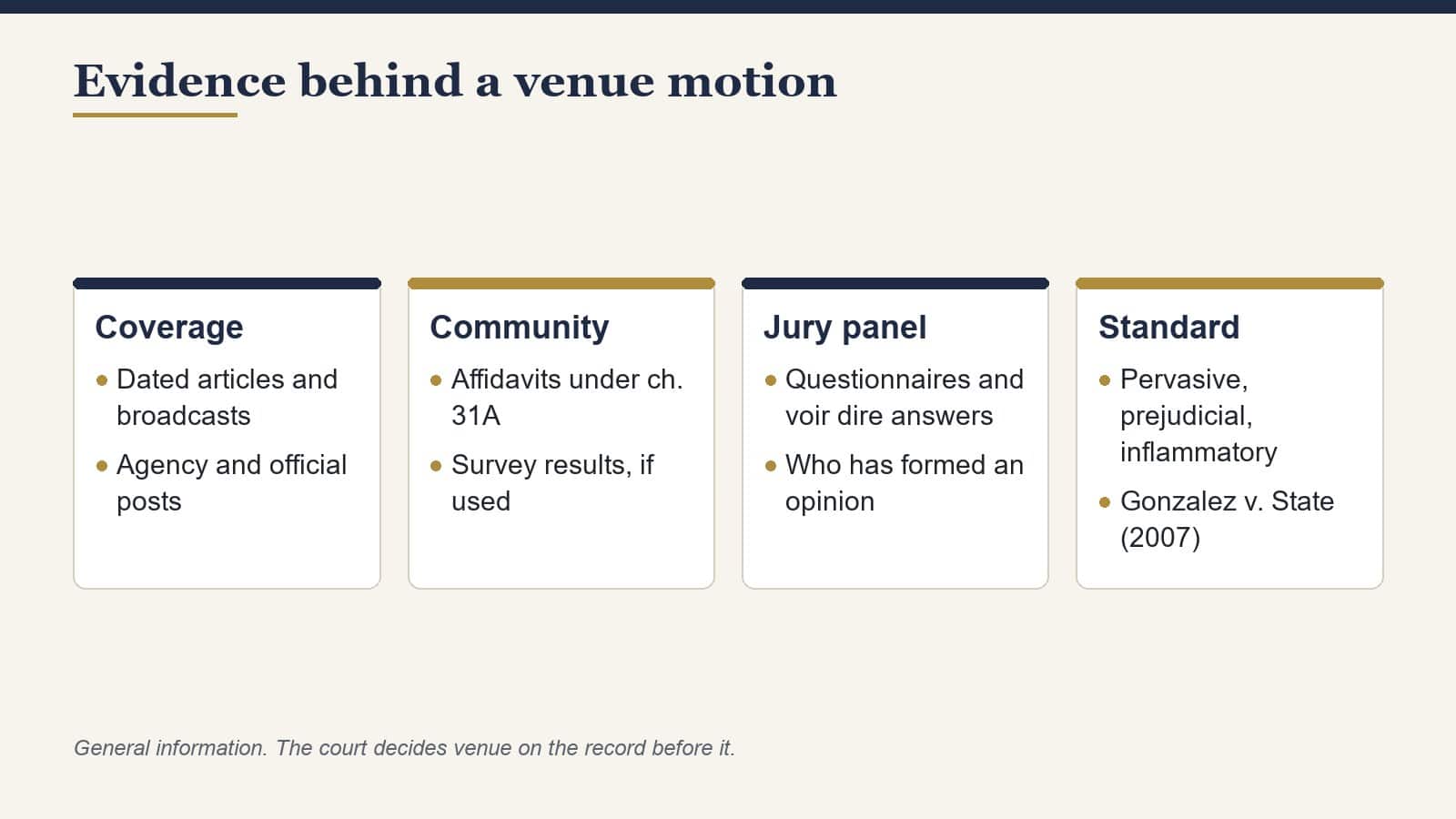
The records I’d gather for the motion:
- dated copies of every article, broadcast clip and agency post
- screenshots of the full comment threads, with web addresses
- every statement by the sheriff, police chief or prosecutor’s office
- the reach of the weekly paper and the nearest TV station into neighboring counties
- names of longtime residents who could serve as affiants
Voir dire as the test
On October 29, 2002, a man and a juvenile companion robbed a Good Times store in El Paso County, and the juvenile shot the clerk with a .22 rifle. Local newscasts played the surveillance tape again and again. The defense moved for a change of venue, and the judge denied it as premature.
Of the 180 people on the panel, 121 had heard of the case, and 58 said they’d formed an opinion they couldn’t set aside. The renewed motion was denied too. In Gonzalez v. State (2007), the Court of Criminal Appeals upheld that ruling and the life sentence.
Gonzalez required publicity that was “pervasive, prejudicial, and inflammatory” and said “widespread publicity by itself is not considered inherently prejudicial.” It also called voir dire one of the two primary ways to test whether publicity has permeated a community.
Art. 35.16(a)(10) first asks a juror with an opinion whether it would influence the verdict. A juror who says yes is discharged. A juror who says no is questioned further.
I’d keep a tally from the first panel forward. Hypothetical numbers:
| Count | Panel of 120 |
|---|---|
| Knew about the case | 88 |
| Had formed an opinion | 41 |
| Excused under art. 35.16(a)(10) | 29 |
The costs of moving
Under art. 31A.004(b), a moved case ordinarily goes to a county in the same or an adjoining judicial district. Sending it farther is reversible on timely contest if the record shows a nearer county wasn’t subject to the same conditions.
Under art. 31A.052, with written consent of the defendant, defense counsel and the State, the original judge may keep the case number, preside and use the original clerk. The jury still comes from the new county.
Art. 31A.151 lets the case return to the original county after trial if the parties consent. Automatic review of a death sentence stays with the Court of Criminal Appeals.
A neighboring county may share the same newspaper and television market. Family members and defense witnesses may have to travel. Those are calls to make with the client before the motion is filed.
Common questions
Does heavy local news coverage mean the trial has to move?
Under Gonzalez, even extensive community knowledge isn’t enough without a showing that the coverage was prejudicial and inflammatory.
Can the same judge keep the case after venue changes?
It can, if the defendant, defense counsel and the State give written consent under art. 31A.052. The jury must come from the new county.
Can we ask the court to stop officials from talking about the case?
You can ask. Sheppard v. Maxwell named limits on statements by lawyers, police and witnesses as one of a trial judge’s tools, and whether a judge enters that kind of order depends on the facts.
Sources
- Tex. Code Crim. Proc. ch. 31A (arts. 31A.001, 31A.003, 31A.004, 31A.005, 31A.052, 31A.151)
- Acts 2023, 88th Leg., R.S., ch. 765 (H.B. 4504), eff. Jan. 1, 2025
- Tex. Code Crim. Proc. art. 35.16(a)(10)
- Tex. Disciplinary R. Prof’l Conduct 3.07, 3.09
- Gonzalez v. State, 222 S.W.3d 446 (Tex. Crim. App. 2007)
- Rideau v. Louisiana, 373 U.S. 723 (1963)
- Sheppard v. Maxwell, 384 U.S. 333 (1966)
- Skilling v. United States, 561 U.S. 358 (2010)
This article provides general information, not legal advice. The law and its application depend on the facts and the law in effect on the relevant date. Consult a lawyer about a specific matter.