
How Does Jury Selection Work in an East Texas Death Penalty Case?
When the State seeks death, jurors are questioned one at a time about whether they could return either sentence the law allows. Lawyers call it death qualification, and the record it builds matters on appeal.
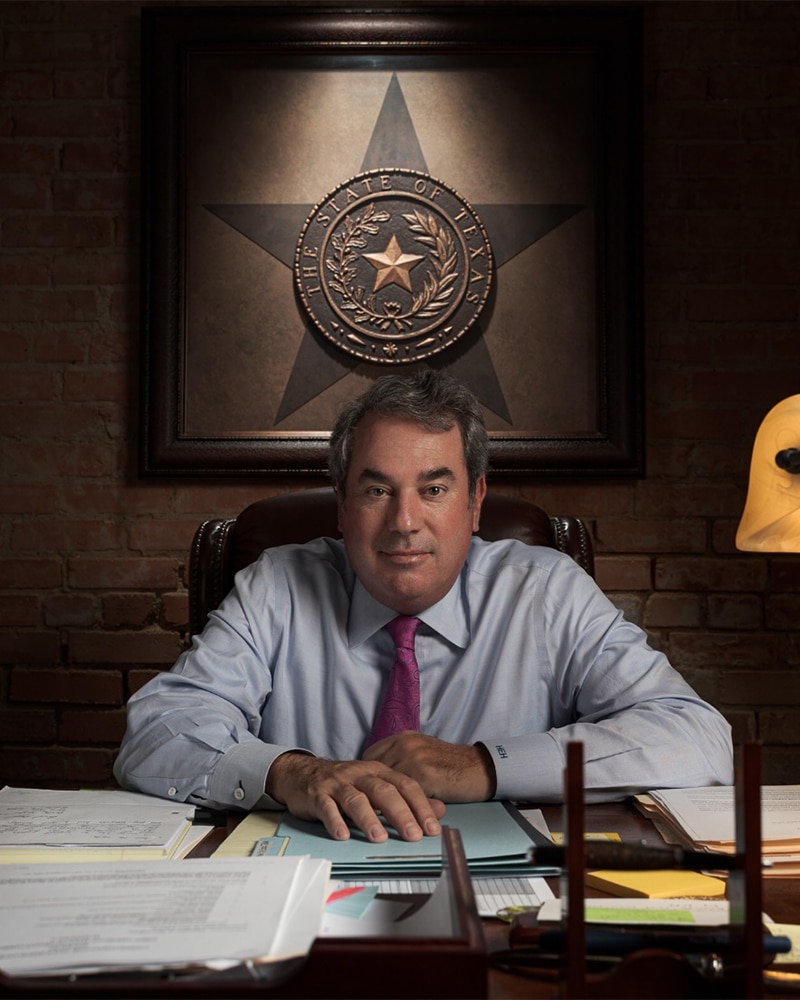
Mr. Heath Enix ‘Heath’ Hyde
Eligible to Practice in Texas
Attorney at Law
Bar Card Number: 00796807
TX License Date: 11/01/1996
Primary Practice Location: Dallas, Texas
Return to the Texas Murder Trial Defense Knowledge Hub
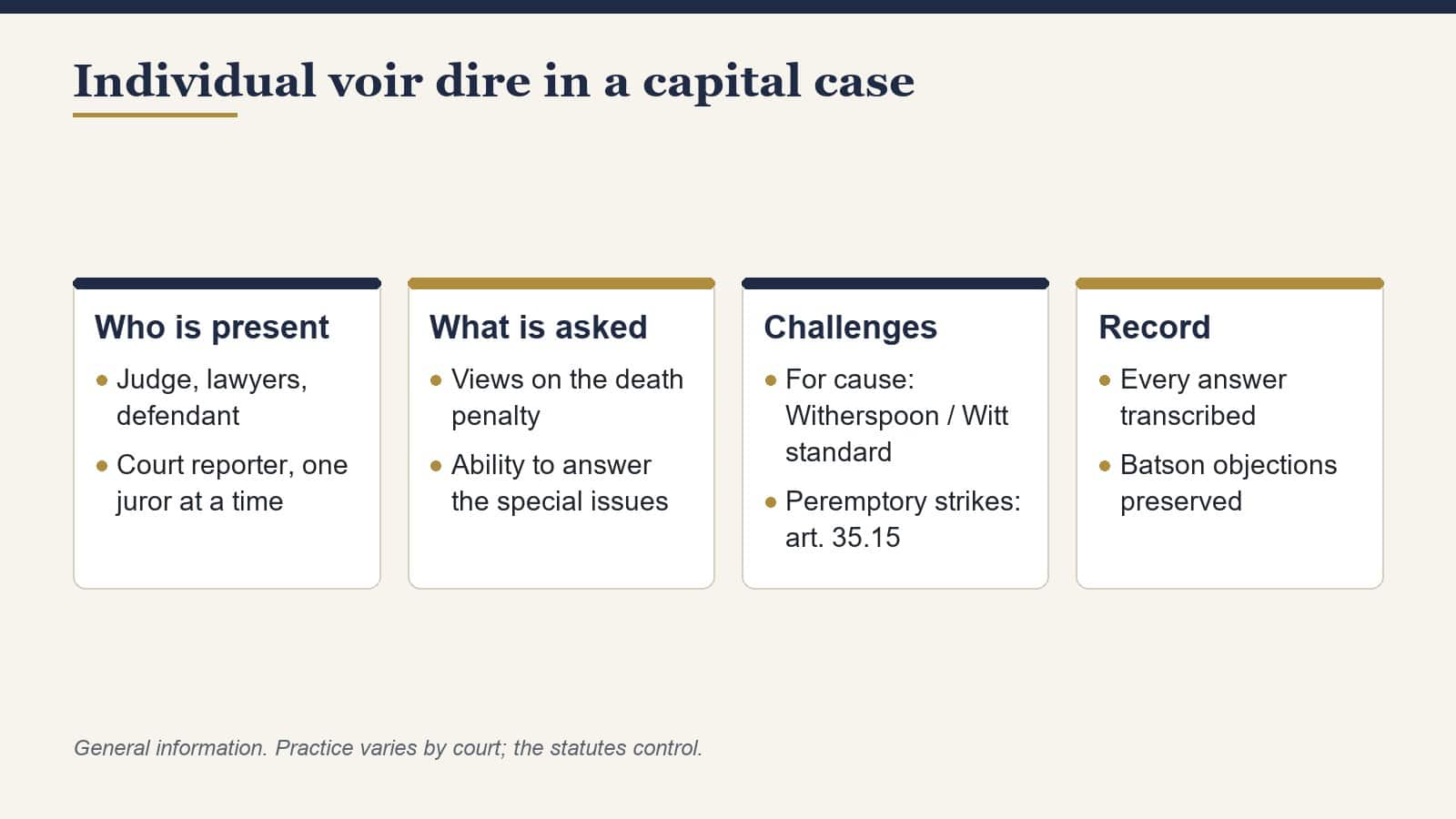
In a Texas death penalty case, each prospective juror can be questioned individually, away from the rest of the panel, and most of the questions concern punishment. Jurors whose views on the death penalty would substantially impair them, or who would automatically vote for death, can be challenged for cause. Each side then has fifteen peremptory strikes, which cannot be used on the basis of race.
Say Juror 47 filled out the court’s questionnaire in March. On a Tuesday in May she sits in the witness chair, alone, facing the judge, two prosecutors, the defense team, the court reporter and the man on trial. The rest of the panel never hears what she says.
Once the State has said it will seek death, art. 35.17 §2 says either side “is entitled to examine each juror on voir dire individually and apart from the entire panel.” Most of the questions are about punishment.
What death qualification means
William Witherspoon was tried in Cook County, Illinois, in 1960 for shooting a police officer while trying to escape arrest. In “rapid succession,” the court excused 47 prospective jurors over their views on the death penalty. The judge said, “Let’s get these conscientious objectors out of the way, without wasting any time on them.”
Thirty-nine of them had admitted scruples and were excused without any effort to learn whether they could still vote for death. In 1968 the Supreme Court held that a death sentence can’t stand if jurors were excused “simply because they voiced general objections to the death penalty.” The conviction stood.
Johnny Paul Witt was sentenced to death in Florida for killing an 11-year-old boy riding his bicycle. Prospective juror Colby said her fear of the death penalty would interfere with her duty: “I am afraid it would.”
In Wainwright v. Witt (1985), the Court upheld her removal. A juror may be excused if her views would “prevent or substantially impair” her duties, and the trial judge’s finding gets deference. Gray v. Mississippi (1987) held that wrongly excusing even one qualified juror isn’t subject to harmless-error review.
The Texas statute and the Supreme Court don’t draw the line in the same place:
| Source | Who can be excused |
|---|---|
| Art. 35.16(b)(1), as written | A juror with “conscientious scruples in regard to the infliction of the punishment of death” |
| Witherspoon and Witt | Only a juror whose views would “prevent or substantially impair” her duties |
Judges apply the narrower rule.
Jurors who would always vote for death
Derrick Morgan was paid $4,000 to kill a drug dealer in Cook County, Illinois, and shot him six times in an abandoned apartment. His lawyer asked the judge to put one question to every juror: “If you found Derrick Morgan guilty, would you automatically vote to impose the death penalty no matter what the facts are?”
The judge refused. He had asked whether jurors could be fair and follow the law, and he had asked the State’s question about automatic votes against death. In Morgan v. Illinois (1992), the Supreme Court reversed the death sentence. An automatic-death juror can be challenged for cause, and on request the court must ask.
Art. 35.16(c)(2) adds a Texas ground for a juror biased against law the defense relies on, including mitigation of punishment.
Texas jurors never write “death” or “life” on the verdict form. They answer art. 37.071 special issues, and I’d test whether each person could answer each one either way:
| Special issue | Statutory text | What I’d ask a juror |
|---|---|---|
| Future danger, §2(b)(1) | “a probability that the defendant would commit criminal acts of violence” | You’ve just found him guilty of an intentional killing. Is your answer on future danger already yes? |
| Parties, §2(b)(2), only if the guilt charge allowed a party verdict | Whether the defendant “actually caused the death” or intended to kill or “anticipated that a human life would be taken” | If he didn’t cause the death, intend a killing or anticipate one, could you vote no? |
| Mitigation, §2(e)(1) | Whether there is “a sufficient mitigating circumstance or circumstances” to warrant life without parole | Could you consider a person’s background and character, and not only the crime? |
A juror who can answer only one way on any row is a cause-challenge candidate.
Art. 37.071 §2(f)(4) defines mitigating evidence as “evidence that a juror might regard as reducing the defendant’s moral blameworthiness.”
Answers that lead to challenges
Answers I’d expect to hear, and the ground each one raises:
- “I’m against the death penalty, but I’d follow the judge’s instructions.” That alone isn’t a ground under Witherspoon and Witt.
- “I could never sign a verdict that sends someone to death.” The State will likely argue substantial impairment.
- “If you kill a child on purpose, death is the only answer.” That’s the Morgan juror.
- “A bad childhood is an excuse, and I wouldn’t listen to it.” That may be bias under art. 35.16(c)(2).
The judge rules under art. 35.21. Standefer v. State (2001) treats a question as a commitment question when an answer would have the juror “resolve or refrain from resolving an issue in the case on the basis of one or more facts contained in the question.” Those are allowed only when they test a legal ground for challenge.
Strikes, alternates and order
Under art. 35.13, a qualified juror is “passed for acceptance or challenge first to the state and then to the defendant.” Art. 35.15(a) gives each side fifteen peremptory strikes. In a joint death trial, each defendant gets eight and the State gets eight per defendant. Art. 35.15(d) adds one strike per side for alternates seated under art. 35.26(b).
A hypothetical sequence shows how a strike complaint gets built:
- The judge keeps Juror 31 after she says she’d answer yes on future danger for any intentional killing.
- The defense uses a peremptory strike on her.
- By Juror 88, all fifteen strikes are gone.
- The defense asks for two more, and the court says no.
- Juror 94, named on the record as objectionable, is seated.
Texas courts generally look for that whole sequence before finding harm. Comeaux v. State (2014) shows how a strike spent elsewhere can undercut the claim.
Race and peremptory strikes
Dallas, 1985. Thomas Miller-El and his accomplices robbed a Holiday Inn, and he shot two employees, killing one. At his trial, prosecutors struck 10 qualified Black panelists. Of the 20 Black members of the panel, one served.
In Miller-El v. Dretke (2005), the Supreme Court looked at three things:
- struck Black panelists next to accepted white panelists who gave similar answers
- Billy Jean Fields, who strongly supported the death penalty and was struck anyway
- jury shuffles that moved Black panelists to the back of the line
Batson v. Kentucky (1986) bars race-based strikes. In Texas the challenge runs under art. 35.261: the State gives a “racially neutral explanation for the challenges,” and the defendant has to prove “purposeful discrimination.” I keep a running chart through selection. A hypothetical page:
| Juror | Race | View on death | State’s action |
|---|---|---|---|
| 14 | Black | Could vote either way | Struck |
| 22 | White | Could vote either way | Accepted |
| 37 | Black | Opposes it, would follow the law | Struck |
| 41 | White | Opposes it, would follow the law | Accepted |
The State’s reasons for striking Jurors 14 and 37 have to explain why Jurors 22 and 41 stayed.
Common questions
Is a juror who opposes the death penalty automatically excused?
Under Witherspoon and Witt, the question is whether her views would prevent or substantially impair her from following the instructions and her oath.
Can the defense tell jurors that one holdout means life without parole?
Art. 37.071 §2(a)(1) bars the court and both sides from telling jurors what happens if the jury can’t agree on a special issue.
What if a juror knows the victim’s family?
A juror related to the victim within the third degree can be challenged under art. 35.16(c)(1). For a friend, the question is “a bias or prejudice in favor of or against the defendant” under art. 35.16(a)(9).
Sources
- Tex. Code Crim. Proc. arts. 35.13, 35.15, 35.16, 35.17, 35.21, 35.26, 35.261
- Tex. Code Crim. Proc. art. 37.071
- Witherspoon v. Illinois, 391 U.S. 510 (1968)
- Wainwright v. Witt, 469 U.S. 412 (1985)
- Gray v. Mississippi, 481 U.S. 648 (1987)
- Morgan v. Illinois, 504 U.S. 719 (1992)
- Batson v. Kentucky, 476 U.S. 79 (1986)
- Miller-El v. Dretke, 545 U.S. 231 (2005)
- Standefer v. State, 59 S.W.3d 177 (Tex. Crim. App. 2001)
- Comeaux v. State, 445 S.W.3d 745 (Tex. Crim. App. 2014)
This article provides general information, not legal advice. The law and its application depend on the facts and the law in effect on the relevant date. Consult a lawyer about a specific matter.