


What Should You Ask Before Hiring a Murder Trial Lawyer?
The questions to ask before you sign, and where to check the answers.
Mr. Heath Enix ‘Heath’ Hyde
Eligible to Practice in Texas
Attorney at Law
Bar Card Number: 00796807
TX License Date: 11/01/1996
Primary Practice Location: Dallas, Texas
Return to the Texas Murder Trial Defense Knowledge Hub
Short answer
A first meeting can tell you who will stand up in court and what the plan is for the next few weeks. It can’t prove the lawyer’s claims about past cases or promise a result. So you write the answers down and check them in public records before anyone signs.
| What a lawyer may say | What you can check |
|---|---|
| “I’m a certified specialist.” | Certified by whom? Search TBLS. |
| “I’ve handled cases just like this.” | The county and year, then the court records |
| “I’ll get this dismissed.” | The plan if it isn’t |
| “I’ll be there every step.” | Who actually appears at hearings and trial |
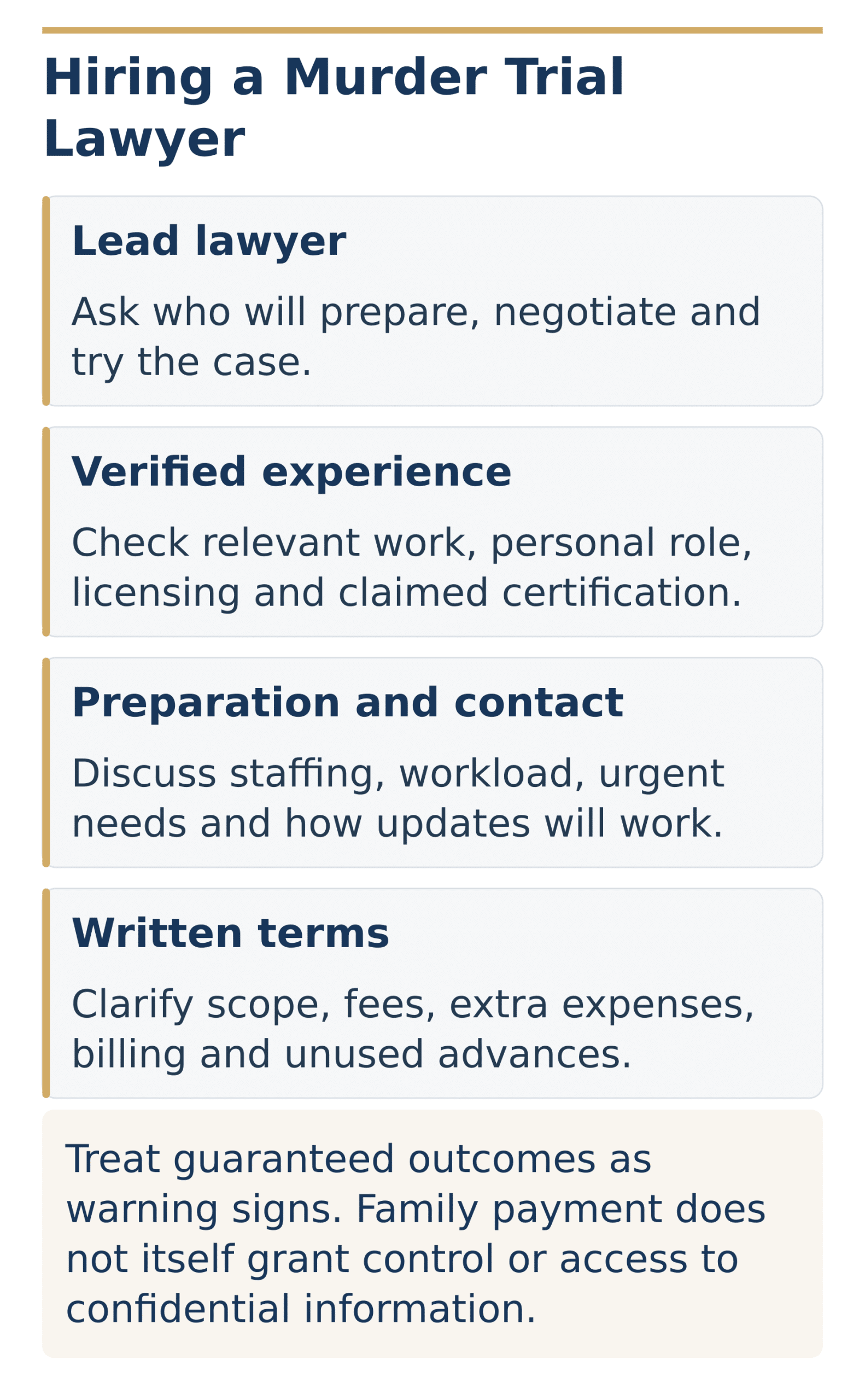
What to do now: Bring a notebook to every consultation, and write each answer next to the lawyer’s name.
Who will actually handle the case?
Say a senior partner runs the first consultation in a corner office on a Tuesday. Three weeks later, an associate you’ve never met shows up at the first hearing. The lawyer you meet first isn’t always the lawyer who goes to court.
The State Bar’s guide on selecting a lawyer suggests asking, “Will you or one of your associates be handling my case?” Ask who will cross-examine the State’s witnesses, too, because trial work can be split.
| Ask | Why |
|---|---|
| Trials set in the same months | The State Bar’s Performance Guidelines say counsel should confirm enough time, resources, knowledge, and experience first |
| Who covers during another trial | A named backup beats a surprise substitute |
How can you check what a lawyer tells you?
Say the lawyer mentions a 2019 murder trial in Smith County that ended in an acquittal. You don’t have to take that on faith.
Start with the lawyer’s State Bar of Texas Find-a-Lawyer profile. It shows whether the lawyer is licensed and lists any public disciplinary actions. Then search the Texas Board of Legal Specialization site at tbls.org. It shows whether a lawyer is board certified, and in which area.
Court case records are generally held by the clerk of the court. The district clerk’s records can show which lawyer appeared in the case the lawyer described.
A Texas lawyer can’t advertise as “Board Certified” in an area unless TBLS has certified them in it. The disciplinary rules also bar statements likely to create unjustified expectations about results.
A promise about the result is a reason to keep asking. No lawyer controls the outcome.
What if the charge is capital murder?
Two days after a capital murder arrest, a family sits across from a lawyer who says he’s “handled plenty of capital cases.” That can mean different things. Many capital murder cases are tried without the State seeking death. In those cases, Penal Code §12.31(a) makes life without parole mandatory for an adult, and the trial has no death-penalty special issues. A case where the State does seek death adds death-qualified jury selection, a separate punishment proceeding under Code of Criminal Procedure art. 37.071 and a mitigation investigation that runs from the first week. So the first question is which kind of case the lawyer means.
Texas sets out qualifications for appointed counsel in death cases. Under art. 26.052, a local selection committee in each administrative judicial region adopts “standards for the qualification of attorneys” and posts the list of qualifying attorneys in district clerks’ offices. Among other things, the statutory standards for lead trial counsel require at least five years of criminal law experience. They also require experience “investigating and presenting mitigating evidence at the penalty phase of a death penalty trial,” and continuing education in death-penalty defense. Lead appellate counsel has a separate set of standards. The statute governs appointments for defendants who can’t afford a lawyer. A family hiring a lawyer privately can still use it as a yardstick.
Here are the questions I’d expect a straight answer to, and what that answer should include:
- Are you on a regional list of attorneys qualified for capital appointments? Expect yes or no, the region, and whether it’s for trial, appeal or both.
- In how many of your capital cases did the State file notice that it would seek death? Expect a number you can check in the district clerk’s records, kept separate from capital cases where it didn’t.
- Who would sit second chair, and what’s their capital background? Expect a name, plus the work that lawyer would handle.
- Who’s the mitigation specialist, and when do they start? Expect a name or a firm, and a start date counted in weeks, not months.
- Who handles the appeal if there’s a death sentence? Expect a plan for appellate counsel, since art. 26.052(k) generally bars appointing trial counsel to handle the appeal.
Two sets of professional guidelines describe how a capital defense should be run. They are the ABA’s Guidelines for the Appointment and Performance of Defense Counsel in Death Penalty Cases (rev. 2003) and the State Bar of Texas’s Guidelines and Standards for Texas Capital Counsel (2006). Both call for a team of at least two lawyers, an investigator and a mitigation specialist. In Wiggins v. Smith (2003), the Supreme Court referred to ABA standards as guides to what reasonable performance means. Bobby v. Van Hook (2009) added that they’re only guides, not rules. I’d still ask a lawyer to explain where the plan for this case differs from them and why.
What should you ask about the plan for this case?
A good first meeting ends with a rough plan for the next few weeks, even before the lawyer has seen the State’s file.
| Ask about | A good answer names |
|---|---|
| The State’s evidence | A discovery request under CCP art. 39.14 |
| What to save now | Store video, phone data, or a changing scene |
| Investigators or experts | A disputed issue, not a standard team |
| The next court date | What it’s for and whether he must attend |
| A possible offer | Weighing it against the evidence and trial risk |
Under art. 39.14(a), the State produces items like offense reports and recorded statements after a request.
Who makes the big decisions?
The week before trial, the prosecutor’s offer arrives by email at 4:55 p.m. on a Friday, and by dinner every aunt and cousin has an opinion. In a criminal case, three decisions belong to the accused, after talking with the lawyer, under Rule 1.02(a)(3):
- pleading guilty or going to trial
- waiving a jury, which CCP art. 1.13 also requires in writing, in open court, with court approval and State consent
- testifying
Under Rule 1.03, the lawyer must keep the client reasonably informed. The lawyer also has to explain enough for him to make informed decisions. The family can share its view, but the accused still makes the call.
What changes when a relative pays?
A mother writes the check, but her son is still the client.
- Rule 1.08(e): her payment needs her son’s consent.
- The same rule keeps her from steering the lawyer’s judgment.
- Rule 1.05(b): if her son says not to tell her something, the lawyer can’t.
Say your mother pays the retainer on March 2. On March 20, she calls asking what her son told the lawyer about the night of the shooting. If her son has told the lawyer to keep that from her, the lawyer can’t tell her.
What should the written agreement say?
Say the draft agreement runs four pages, and the word “appeal” doesn’t appear anywhere in it. Ask before you sign. Rule 1.04(c) says a new client must be told the basis or rate of the fee, preferably in writing.
| Clause | What to look for |
|---|---|
| Scope | Trial, punishment hearing, motion for new trial, or appeal |
| Expenses | Investigators, experts, and transcripts billed on top |
| Billing | An itemized bill of work and expenses |
| Unspent advance | What happens to money that isn’t used |
The State Bar’s guide says a client should get that itemized bill. It also tells clients to read the contract before signing. If something you discussed in the meeting isn’t on the page, ask for it to be added.
What can a family do before anyone signs?
Maybe you’ve met three lawyers in four days, and the names are starting to blur. Maybe your brother’s next court date is nine days away.
Lay these side by side on the kitchen table:
- Your notes from each consultation
- Each lawyer’s State Bar profile
- Each TBLS search result
- The draft fee agreement
Then let your brother, with the lawyer he picks, make the final call.
Frequently asked questions
Is a board-certified lawyer required for a murder case?
Certification shows the lawyer met TBLS criteria in an area. It isn’t required to handle a murder case.
Can we interview more than one lawyer?
The State Bar’s guide notes that a first meeting doesn’t obligate you to hire that lawyer.
Can the lawyer tell us everything about the case?
Not always. Rules on confidentiality and discovery limit what can be shared, so it depends on what the client allows and the law permits.
What should we bring to the first meeting?
The charging papers, bond paperwork, and court dates. The family arrest guide lists more.
Talk with Heath Hyde
Bring your questions and the paperwork you have. Call Heath Hyde, P.C. at 903.439.0000 or request a free consultation.
Legal sources
- Tex. Disciplinary R. Prof’l Conduct 1.02–1.05, 1.08, 7.01–7.02
- Tex. Code Crim. Proc. art. 1.13
- Texas Board of Legal Specialization
- Texas Penal Code §12.31
- Texas Code of Criminal Procedure arts. 26.052, 37.071
- American Bar Association, Guidelines for the Appointment and Performance of Defense Counsel in Death Penalty Cases (rev. 2003), 31 Hofstra L. Rev. 913 (2003)
- State Bar of Texas, Guidelines and Standards for Texas Capital Counsel, 69 Tex. B.J. 966 (2006)
- Wiggins v. Smith, 539 U.S. 510 (2003)
- Bobby v. Van Hook, 558 U.S. 4 (2009)
This article provides general educational information, not legal advice. Every case depends on its facts, evidence, court, deadlines and governing law. Past results do not guarantee a similar outcome.