

The Agents in the Waiting Room
It doesn’t start with sirens. It starts on an ordinary Tuesday morning at a clinic in Tyler, a pharmacy in Longview, a home-health office in Sulphur Springs. Two people in business attire ask for the owner. They show credentials — FBI, or HHS Office of Inspector General — and they are polite, unhurried, and already better informed about your billing records than you are. Or it starts with a letter: a grand jury subpoena demanding years of claims data, or a target letter announcing that a federal prosecutor believes you committed a crime.
Either way, understand what has actually happened: the government did not just start investigating you. By the time agents knock or a letter lands, federal investigators have often spent months or years analyzing your Medicare and Medicaid claims, interviewing former employees, and possibly recording conversations. The knock is not the beginning of the investigation. It is closer to the end — the point where they collect the last, most damaging piece: your own statements.
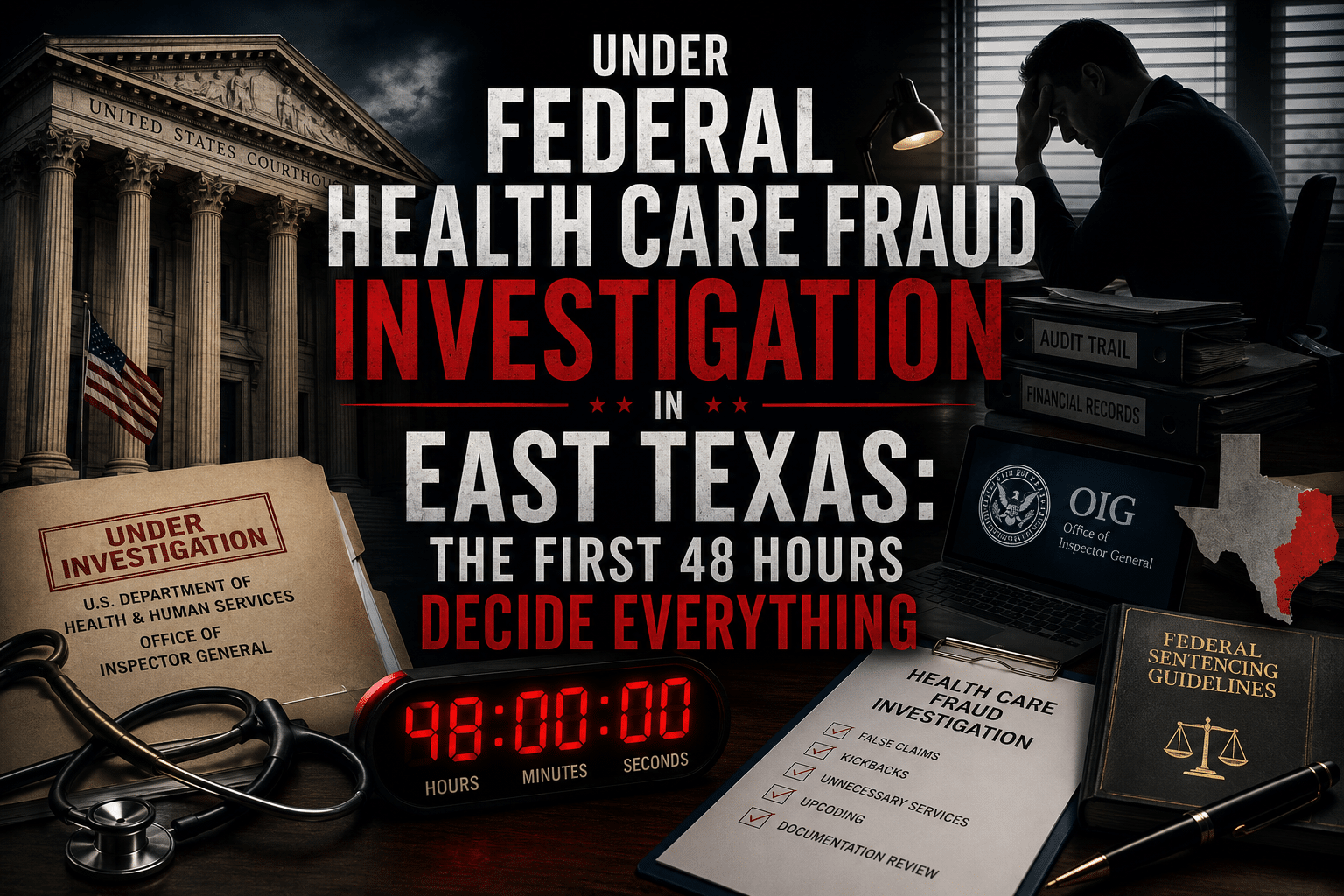
This is the moment that decides everything. Not the trial, if there ever is one. Now. In the first 48 hours, when frightened providers and business owners make exactly the mistakes federal prosecutors are counting on.
Who You’re Actually Fighting
A federal health care fraud investigation is not a billing dispute, and it is not handled like one. It is run by the United States Department of Justice — often through a U.S. Attorney’s Office such as the Eastern District of Texas — with the combined resources of the FBI, the HHS Office of Inspector General, the DEA in prescription cases, the Texas Attorney General’s Medicaid Fraud Control Unit, and data-analytics teams that flag billing patterns across millions of claims before a human ever opens your file.
The stakes are on a different scale from state court. 18 U.S.C. § 1347, the federal health care fraud statute, carries up to ten years in federal prison per count — up to twenty if a patient suffers serious bodily injury — and prosecutors routinely stack counts, add conspiracy under § 1349, and layer on charges under the Anti-Kickback Statute (42 U.S.C. § 1320a-7b) and money-laundering statutes. Beyond prison, a conviction — or even a settlement — can mean exclusion from Medicare and Medicaid, the loss of a medical or professional license, forfeiture of assets, and civil liability under the False Claims Act with treble damages.
And federal cases move differently. There is no friendly local courthouse rhythm. There are proffer sessions with rules most people have never heard of, sentencing guidelines driven by “loss amounts” the government calculates aggressively, and a conviction rate that should sober anyone who thinks they can simply explain the billing.
You do not out-talk this machine. You do not fix it by “cooperating” blind. You meet it with someone who knows federal practice from the inside — and who has taken the government’s biggest cases to trial.
Why You Want a Lawyer Who Has Tried the Government’s Biggest Health Care Case
Here is the promise of this article: by the end, you will understand how a federal health care fraud case is built, the specific early mistakes that convert an investigation into an indictment, and what a serious federal defense actually attacks. That understanding comes from experience at the highest level of this exact practice.
Heath Hyde began his career as a prosecutor at the Dallas County District Attorney’s Office, handling thousands of felony cases, before clerking for former United States Attorney James A. Rolfe and building a federal defense practice that spans the country. He tried the largest health care fraud case to go to trial in the United States, has handled federal matters nationwide, and has been named among the 100 Top Trial Lawyers in the United States. His practice covers the full arc of a federal case — target letters, grand jury subpoenas, health care fraud defense, and healthcare compliance before charges ever exist.
When you have stood across from the government in its biggest health care prosecution, you know how these cases are assembled — and precisely where they come apart.
The information below is general legal education, not legal advice for any specific case.
Key Takeaways
- By the time you learn of a federal health care fraud investigation, the government has usually been building its case for months or years. The first 48 hours after contact are your most important window.
- Do not talk to federal agents without counsel. Lying to a federal agent is itself a felony under 18 U.S.C. § 1001 — even an innocent misstatement can become a charge.
- Never destroy, delete, or “clean up” records. Obstruction charges are often easier for the government to prove than the underlying fraud.
- A target letter or grand jury subpoena is not a conviction — it is a signal that the window to shape the outcome is still open, but closing fast.
- Federal exposure is layered: prison under § 1347, kickback liability, False Claims Act damages, Medicare/Medicaid exclusion, and license loss.
- Real defenses exist — good faith, lack of intent, billing complexity, reliance on billing staff or consultants, flawed data analysis — but they must be built early, before the government’s loss numbers harden.
Building the Defense: How a Federal Health Care Fraud Case Is Fought
The short answer first: if agents have made contact, or a subpoena or target letter has arrived, say nothing substantive, touch nothing in your records, and get experienced federal defense counsel involved today — before any interview, before any document production, before any employee talks. Here is the chain of reasoning behind that.
Link 1: The statute punishes intent — and intent is where these cases are won or lost
18 U.S.C. § 1347 criminalizes knowingly and willfully executing a scheme to defraud a health care benefit program. That word — knowingly — is the battlefield. Medicare and Medicaid billing rules run to thousands of pages, change constantly, and are routinely misapplied by honest providers, billing companies, and consultants. The government’s job is to turn billing errors into a criminal scheme; the defense’s job is to show good faith, complexity, and reliance on others. Which story the evidence supports is shaped by what happens in the first days — especially by whether the target hands the government damaging statements before counsel is involved.
Link 2: The interview is the trap — and § 1001 is the tripwire
Federal agents who arrive unannounced are not there to give you a chance to clear things up. They already have the claims data, and they are comparing every sentence you say against it. Under 18 U.S.C. § 1001, a false statement to a federal agent is a felony on its own — no fraud conviction required — and many federal defendants are charged for the interview, not the billing. The correct response is calm and simple: take the agents’ cards, decline the interview politely, and say counsel will be in touch. That is not obstruction. That is the Constitution.
Link 3: The documents must be preserved — obstruction is the government’s shortcut
The instinct to tidy up files, delete emails, or amend old records after learning of an investigation is the single most catastrophic mistake in white-collar cases. Obstruction and document-destruction charges are frequently easier to prove than the underlying fraud, and they poison every later negotiation. The moment an investigation surfaces, everything gets preserved — and every response to a subpoena is managed by counsel, who can negotiate scope, assert privileges, and control how the production tells your story.
Link 4: The government’s case is a data model — and models can be wrong
Modern health care fraud cases are born in spreadsheets: algorithms flag providers whose billing codes, patient volumes, or prescribing patterns deviate from statistical norms. But outlier data is not fraud. A rural East Texas practice serving an older, sicker population will look different from a national average. Defense work means retaining independent billing and coding experts, auditing the government’s loss calculations, and showing that the “scheme” is actually medical judgment, patient mix, or documented complexity. Loss amount drives the sentencing guidelines — which means every dollar the defense knocks out of the government’s model matters enormously.
Link 5: The earlier counsel engages, the more outcomes remain possible
A federal investigation is a long corridor with doors that close one by one. Before indictment, counsel can engage prosecutors, present exculpatory evidence, correct the government’s assumptions, negotiate civil rather than criminal resolution, or in some cases end the matter with no charges at all. After indictment, the options narrow sharply. This is why a target letter or subpoena, frightening as it is, is also an opportunity — the government is telling you the outcome is not yet decided. What you do next decides it.
The East Texas Reality: Federal Court Is a Different World
Health care fraud cases arising in East Texas are typically prosecuted in the Eastern District of Texas — with federal courthouses in Sherman, Plano, Tyler, Texarkana, Marshall, Beaumont, and Lufkin — a district known for moving cases quickly and trying them hard. Depending on where a practice operates, matters may also land in the Northern District in Dallas. These courts run on the Federal Rules, federal sentencing guidelines, and a pace that punishes unprepared defense teams.
The jury pool, though, is still East Texas: neighbors, retirees, nurses, small-business owners — people with their own experiences of doctors, hospitals, and insurance companies. A lawyer who has tried federal cases before these juries understands how they hear a government data analyst versus a hometown physician, and how the government’s “scheme” narrative can be dismantled in front of people who know what rural medicine actually looks like. (For background on the federal courts, see the United States Courts official site and the U.S. Attorney’s Office for the Eastern District of Texas.)
And in a small community, the investigation itself is a punishment — agents interviewing your employees, rumors reaching your patients, a professional reputation built over decades suddenly in question. Mounting a serious defense early is how you protect not just your liberty, but your license, your practice, and your name.
Frequently Asked Questions
Federal agents just showed up at my office. What do I do right now? Be polite, take their business cards, decline to be interviewed, and do not consent to any search beyond what a warrant authorizes. Then contact experienced federal defense counsel immediately — before agents return, and before any employee is interviewed.
I received a grand jury subpoena for my billing records. Am I being charged? Not necessarily — a subpoena can mean you are a witness, a subject, or a target, and the difference matters enormously. Counsel can often learn your status from the prosecutor and manage the production strategically. Never respond to a federal subpoena without a lawyer.
I think my biller made mistakes. Can honest errors really be prosecuted as fraud? The statute requires knowing and willful conduct — honest mistakes are not crimes. But the government decides what looks “knowing,” and it draws that conclusion from patterns, emails, and statements. Establishing good faith is defense work, and it starts long before trial.
What are the penalties for federal health care fraud? Up to ten years in federal prison per count under 18 U.S.C. § 1347 — more if patients were harmed — plus potential kickback and conspiracy charges, fines, restitution, asset forfeiture, False Claims Act liability, exclusion from federal health programs, and professional license consequences. Actual exposure depends entirely on the specific allegations.
Should I just cooperate and explain everything? Not without counsel. Cooperation can be valuable — but only when it is structured, protected, and timed by a lawyer who knows what the government has. Unprotected “explaining” is how investigations become indictments.
Is this article legal advice? No. This is general educational information about federal health care fraud law. Every case is unique. If you or your practice is under investigation, speak directly with a qualified federal criminal defense attorney about your specific situation.
Related Resources From Heath Hyde
- Health Care Fraud Defense — Heath Hyde’s approach to defending federal health care fraud charges.
- Federal Target Letter — what a target letter means and how to respond.
- Grand Jury Subpoena — handling federal subpoenas without making things worse.
- Anti-Kickback Statute — the referral and remuneration rules that accompany most health care investigations.
- Healthcare Compliance — reducing risk before the government ever calls.
- Eastern District of Texas Criminal Defense — federal defense in the district where most East Texas cases are tried.
Official Government Resources
For readers who want to verify any of the above against primary sources:
- 18 U.S.C. § 1347 — Health Care Fraud — the core federal health care fraud statute.
- 42 U.S.C. § 1320a-7b — Anti-Kickback Statute — the federal criminal prohibition on health care kickbacks.
- 18 U.S.C. § 1001 — False Statements — why statements to federal agents carry independent criminal risk.
- HHS Office of Inspector General — the lead health care fraud enforcement agency.
- U.S. Attorney’s Office, Eastern District of Texas — the office prosecuting most East Texas federal cases.
- State Bar of Texas — Find a Lawyer — verify any Texas attorney’s license and standing.
About the Author: Heath Hyde
Heath Hyde is a Texas criminal defense attorney and a fifth-generation East Texan who has spent his career on both sides of the courtroom. He began as a prosecutor at the Dallas County District Attorney’s Office, where he handled thousands of felony prosecutions and was named a finalist for Henry Wade Prosecutor of the Year in 2004.
He earned his undergraduate degree from Texas A&M University and his law degree from Texas Wesleyan University School of Law, then clerked for former United States Attorney James A. Rolfe before entering private practice.
In more than two decades since, Heath has tried over 400 jury trials, handled over 9,000 criminal cases in state and federal court, and tried the largest health care fraud case to go to trial in the United States. He has handled federal matters nationwide, represented clients in 53 Texas counties, and has been named among the 100 Top Trial Lawyers in the United States. That federal trial experience — at the highest stakes the government can bring — is the knowledge he now uses exclusively to defend the accused.
Heath Hyde — Attorney at Law Licensed by the State Bar of Texas | Bar No. 00796807 Serving East Texas and statewide
This article is provided for general informational and educational purposes only and does not constitute legal advice, nor does it create an attorney-client relationship. If you or your practice is facing a federal investigation or charges, consult a qualified federal criminal defense attorney about your specific situation.