


Federal Criminal Defense · Eastern District of Texas
A Federal Target Letter Just Landed in East Texas. The First 48 Hours Decide Everything.
It arrives by certified mail, not a knock at the door. A single page from a United States Attorney tells you that a grand jury is now looking at you. What you do in the next two days — before you say a word to an agent — can determine whether this ends in a closed file or an indictment.

The Letter Nobody Expects
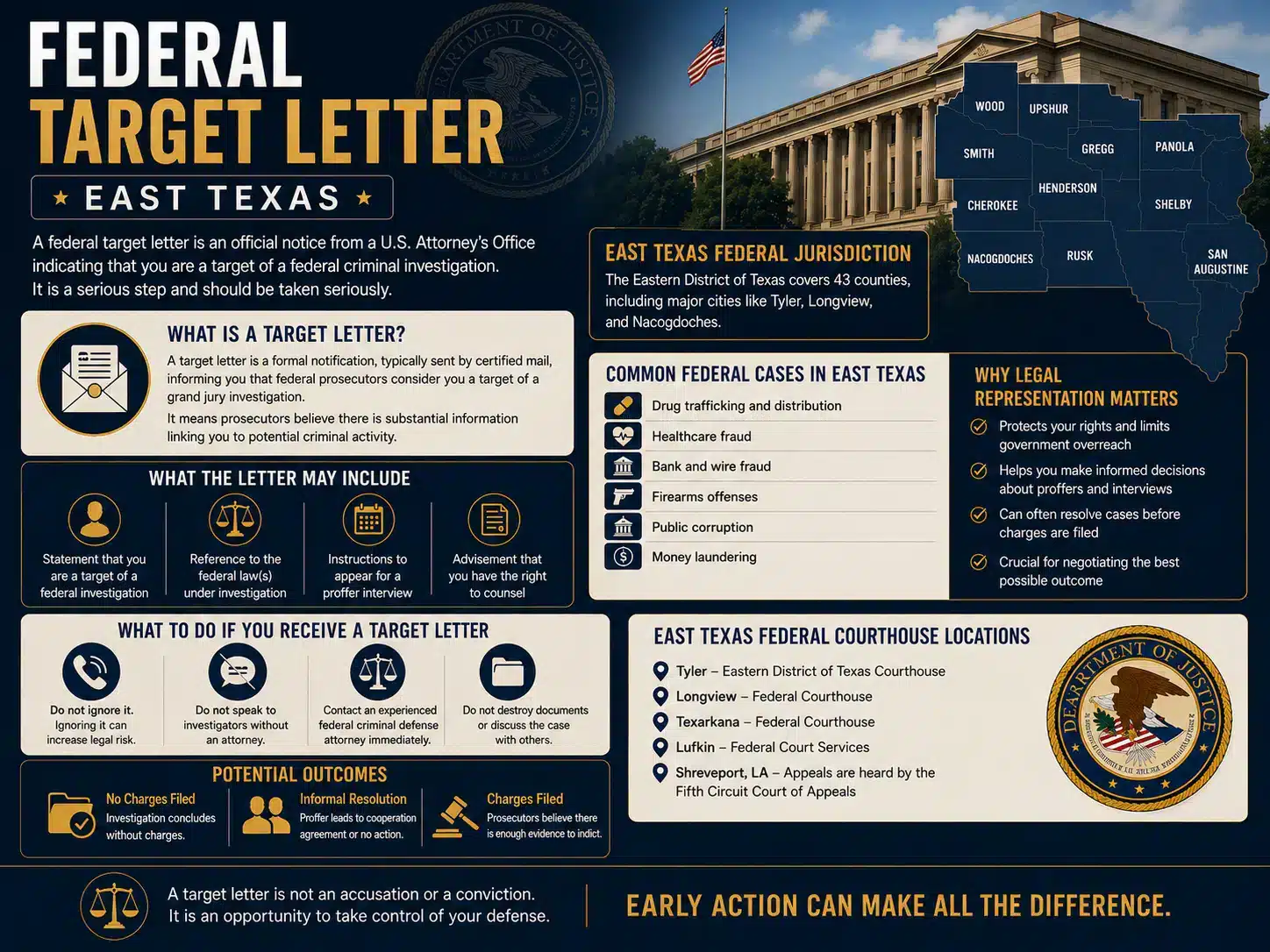
There was no SWAT team and no handcuffs. For most people pulled into a federal investigation, the first sign is quiet and bureaucratic: an envelope on letterhead from the United States Department of Justice, signed by an Assistant United States Attorney, with two words that turn a clinic owner, a billing manager, or a physician’s life upside down — “target letter.”
In the language of the Justice Manual, a “target” is a person the prosecutor believes is linked by substantial evidence to a crime and who is likely to be charged. A “subject” is someone whose conduct falls within the scope of the grand jury’s investigation. A “witness” is everyone else. The label at the top of that letter is not an accident — it is the government telling you, in writing, where you stand.
By the time that letter reaches your mailbox, the investigation is not beginning. It is maturing. Federal agents have likely spent months — sometimes years — pulling billing records, interviewing former employees, issuing subpoenas to your bank, and building a timeline. The letter is an invitation to come talk, or to testify before the grand jury. It feels like a chance to clear things up. For a target, it is almost never that.
This is the moment the rest of a career, a license, and a family’s future gets decided. Not in a courtroom a year from now. Now — in the 48 hours when frightened, well-meaning people make the exact decisions the government is counting on.
Section OneWho You’re Actually Fighting
Understand the apparatus that has turned toward you. A federal white collar case — health care fraud, wire fraud, kickbacks, false claims — is not handled by a single overworked investigator. It is built by a coordinated machine.
On the criminal side stands the United States Attorney’s Office for the Eastern District of Texas, prosecuting on behalf of the United States. Behind the prosecutor sits a stack of federal agencies: the FBI’s health care fraud units, the Department of Health and Human Services Office of Inspector General, the Drug Enforcement Administration in diversion cases, and IRS Criminal Investigation when money movement is in play. A federal grand jury issues subpoenas with a reach no state investigator has. Data analysts flag your claims against statistical “outlier” models before a human ever reads your chart notes.
And the charges themselves are stacked by design. A single billing scheme can be charged as health care fraud under 18 U.S.C. § 1347, as wire fraud for each electronic claim, as a conspiracy under 18 U.S.C. § 1349, and as illegal remuneration under the federal Anti-Kickback Statute — all from the same conduct. In the federal system there is no parole. A sentence is largely driven by the United States Sentencing Guidelines, where the single biggest lever is the alleged “loss amount,” a number prosecutors push as high as the theory will allow.
You do not talk your way out of this. You do not explain it away over the phone with an agent who is taking notes. You meet it with someone who has stood on the government’s side of that table and knows exactly how the case is assembled.

Section TwoWhy You Want a Former Prosecutor Who Has Tried These Cases
Here is the promise of this article: by the time you finish, you will understand how the federal government grades a fraud case, the specific mistakes that sink people in the first 48 hours, and what a real defense actually attacks. That understanding comes from someone who has sat at both tables.
Heath Hyde spent a decade as a prosecutor at the Dallas County District Attorney’s Office, handling thousands of felony cases and earning a finalist nod for Henry Wade Prosecutor of the Year. He clerked for a former United States Attorney before entering private practice, and for more than two decades since he has defended the accused across Texas state and federal courtrooms — including white collar and fraud matters that cross into federal jurisdiction in the Eastern District of Texas.
When you have helped build the government’s cases, you know precisely where they break — which “loss” calculations are inflated, where the intent evidence is thin, and where an aggressive theory outruns the proof. That is the knowledge Heath now uses for the people the government has put in its sights.
The information below is general legal education, not legal advice for any specific case.
Key Takeaways
- The first 48 hours matter most. A target letter often arrives before charges. What you do now — not at trial — can shape whether you are indicted at all.
- Do not “explain.” Do not produce documents. Anything you say to an agent or hand over can be used to build the case. Route every contact through counsel first.
- A target letter is a label, not a verdict. Target, subject, and witness mean very different things — and counsel can sometimes move you down that ladder.
- The “loss amount” drives federal sentencing. Under the Sentencing Guidelines, the government’s loss figure often matters more than the conduct itself, and it is frequently contestable.
- Charges stack. One billing scheme can be charged as fraud, wire fraud, conspiracy, and kickbacks at once. The defense’s job is to keep the theory from snowballing.
- The lawyer you hire in the first days — ideally one who has worked both sides — can change the entire trajectory.
How a Federal Health Care Fraud Case Is Won
The short answer first, then the reasoning.
If you have received a federal target letter, do not call the agent, do not “just answer a few questions,” and do not gather or hand over any records on your own. Engage an experienced federal defense attorney today — before the response deadline on that letter passes and before any interview. Then let counsel manage every point of contact with the government.
Link 1: A federal fraud charge is graded by intent and by loss
Federal health care fraud lives mainly in 18 U.S.C. § 1347, which targets schemes to defraud a health care benefit program. But what separates a billing dispute from a felony is intent — the government must prove you knowingly and willfully set out to defraud, not that a coder made an honest mistake. And what separates a short sentence from a long one is the loss amount calculated under the Sentencing Guidelines. The earliest and most important battles in these cases are over intent and over that number.
Link 2: The “interview” is built to make the case, not close it
Agents are trained, patient, and permitted to use deception. “We just want to understand your side, and then we can put this behind us” is a technique, not a promise. Worse, lying to a federal agent is itself a separate felony under 18 U.S.C. § 1001 — meaning a nervous, well-intentioned misstatement in a voluntary interview can create a brand-new charge that did not exist before you opened your mouth. The Fifth and Sixth Amendments exist for precisely this room.
Link 3: Document requests are evidence requests
A target who starts pulling files, deleting nothing but reorganizing everything, or forwarding records to “be helpful” is doing the government’s work and risking an obstruction charge. Subpoenas have scope, privilege, and timing that counsel manages. Nothing should leave your office or your hands without legal review.
Link 4: The government’s case is a story told in data — and data has holes
Federal fraud cases are assembled from claims data, statistical outlier analysis, cooperating former employees, and financial records. None of it is as clean as a press release suggests. “Outlier” billing can have legitimate clinical explanations. Cooperators have powerful incentives to shade their testimony for a better deal. Loss models routinely count lawful, medically necessary services as “fraud” to inflate the number. A lawyer who has built these cases knows which threads to pull.
Link 5: Real defenses exist — and the burden never shifts
The government must prove every element beyond a reasonable doubt. Lack of fraudulent intent, good-faith reliance on coders or compliance advice, a billing error rather than a scheme, an inflated loss calculation, or a kickback theory that does not fit the facts — each is a recognized line of defense. Many strong outcomes in these cases never reach a jury at all: a thorough, early defense submission can persuade prosecutors to decline charges or resolve a matter civilly. That is why the work has to begin before the government’s version hardens into the only story anyone hears.
When you have helped the government build these cases, you know exactly where they come apart.
The Eastern District Reality: Federal Court in East Texas
A federal case here is handled in the United States District Court for the Eastern District of Texas, a sprawling district with divisions in Sherman, Plano, Tyler, Marshall, Texarkana, Beaumont, and Lufkin. Each division has its own bench and its own rhythm, and the district as a whole has long been one of the busier and faster-moving federal courts in the country.
That pace matters. Federal practice runs on its own clock and its own rules — pretrial motions, the rules of evidence, and the Sentencing Guidelines all operate very differently from a state courthouse down the road. A lawyer who is comfortable in the Eastern District of Texas understands how a particular Assistant U.S. Attorney tends to charge, how a judge approaches loss disputes at sentencing, and how to engage the office early enough to shape the outcome.
There is also the reputational weight unique to East Texas, where a single federal indictment can define a professional and a family for a generation. Mounting a serious, dignified defense is not only about the verdict — it is about protecting a name and a license in a place where both are remembered.
Frequently Asked Questions
I just got a federal target letter. What is the single most important thing to do right now?
Two things, immediately: do not contact the agent or respond on your own, and retain an experienced federal defense attorney before the deadline in the letter passes. A target letter usually arrives before any charge — the work done now can affect whether you are indicted at all.
The agent says they just want to hear my side. Shouldn’t I cooperate?
Not without counsel. Agents may lawfully use deception, and a voluntary interview almost always gives the government evidence. Worse, a false or mistaken statement to a federal agent is itself a felony under 18 U.S.C. § 1001. Let your lawyer decide what, if anything, is shared and when.
What is the difference between a target, a subject, and a witness?
Under the Justice Manual, a target is a person the prosecutor believes is substantially linked to a crime and likely to be charged; a subject is someone whose conduct is within the grand jury’s scope; and a witness is everyone else. The labels carry real legal consequences, and counsel can sometimes work to move you down that ladder.
Can a federal investigation end without charges?
Yes. Prosecutors decline cases, resolve matters civilly, or accept a defense showing that intent or loss cannot be proven. A thorough, early submission from defense counsel — before indictment — is one of the most effective tools for steering a case toward a declination.
Why does the “loss amount” matter so much?
Federal sentences are driven by the United States Sentencing Guidelines, and in fraud cases the loss amount is the single largest factor in the calculation. Prosecutors often advance an aggressive figure that counts lawful services as fraud. Contesting that number is frequently the most consequential fight in the entire case.
Is this article legal advice?
No. This is general educational information about federal criminal investigations. Every case is unique. If you or someone you know has received a target letter or learned of a federal investigation, speak directly with a qualified criminal defense attorney about your specific situation.
Related Resources From Heath Hyde
- Federal Criminal Defense in the Eastern District of TexasHow Heath approaches federal cases from investigation through trial and sentencing.
- White Collar Criminal DefenseFraud, conspiracy, and financial-crime defense for professionals and businesses.
- Health Care Fraud DefenseDefending physicians, clinics, and billing companies against § 1347 and kickback allegations.
- Heath Hyde — Home & Free ConsultationStart here if you have received a target letter or learned of an investigation.
Official Government Resources
For readers who want to verify any of the above against primary sources:
- 18 U.S.C. § 1347 — Health Care FraudThe federal statute defining the core offense (Cornell Legal Information Institute).
- 42 U.S.C. § 1320a-7b — Anti-Kickback StatuteThe statute governing illegal remuneration in federal health programs.
- U.S. Department of Justice — Justice ManualThe DOJ’s own policies, including target, subject, and witness definitions.
- HHS Office of Inspector GeneralThe agency that investigates fraud against federal health care programs.
- United States Sentencing CommissionThe source of the Sentencing Guidelines that drive federal sentences.
- U.S. District Court — Eastern District of TexasThe federal court where these cases are tried.
- State Bar of Texas — Find a LawyerVerify any Texas attorney’s license and standing.
This article is provided for general informational and educational purposes only and does not constitute legal advice, nor does it create an attorney-client relationship. Federal investigations move quickly and the law changes over time. If you or someone you love has received a target letter or learned of a federal investigation, consult a qualified criminal defense attorney about your specific situation.