


Posted by the Law Office of Heath Hyde | Texas Criminal Defense
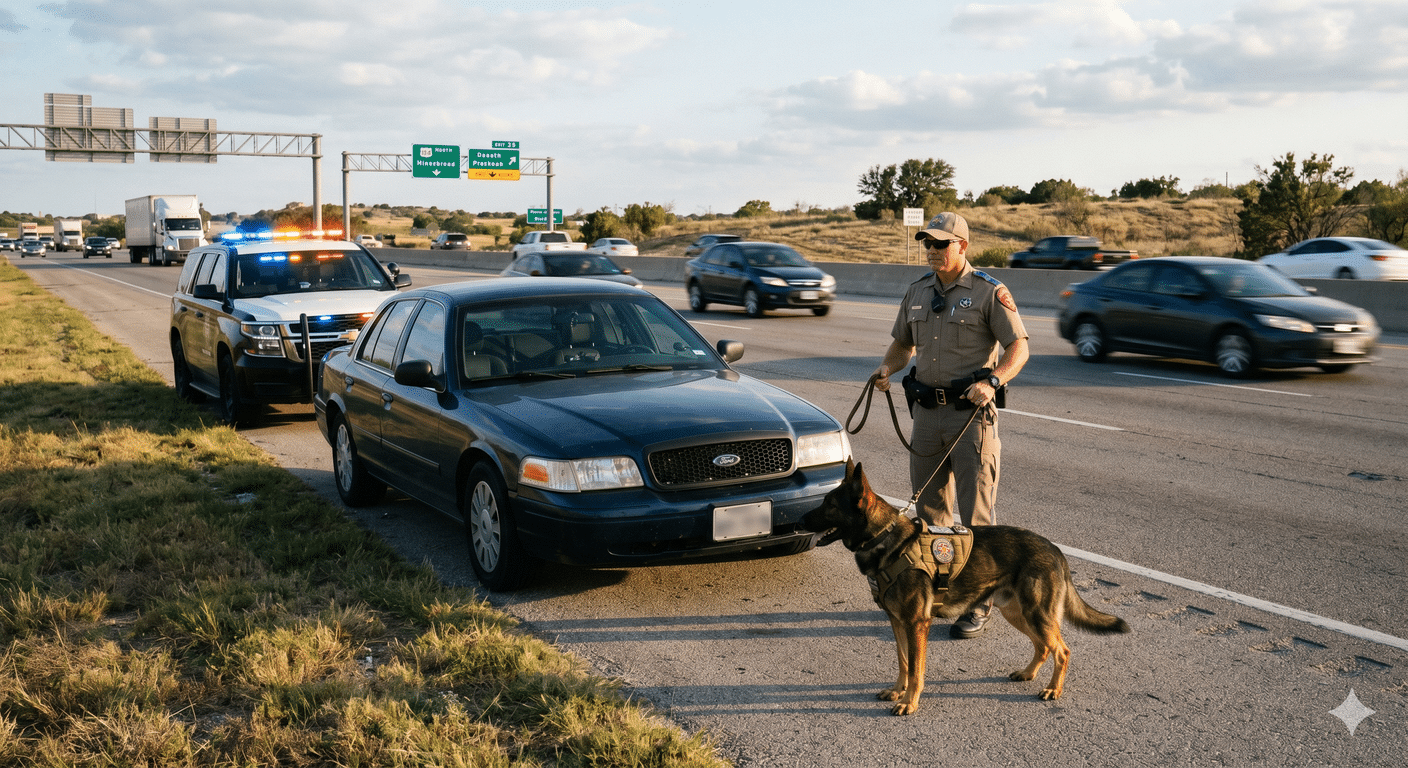
Anybody who drives Interstate 30 from Dallas to Texarkana, or Interstate 20 from Dallas through Tyler and Longview to Shreveport, has seen it: state troopers parked in the median, K-9 units running the eastbound traffic, DEA task forces working out of unmarked vehicles. East Texas has quietly become one of the most aggressive drug interdiction corridors in the country, and the cases coming out of these stops are not your typical “small bag of weed” prosecutions. We’re talking about first-degree felony trafficking charges with mandatory minimums, asset forfeitures, and federal indictments that can put a person away for decades.
If you’ve been pulled over on I-30, I-20, US-59, US-69, or US-271 and you’re now facing a drug charge — or if a loved one called you from the Hopkins County Jail, the Bowie County Jail, or the Smith County Jail after a stop that “started over a tag light” — this article is for you.
How Texas Classifies Drug Charges: It All Comes Down to Penalty Group and Weight
Texas drug law isn’t found in the Penal Code. It lives in the Texas Controlled Substances Act, Health & Safety Code Chapter 481. Understanding how this chapter works is the first step in understanding the exposure you’re facing.
Controlled substances are sorted into Penalty Groups 1, 1-A, 1-B, 2, 2-A, 3, and 4. Then the weight (called the “aggregate weight including any adulterants and dilutants”) drives the punishment range:
Penalty Group 1 — Cocaine, Heroin, Methamphetamine, Most Opioids
Found in Health & Safety Code § 481.102. Possession penalties under § 481.115 run from a state jail felony for less than one gram all the way to a first-degree felony with a 10-99 year minimum range for 4 grams or more. 400 grams or more of meth or cocaine triggers a mandatory minimum of 10 years up to life and a fine up to $100,000.
Manufacture or delivery — meaning trafficking — is treated even more harshly under § 481.112. Delivery of 400+ grams carries a 15-99 year minimum and a fine up to $250,000.
Penalty Group 1-B — Fentanyl
Created by the Texas Legislature in recent sessions, Penalty Group 1-B specifically targets fentanyl and fentanyl analogues. The penalty enhancements here are severe, and the recent legislative changes around fentanyl-induced deaths have created a whole new category of fentanyl murder charges. We’ve written about this in detail in our article on Fentanyl Murder Charges in East Texas: What HB 6 Means.
Penalty Group 2 — MDMA, PCP, Psilocybin Mushrooms, THC Concentrates
Listed in § 481.103. Penalties under § 481.116 follow a similar weight-based ladder. THC concentrates and edibles count by total weight — meaning a single brownie or vape cartridge can put a person well into felony territory.
Marijuana — A Category of Its Own
Marijuana is treated separately under § 481.121. More than 5 pounds is a felony, more than 50 pounds is a second-degree felony, and more than 2,000 pounds is a first-degree felony with a mandatory minimum of 10 years.
For a complete walkthrough of how these classifications work, our Drug Trafficking Defense page goes into much more detail.
Call 903.439.0000 or request a free consultation right now. The 24-hour jail release line is (214) 520-7373.
Why East Texas Stops Turn Into Trafficking Cases
The interstates running through East Texas are major thoroughfares between Mexico, Houston, and the Eastern Seaboard. Law enforcement knows it, and they have built sophisticated interdiction units around it. Here’s what we typically see:
- Pretextual traffic stops. A trooper sees a rental car with out-of-state plates traveling above or below the speed limit. He follows for a mile, finds something — a tag light, weaving inside the lane, following too close — and pulls the driver over.
- Extended detention. The driver is held while the officer asks about travel plans, looks for “indicators,” and waits for a K-9.
- The dog “alerts.” A search ensues, often without a warrant, often without true probable cause.
- The find. Sometimes drugs, sometimes cash that the officer claims is “drug proceeds,” sometimes both.
- The charges. Possession with intent, manufacture and delivery, money laundering, organized crime enhancements, and frequently a federal referral to the U.S. Attorney’s Office for the Eastern District of Texas.
The Fourth Amendment Fight: Where These Cases Are Won
The single most important question in any drug interdiction case is: Was the stop and the search legal?
Under the Fourth Amendment and Article I, Section 9 of the Texas Constitution, a traffic stop must be supported by reasonable suspicion of a traffic violation. The officer cannot extend the stop beyond the time it takes to address the original violation without independent reasonable suspicion of another crime — that’s the rule from the Supreme Court’s decision in Rodriguez v. United States. We see violations of this rule constantly in East Texas cases.
Other common suppression issues include:
- Invalid consent to search — was consent given freely or under coercion?
- Unreliable K-9 alerts — what’s the dog’s training history? False-positive rate? Was the alert visible on dash cam?
- Defective warrants under Code of Criminal Procedure Chapter 18
- Miranda violations during in-car interrogations
- Chain of custody breaks on the lab analysis
If a motion to suppress wins, the State’s case usually collapses. We’ve had a number of trafficking cases dismissed outright after a successful suppression hearing — see our Results page.
State or Federal? It’s Not Always Up to You
One of the trickiest parts of an East Texas drug case is jurisdiction. The same facts can be charged in:
- Texas state court under Health & Safety Code Chapter 481, or
- Federal court under 21 U.S.C. § 841 (Controlled Substances Act) or § 846 (conspiracy)
Federal cases come with the United States Sentencing Guidelines, mandatory minimums, and very limited parole. A person looking at 5-99 years in state court might be looking at a flat 10-year federal mandatory minimum on the same drugs. The decision about where the case is filed often happens early — sometimes before charges are even filed — and an experienced defense attorney can sometimes influence which side picks it up.
If your case is already federal, our Federal Narcotics Defense page covers what to expect. We also handle cases throughout the Eastern District of Texas, the Northern District, the Western District, and the Southern District.
Asset Forfeiture: They Want Your Money, Your Car, and Sometimes Your House
Texas civil asset forfeiture is governed by Code of Criminal Procedure Chapter 59. The State can seize cash, vehicles, and even real property they claim is “contraband” — meaning property used in or proceeds from a felony. The kicker: the forfeiture case is civil, not criminal. The State doesn’t have to prove guilt beyond a reasonable doubt. They only have to show by a preponderance of the evidence that the property was connected to the offense.
This means you can be acquitted of the criminal case and still lose your truck, your cash, and sometimes your home if you don’t fight the civil forfeiture properly and on time. There are strict deadlines under Chapter 59 to file an answer — miss them, and the property is gone forever.
Drug-Free Zone Enhancements
One of the harshest enhancements in Texas drug law is the Drug-Free Zone enhancement under § 481.134. If a drug offense occurs within 1,000 feet of a school, a public playground, a public youth center, or a public swimming pool, the punishment range is bumped up by an entire degree. A second-degree felony becomes a first-degree. A first-degree becomes a 15-99 minimum.
In smaller East Texas towns where everything is within 1,000 feet of something, this enhancement gets attached to a lot of cases. Challenging it requires getting the State’s mapping and surveying expert under cross-examination — and frankly, those maps are often wrong.
Call 903.439.0000 or request a free consultation right now. The 24-hour jail release line is (214) 520-7373.
Other High-Stakes Issues That Often Come With Trafficking Cases
It’s rare that a trafficking case stands alone. Often we see paired charges including:
- Money laundering under Texas Penal Code Chapter 34
- Engaging in organized criminal activity under Penal Code Chapter 71
- Unlawful possession of a firearm under Penal Code Chapter 46 — and on the federal side, the dreaded 18 U.S.C. § 924(c)
- Conspiracy charges based on text messages, phone records, and codefendant statements
For firearms-related companion charges, see our pages on Federal Firearms Defense and Armed Robbery Defense for the state-level analog.
What an Aggressive East Texas Drug Defense Looks Like
Defending one of these cases is part lawyering, part investigation, and part strategy. Some of what we do:
- Pull the dash cam and body cam immediately. Many agencies overwrite footage in 90 days. We send preservation letters the day we’re hired.
- Obtain the K-9’s training and deployment records. A dog with a 70% false-positive rate is not probable cause.
- Independent lab testing. The State’s lab is not infallible. Substance misidentifications happen. Weight discrepancies happen.
- Investigate the informant. Many of these stops aren’t actually random — they’re tipped. The credibility of the tipster matters.
- Challenge expert testimony on drug quantity, purity, and “consistent with distribution” opinions.
- Negotiate from strength. Once we’ve identified the weaknesses, the conversation with the prosecutor changes.
Bond Issues and Pretrial Detention
Most first-degree drug trafficking arrests in East Texas come with high bonds — often $100,000 to $500,000 or higher. Under Code of Criminal Procedure Chapter 17, bond must be set in an amount sufficient to ensure appearance, but not so high as to be an instrument of oppression. We routinely file motions for bond reduction and have gotten substantial reductions in cases throughout this region.
For folks charged with violent felonies attached to drug cases, the new Proposition 3 rules can make bail harder to get. Knowing how to navigate these new rules is essential.
Heath Hyde, P.C. — Drug Trafficking Defense Throughout East Texas
Heath Hyde is a former Assistant District Attorney with over a decade inside the prosecutor’s office. He knows how the State builds these cases because he used to build them himself. He has tried over 400 jury trials, including extensive narcotics work in both state and federal court, and he is one of only a handful of attorneys in this part of Texas with the experience to take a major trafficking case to verdict and win.
We serve clients throughout East Texas including Sulphur Springs, Tyler, Marshall, Texarkana, Mount Pleasant, Paris, Longview, Jefferson, Pittsburg, Mount Vernon, Atlanta, New Boston, and every county along the I-30 and I-20 corridors. Phones are answered 24 hours a day, 7 days a week.
If you or a loved one is facing a drug trafficking, possession, or distribution charge in East Texas — state or federal — call 903.439.0000 or request a free consultation right now. The 24-hour jail release line is (214) 520-7373.
Your freedom is our profession.
Disclaimer: This article provides general information about Texas drug trafficking law and is not legal advice. Each case turns on its own facts and the specific statutory framework in effect at the time of the alleged offense. Reading this article does not create an attorney-client relationship.