

Posted by the Law Office of Heath Hyde | Texas Criminal Defense
For as long as most folks in East Texas can remember, there was a certain predictable rhythm to what happened after an arrest. Somebody got picked up in Smith County or Gregg County or Harrison County, they went to the jail, they saw a magistrate within a day or so, and a bond got set. Family scraped together the money, called a bondsman on Spur 63 or Highway 80, and got their loved one home. From there, the real work of defending the case could begin.
That rhythm has changed. And if you or someone you love is sitting in a county jail in East Texas right now wondering why the judge said the word “denied” instead of setting a bond, this article is for you.
In November 2025, Texas voters approved Proposition 3, a constitutional amendment that fundamentally expanded when a Texas judge can deny bail entirely in a felony case. It took effect on December 4, 2025, and as we move through 2026, its real-world impact is being felt in rural and small-city courthouses all across East Texas. Whether the case is in Tyler, Longview, Marshall, Mount Pleasant, Paris, Jefferson, Carthage, Henderson, or Texarkana, the playing field at the front end of a felony case has shifted.
Proposition 3 did not just raise bond amounts. It gave Texas judges the power to refuse bail completely in certain felony cases — meaning the accused sits in jail until the case resolves, which can be a year or longer in a serious felony.
What Proposition 3 Actually Did
Before Prop 3, the Texas Constitution guaranteed bail in almost every criminal case, with narrow exceptions for capital murder. If you were charged with aggravated assault, aggravated robbery, or even certain murder charges, you had a constitutional right to have a bond set. It might have been high. It might have required a cash deposit. But there had to be a number.
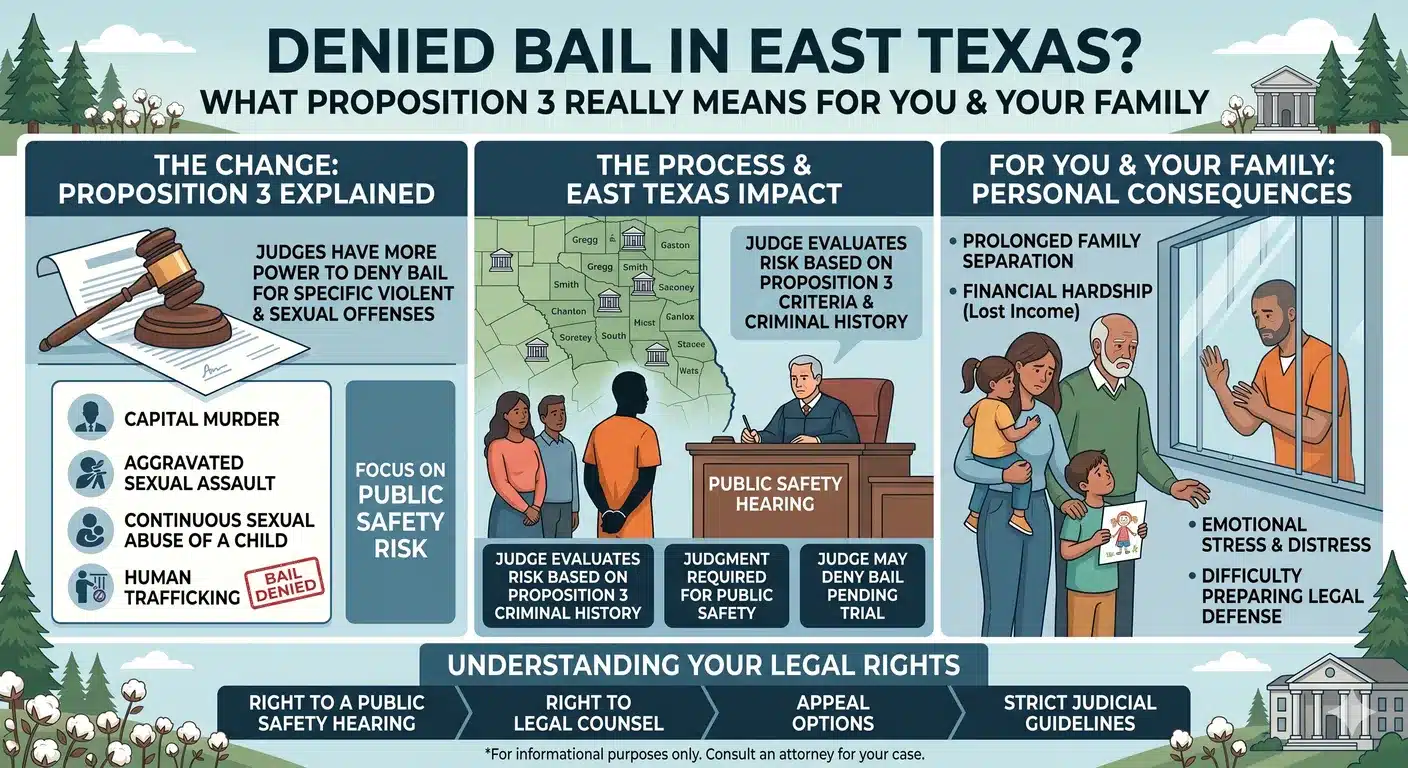
Proposition 3 changed that. Under the amendment, judges in Texas can now deny bail entirely for a long list of violent felonies if the prosecutor can show, by clear and convincing evidence, that no conditions of release will reasonably protect the community or ensure the defendant’s appearance in court. You can read the official analysis and ballot language through the Texas Secretary of State. The covered offenses include murder, aggravated assault, aggravated robbery, aggravated kidnapping, aggravated sexual assault, sex trafficking, and certain continuous offenses against children.
The effect in East Texas has been immediate. According to reporting from The Texas Tribune, prosecutors across the state are now routinely requesting no-bail holds in cases where, a year ago, a standard bond schedule would have applied. Courthouses that used to process these decisions in ten minutes are now holding full evidentiary hearings, with prosecutors calling witnesses and introducing documentary evidence to justify keeping a defendant in custody.
Why This Hits Rural East Texas Counties Harder
This is where the local piece really matters. In a place like Harris County or Dallas County, the public defender’s office is large, well-resourced, and experienced with complex pretrial motion practice. They have dedicated lawyers who do nothing but bond hearings.
In East Texas, it’s a different story. Many of our counties have a handful of appointed attorneys covering a massive docket. The first court-appointed lawyer a defendant meets may be shuffling between three dockets in two counties the same morning. If the appointed attorney isn’t ready to put on a real, contested evidentiary hearing against an experienced prosecutor with witnesses lined up, the defendant can end up held without bond before anyone has even looked at the police reports carefully.
And the consequences of being held without bond are enormous:
- You lose your job. Most employers will not hold a position for six or twelve months.
- You lose your housing. Rent doesn’t stop because you’re in jail.
- You cannot help your own lawyer investigate the case. You can’t drive out to talk to witnesses, gather your own evidence, or track down the people who can vouch for you.
- You are under enormous pressure to plead guilty. Prosecutors know that every month a person sits in jail is another month their resolve weakens. Many innocent people plead to crimes they didn’t commit simply to get out of custody.
- Your family suffers. Kids go without a parent. Spouses scramble to cover bills. Grandparents step in to raise children.
According to the ACLU of Texas, pretrial detention dramatically increases the likelihood of conviction and results in longer sentences on average — even when the underlying facts are identical to cases where the defendant was released before trial. Being held pretrial is not a neutral event. It shapes the entire outcome of the case.
What a Proposition 3 Hearing Actually Looks Like
When the state moves to deny bail under Prop 3, the law requires a real hearing. The prosecutor has the burden of proof. They have to show, with clear and convincing evidence — a higher standard than ordinary civil cases, though not as high as beyond a reasonable doubt — that:
- There is probable cause to believe the person committed one of the covered offenses, AND
- No set of release conditions (ankle monitor, curfew, no-contact orders, drug testing, surrender of firearms, GPS tracking, reporting requirements) would reasonably protect the community or ensure the defendant’s appearance at trial.
That second prong is where a good defense lawyer makes all the difference. Most defendants in East Texas are not actually flight risks. They have lived in the same county their whole lives. Their mama lives two streets over. Their kids go to school down the road. Their job is at the mill, or the refinery, or the school district, or the ranch. The idea that they’re going to run to Mexico is almost laughable in most cases — but if nobody stands up and says so, with evidence and witnesses, the judge can easily conclude the state has met its burden.
The defense lawyer’s job at that hearing is to put on a real case. Bring family members to testify. Bring employer letters. Bring proof of ties to the community. Propose real, specific conditions of release that address whatever concerns the state is raising. Challenge the strength of the state’s probable cause showing. Cross-examine the officer. Make the record so that, if the judge denies bail anyway, there’s a foundation for an appeal.
The Appeal Option Most People Don’t Know About
Here’s something a lot of families don’t realize: a denial of bail can be appealed — and it can be done quickly through a writ of habeas corpus. Under Texas law, when a magistrate or trial court denies bail, the defendant has the right to seek review through the higher courts, and these cases can move faster than an ordinary appeal.
But the habeas writ only works if the record is good. That means the lawyer at the initial hearing has to know what they’re doing. They have to preserve objections. They have to put on evidence. They have to make the state prove every element. A skipped question at the trial level is often an argument that can never be made on appeal.
This is exactly why experience matters so much right now. Proposition 3 is new. The appellate courts are just starting to work through what “clear and convincing evidence” means in this context, what due process the defendant is owed, and how much discretion the trial judges actually have. A lawyer who has been through the appellate process before — who knows the Court of Criminal Appeals, who knows the intermediate courts of appeals for East Texas in Tyler and Texarkana — is a lawyer who knows how to build the kind of record that gives you a real shot on review.
What Else Changed in 2026 That Families Need to Know
Prop 3 did not arrive alone. The 89th Texas Legislature passed a raft of related changes, many of which took effect September 1, 2025 or January 1, 2026. A few of the biggest:
- DWI in a school zone (SB 826) is now charged as a state jail felony, not a misdemeanor. That is a huge increase in exposure for a very common offense.
- Intoxication manslaughter with multiple deaths (SB 745) is now a first-degree felony.
- Drug delivery via social media (HB 2695) now carries a one-level penalty enhancement. If your teenager is using Snapchat or Instagram in connection with any alleged drug activity, the stakes just went up substantially.
- SB 40 bans counties and cities from funding nonprofit bail funds, eliminating one of the pretrial release resources that had helped some East Texans in recent years.
- Attempted capital murder of a peace officer (HB 1871) now carries 25 years to life.
Taken together, the message from Austin is clear: Texas has gotten tougher at every stage of the criminal process — from the first appearance in front of a magistrate all the way through sentencing. The margin for error for someone facing a serious charge has gotten much smaller.
What to Do If You Get That Phone Call
If the phone rings at 2 a.m. and a family member has been arrested on a serious charge in East Texas, here is what matters in the first twenty-four hours:
- Do not post bond through just any bondsman without consulting a lawyer first. If Prop 3 is going to be invoked, you need to know before you start moving money.
- Do not let your family member talk to investigators. Not on the jail phone. Not during transport. Not at the courthouse. Every jail call is recorded.
- Do not wait for the court-appointed lawyer to be assigned. By the time that happens, the bond hearing may already be over.
- Find out immediately whether the state is planning to seek a no-bail hold. If so, the first hearing is going to be the most important event in the early life of the case.
- Get a lawyer with real trial and appellate experience into that first hearing. Not someone who will show up, nod along, and accept whatever the judge decides.
Why Heath Hyde for an East Texas Bond Fight
Attorney Heath Hyde has been defending serious felony cases in Texas for nearly thirty years. He has tried over 400 state and federal jury trials. He has represented clients in 53 different Texas counties — which, in a state as sprawling as this one, means he has walked into a lot of small courthouses and stood up against a lot of different prosecutors.
That matters at a Prop 3 hearing in East Texas. The judge in Panola County knows things that the judge in Harris County doesn’t. The prosecutor in Cass County operates differently than the prosecutor in Bowie County. An attorney who has done this work across the region walks in knowing the room.
His practice covers exactly the kind of charges most often triggering Prop 3 hearings right now, including Texas murder defense, aggravated assault, armed robbery, and drug trafficking. For clients in and around the Ark-La-Tex region, there is a dedicated page for Texarkana criminal defense. For cases that cross over into federal jurisdiction, you can find information on federal criminal defense as well.
The Bottom Line
Proposition 3 is a serious change to the rules of the game in Texas criminal cases, and it is being applied right now in every felony courtroom in East Texas. The people most at risk are the people who assume that the system will work the way it always has, that a bond will be set, and that there will be time to figure things out later. Under Prop 3, that assumption can cost a person their freedom for a year or more before they’ve been convicted of anything.
If you or your family is facing this situation, the worst thing you can do is wait and hope. The bail decision at the front end of a case sets the tone for everything that follows. Get a real defense attorney involved from the first phone call — not the first court date.
Speak With an East Texas Criminal Defense Attorney Today
If you or a loved one is facing a felony charge in East Texas and worried about a bond denial under Proposition 3, contact the Law Office of Heath Hyde for a confidential 24/7 consultation. Visit heathhydelawyer.com to reach out. In the first 24 to 72 hours after an arrest, decisions get made that can affect your case for a year or more. Do not wait to get the right lawyer on your side.
Disclaimer: This article is provided for general informational purposes only and is not legal advice. Reading it does not create an attorney-client relationship. If you are facing criminal charges in Texas, consult a licensed criminal defense attorney about the specific facts of your case.